A Challenge and A Request

There are a lot of good pro-gun candidates around the country that need our help. I plan on sending contributions to a handful of them early next week. I’d like to ask the readers of this blog to make suggestions on who should get those contributions.

Here are my requirements:

  • Pro-gun
  • In a winnable race
  • Conservative to libertarian in outlook
  • If a Democrat, the Republican has to be really, really anti-gun
  • Preference is given to challengers over incumbants
  • Running for US House, US Senate, or Governor
  • Outside of North Carolina as I am already supporting politicians here

The only other thing I ask is that you say why I should give them money. In other words, do more than just suggest a name. You can either post the name and supporting info in the comments section or send me an emal at jpr9954@gmail.com.

City of Cleveland v. State of Ohio

As I mentioned a couple of days ago, Cleveland and the state of Ohio squared off before the Ohio Supreme Court over Ohio’s state preemption of local gun laws. The Ohio Supreme Court is, in my opinion, very progressive in allowing access to court proceedings by the public. They offer live streaming video of all proceedings as well as archiving the oral arguments. Some are available as video and others are available as audio only. It appears this case is audio only.

The audio can be found here. Unfortunately, my efforts to use their embedded audio player didn’t work.

Civil Rights for Wounded Veterans

Grass Roots North Carolina just released this video regarding gun rights for veterans. It features a speech by Senator Richard Burr of NC on his bill that would have protected the rights of wounded veterans. He gave it at GRNC’s Gun Rights Gala held in Charlotte this past May.

In light of the Second Amendment Foundation’s newest lawsuit, the timing is impeccable. And yes, that is Alan Gura sitting to Burr’s right on the dais.

Schrader et al v. Holder et al: A New SAF Gun Law Challenge

Alan Gura and the Second Amendment Foundation filed suit yesterday in the U.S. District Court for the District of Columbia on behalf of a Georgia man who was prohibited from purchasing a firearm due to a decades-old conviction for simple misdemeanor assault. The plaintiff, Jefferson Wayne Schrader, was also informed that he must surrender all of his current firearms or face criminal prosecution. The defendents in this case are Attorney General Eric Holder and the Federal Bureau of Investigation.

Jefferson Schrader was serving in the U.S. Navy when he was attacked by a street gang in the summer of 1968 while stationed in Annapolis, Maryland. The gang assaulted Schrader because they said he was “in their territory”. A few days after this initial attack, he was walking in Annapolis when he was accosted by one of his original assailants. A fight ensued and Schrader punched the gang member. Unfortunately, this was seen by a local police officer and Schrader was arrested for assault and battery, and disorderly conduct.

In court, Schrader was found guilty of misdemeanor assault and battery. He was fined $109 including court costs which he paid. The alternative to not paying the fine was 30 days in jail. Sometime after this, Schrader shipped out for a tour of duty in Vietnam and then was honorably discharged upon his return. Since that time, Schrader has not had any further brushes with the law with the exception of one traffic ticket.

The key points to remember here is that Schrader was only convicted of a simple misdemeanor for which at the time Maryland law did not set any maximum sentence. As the complaint notes, the only maximum was that guaranteed under the Eight Amendment governing cruel and unusual punishments. Further, he is an honorably-discharged veteran, did not commit any act of domestic violence, does not have any domestic restraining orders against him, doesn’t use drugs, and has not been found to be mentally defective or had a commitment to a mental institution.

All Schrader is guilty of is being in the wrong place at the wrong time and, perhaps, reacting a bit strongly when accosted by a street thug. Schrader is a normal guy who served his country, kept his nose clean, has gone about his life, and who, by all accounts, should be allowed to exercise his Second Amendment rights to purchase and possess a firearm.

Fast forward to late 2008. His companion attempted to purchase a shotgun for him as a gift. This transaction was canceled when the NICS check indicated he was a prohibited person. According to the complaint, in January 2009, Schrader also placed an order at his local gun shop for a handgun for self-defense.

In June 2009, Schrader was advised by the FBI that the shotgun transaction was denied because of his Maryland misdemeanor assault conviction and that he was considered a prohibited person under 18 USC §922(g)(1). An FBI Agent at the time also advised Schrader to dispose of any firearm that he might possess or he would face criminal prosecution. He immediately canceled his handgun order.

18 USC §922(g)(1) which describes who is a prohibited person is as follows:

It shall be unlawful for any person—
(1) who has been convicted in any court of, a crime punishable by imprisonment for a term exceeding one year;
(2) who is a fugitive from justice;
(3) who is an unlawful user of or addicted to any controlled substance (as defined in section 102 of the Controlled Substances Act (21 U.S.C. 802));
(4) who has been adjudicated as a mental defective or who has been committed to a mental institution;
(5) who, being an alien—
(A) is illegally or unlawfully in the United States; or
(B) except as provided in subsection (y)(2), has been admitted to the United States under a nonimmigrant visa (as that term is defined in section 101(a)(26) of the Immigration and Nationality Act (8 U.S.C. 1101 (a)(26)));
(6) who has been discharged from the Armed Forces under dishonorable conditions;
(7) who, having been a citizen of the United States, has renounced his citizenship;
(8) who is subject to a court order that—
(A) was issued after a hearing of which such person received actual notice, and at which such person had an opportunity to participate;
(B) restrains such person from harassing, stalking, or threatening an intimate partner of such person or child of such intimate partner or person, or engaging in other conduct that would place an intimate partner in reasonable fear of bodily injury to the partner or child; and
(C) (i) includes a finding that such person represents a credible threat to the physical safety of such intimate partner or child; or
(ii) by its terms explicitly prohibits the use, attempted use, or threatened use of physical force against such intimate partner or child that would reasonably be expected to cause bodily injury; or
(9) who has been convicted in any court of a misdemeanor crime of domestic violence,
to ship or transport in interstate or foreign commerce, or possess in or affecting commerce, any firearm or ammunition; or to receive any firearm or ammunition which has been shipped or transported in interstate or foreign commerce.

The suit asks that the Attorney General correct the erroneous NICS information under his authority from 18 USC §925A and remove Schrader from the prohibited person’s list. The relevant part of that section of the code reads:

A person who is prohibited from possessing, shipping, transporting, or receiving firearms or ammunition may make application to the Attorney General for relief from the disabilities imposed by Federal laws with respect to the acquisition, receipt, transfer, shipment, transportation, or possession of firearms, and the Attorney General may grant such relief if it is established to his satisfaction that the circumstances regarding the disability, and the applicant’s record and reputation, are such that the applicant will not be likely to act in a manner dangerous to public safety and that the granting of the relief would not be contrary to the public interest.

The second claim for relief made in the suit asks for a permanent injunction barring enforcement of 18 USC §922(g)(1) by the Defendents and all of those under their power on the basis of simple common-law misdemeanor offenses which have no statutory penalties.

As Alan Gura said at the Gun Rights Policy Conference regarding his post-McDonald litigation, he looks for situations where you have “low hanging fruit”, it is annoying, and unconstitutional. I would say this situation qualifies on all three counts.

HuffPo: Rand Paul at Knob Creek

The Huffington Post reports the Republican Senate candidate Dr. Rand Paul appeared at Knob Creek Machine Gun Shoot this past weekend. Interesting enough for HuffPo, they played it straight and didn’t editorialize. The comments on the other hand – well, what can you expect. The disdain shown by some is so thick that you could cut it with a stream of fire from the .50 cals in the video below.

Paul was at the event to rally support from Kentucky gun owners. He addressed supporters saying:

“I don’t have to apologize for supporting the second amendment. I support it and will continue to support it no matter what the liberals say,” the Tea Party-backed Republican told a crowd of Second Amendment devotees, according to a report from The Daily Caller.

“The president says that you’re out here in the middle of the country clinging to your guns and ammunition. What I tell the President is, ‘We’re clinging to our guns, our religions and our ammunition,'” Paul continued.

SAF Sues Holder and FBI Over Misdemeanor Gun Rights Denial

The Second Amendment Foundation released the following this evening:

SAF SUES ERIC HOLDER, FBI OVER
MISDEMEANOR GUN RIGHTS DENIAL

BELLEVUE, WA – Acting on behalf of a Georgia resident and honorably discharged Vietnam War veteran, the Second Amendment Foundation today filed a lawsuit against Attorney General Eric Holder and the Federal Bureau of Investigation over enforcement of a federal statute that can deny gun rights to someone with a simple misdemeanor conviction on his record.

The lawsuit was filed in United States District Court for the District of Columbia. SAF and co-plaintiff Jefferson Wayne Schrader of Cleveland, GA are represented by attorney Alan Gura, who successfully argued both the Heller and McDonald cases before the U.S. Supreme Court.

In July 1968, Schrader, then 21, was found guilty of misdemeanor assault and battery relating to a fight involving a man who had previously assaulted him in Annapolis, MD. The altercation was observed by a police officer, who arrested Schrader, then an enlisted man in the Navy, stationed in Annapolis. The man he fought with was in a street gang that had attacked him for entering their “territory,” according to the complaint.

Schrader was ordered to pay a $100 fine and $9 court cost. He subsequently served a tour of duty in Vietnam and was eventually honorably discharged. However, in 2008 and again in 2009, Mr. Schrader was denied the opportunity to receive a shotgun as a gift, or to purchase a handgun for personal protection. He was advised by the FBI to dispose of or surrender any firearms he might have or face criminal prosecution.

“Schrader’s dilemma,” explained SAF Executive Vice President Alan Gottlieb, “is that until recently, Maryland law did not set forth a maximum sentence for the crime of misdemeanor assault. Because of that, he is now being treated like a felon and his gun rights have been denied.

“No fair-minded person can tolerate gun control laws being applied this way,” he added. “Mr. Schrader’s case is a great example of why gun owners cannot trust government bureaucrats to enforce gun laws.”

The complaint is not yet up on the Federal Courts Pacer site. As soon as it is, I will post the complaint.

Update on Korean Garands and M-1 Carbines

David Codrea in his National Gun Rights Examiner column has some very interesting information regarding the Korean M-1 Garands and M-1 Carbines that have not been allowed to be imported into the United States.

It seems the State Department is using a BATFE Advisory as the basis for denial.  The key phrase in the letter is that ATF believes these firearms “pose a threat to public safety in the U. S.” Oh, please! Give me a break.

Go to the link above and read the whole column and then go and read the ATF document below. As Bugs Bunny might have said, “What a bunch of maroons”.

M1import

Ezell v. Chicago: Preliminary Injunction Denied

Judge Virginia M. Kendall declined to grant a preliminary injunction to the plaintiffs in the case challenging Chicago’s ban on gun ranges, Ezell v. Chicago. In her Memorandum Opinion and Order which was released today, Kendall said:

Now after the benefit of full briefing, an amicus brief filed by the National Rifle Association, and two days of witness testimony, this Court concludes that Plaintiffs have failed to meet their burden in establishing that they have suffered an irreparable injury and that they have no adequate remedy at law.

In the hearing that was held on October 1st and 4th, the plaintiffs called three witness while the defendants presented two witness. Testifying on behalf of the plaintiffs were Christopher Hart, Midwest Range Consultant for Action Target, Inc.: Julianne Versnell, Director of Operations for the Second Amendment Foundation; and Richard Pearson, Executive Director of the Illinois State Rifle Association. Chicago called as their witnesses Pattie Scudiero, Commissioner of the Chicago Department of Zoning and Land Use Planning, and Sgt. Dan Bartoli, the former Range Master for the Chicago PD.

Hart testified that Action Target manages a number of ranges in Chicago for Federal agencies. He said he believed that there was a market for public ranges in Chicago but admitted he had not talked to potential range investors since July. He testified that mobile ranges used equipment similar to that used in outdoor ranges and that it takes 9 months to a year to construct a permanent range.

Versnell testified that SAF has 1,700 members in Chicago and that she had coordinated with the other plaintiffs in the case to secure the two locations for a mobile range. She said ISRA would be responsible for managing the proposed Chicago mobile range and providing the instructors. Firearms would be provided at the range and the range would have security guards on site. Versnell admitted she did not have first-hand knowledge of the mobile range she contracted to bring to Chicago nor did she know if the ISRA had ever operated a mobile range.

Pearson said the ISRA owns a shooting range 60 miles outside of Chicago in Bonfield, IL. He said that they don’t have experience in operating a mobile range nor had he spoken to anyone with experience operating one before the hearing. He said he didn’t think it would take long to adjust his safety protocol from an outdoor range to the mobile range. In what must have been a response to questions by the City of Chicago, he responded:

(he) is not aware of the location of the closest hospital to the mobile range site, or if toilets and hand-washing facilities will be available or allowed on site. Pearson admits that if hand-washing facilities are not allowed on-site, he would be forced to look for a new location to place the mobile range.

 Scudiero said every property in Chicago is zoned for something and when new uses arise that aren’t covered by the ordinance, they make an assessment of the use and then make recommendations to the city council. After admitting she had never been to a gun range (emphasis mine), she testified that she thought they should be located in manufacturing districts and that gun ranges would have to apply for a special use permit from the Zoning Board of Appeals. She also thought one of the sites suggested was inappropriate. She then testified:

Scudiero’s office does not control any of the federal firing ranges located in Chicago. She does not see any harm in allowing the Chicago Police Department (“CPD”) to operate firing ranges in the city because they do not allow public access. Scudiero did not participate in drafting the Chicago Firearms Ordinance 8-20-280. She also has no personal knowledge regarding the noise or pollution that emanate from a firing range. She has not heard of any complaints from residents about the CPD firing ranges.

The final witness was Bartoli who has been with Chicago Police Department since 1995. While range master, he supervised all firearms training in the Department and oversaw six permanent ranges open 24/7.

Bartoli sees mobile ranges as a threat to public safety because they are in the open and raise issues concerning human traffic management. Bartoli advised anyone seeking to open and operate a mobile range that they should use opaque permanent fencing, have only one entrance, a secure parking lot, a separate area for loading and unloading of weapons, and a separate area for live fire. Bartoli also counseled that people do not follow directions at ranges, and even CPD officers will violate the rules and bring their own guns to the range. Bartoli sees this as being a problem for a mobile range, with armed customers wanting advice on how to use their particular gun even if ISRA is providing weapons to use during live fire. He also sees customers bringing their own guns to the range as a safety risk to themselves, as they will be more prone to crime and theft in the parking lot.

Bartoli noted that all of his permanent ranges had washrooms with lucrative amounts of cold running water and soap.

Bartoli did agree that training can help prevent accidents and make you safer. He didn’t believe the CPD ranges had a negative effect on surrounding neighborhoods.

Judge Kendall then went on to discuss the factors that needed to be considered for injunctive relief in the Seventh Circuit. They include:

(i) the presence of irreparable harm to the moving party; (ii) the absence of an adequate remedy at law; (iii) the balance of the harms between the parties; (iv) the prospect of some likelihood of success on the merits of the claim; and (v) the public interest.

The Seventh Circuit found intermediate scrutiny was appropriate in Skoien because it would have absolutely barred possession of a firearm. Since a firing range ban, in her opinion, does not prohibit a person from possessing a firearm but only makes them travel outside the city to obtain their training, she declined to adopt even this level of scrutiny.

In other words, she adopted the least restrictive standard which is rational basis. It should be noted here that Justice Alito in writing the Court’s Opinion in the McDonald case said “In Heller, however, we expressly rejected the argument that the scope of the Second Amendment right should be determined by judicial interest balancing.” Enumerated rights such as the freedom of the press or freedom of speech have traditionally been granted the highest level of scrutiny or strict scrutiny. Lest we forget, the Second Amendment is an enumerated right.

Kendall then examined whether the plaintiffs had suffered irreparable harm. She concluded that they did not. She noted that all of the individual plaintiffs had traveled outside the city limits of Chicago to either take their required training or to shoot on a regular basis. With regard to Action Target who had alleged that it was harmed by not being allowed to construct a range within Chicago, she noted that they had no current plans to build a range, had not searched for a location for a range, and wouldn’t be able to construct a range in under nine months.

Kendall rejected the argument that the City’s boundaries were constraints in keeping the plaintiffs from completing their required training. She noted that depending where one was located within the City of Chicago, it could well be closer to go to a range outside the city than to the mobile range proposed by the Second Amendment Foundation. Thus, she said the plaintiffs had failed to meet their burden to show travel outside of Chicago is more burdensome and thus caused irreparable damage. The City had argued that even if a person had a greater expense for training due to travel, that could be quantified and made into monetary damages. She agreed with this line of reasoning and extended it to those failing to meet the training requirement during the amnesty period.

Even if that resident did not comply with the amnesty period and was therefore not permitted to possess that particular firearm, she would still be able to possess another firearm by going through the permitting process. Again, her damages for the loss of the firearm in her possession can be equated to a dollar amount and therefore can be remedied through traditional means.

With regard to the organizational plaintiffs, the Second Amendment Foundation and the Illinois State Rifle Association, she said they had failed to present sufficient evidence to support their position that their members would be unable to comply with the statute. Moreover, she went on to say that they hadn’t shown evidence that any member of either organization had been unable to travel outside the City of Chicago to obtain range training.

Kendall said that even if she had applied intermediate scrutiny she said the City of Chicago had presented enough evidence to meet that test that its objective was an important one and that this objective was being advanced by a means strongly related to that objective. She said Chicago had presented evidence that firing ranges would fall under the intensive use category and be zoned for manufacturing/light industrial districts which is appropriate for business that have a high level of risk to the public.

The City has presented evidence that firing ranges must be highly regulated due to the risks that can be inflicted upon the surrounding community including the risk of stray bullets, the risk that individuals transporting weapons to the range are at higher likelihood of being targets for criminals who would seek to obtain the weapons, and the risk of contamination from the residue of the lead that is left on individuals who use the weapons (requiring appropriate washing facilities to remove the residue). The City has elucidated its long history of careful zoning to ensure the health and safety of its residents and since no zoning has been established to cover a firing range within the City, it is unable to enforce any health or safety restrictions. Historically, the City would review such proposed businesses and determine what those risks are and would also permit residents to object to the placement of such high-risk enterprises prior to granting permission for the placement of such a business within a particular area of the city. None of these safeguards are in place today to ensure that these risks are addressed appropriately and as such the City has presented adequate evidence that the safety of its citizens is at risk when compared to the minimal inconvenience of traveling outside of the City for a one-hour course.

I would note here that if you go back and look at what Pattie Scudiero, the Commissioner of the Chicago Department of Zoning and Land Use Planning, said in her testimony above, you will note that she had never, ever visited a gun range. I will leave it at that.

Kendall then looks at the likelihood of the plaintiffs succeeding on the merits. She notes that the body of law regarding firearm’s ordinances is evolving rapidly. She said two facts are certain – that no court at any level has addressed the regulation of firearms range training ordinances and that the Seventh Circuit has left open the proper level of scrutiny for another day. Kendall said the merits still need to be examined and that a preliminary injunction is not appropriate in this case. She goes on to examine whether an injunction is the proper remedy and concludes since any and all damages can be quantified, then monetary damages can be calculated if the plaintiffs succeed. She then adds:

Again, each Plaintiff is entitled to possess a weapon and therefore his Second Amendment right is not being completely impinged.

I’ll leave it to the legal scholars to argue whether she meant to use infringe or the word she did use.

She concludes her analysis by conducting a balancing test of the harms suffered by each party. Kendall finds that the harms that the City would suffer outweigh the “inconvenience which all of them have been willing to incur in the past”. The harms to the city would be the health and safety risks from failing to highly regulate a firing range.

The last argument that Judge Kendall considers was the First Amendment argument put forth by the plaintiffs and summarily dismisses it saying they failed to support this argument with any facts.

In conclusion, Judge Kendall agreed with the City of Chicago and denied the plaintiff’s motion for a preliminary injunction so that they could bring a mobile firing range into the City of Chicago. She used as her standard the rational basis test which could very well put her at odds with the Supreme Court opinions in Heller and McDonald. Regardless of the eventual outcome of this case in her court on the merits, I have no doubt that this case will be appealed by one side or the other or both.

Ezell et al v. Chicago et al – Memorandum Opinion and Order

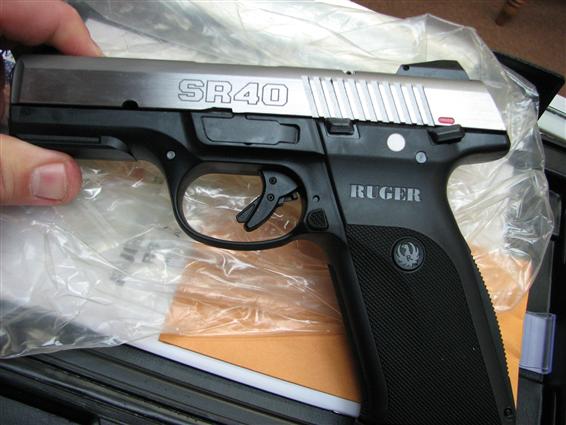
Ruger SR40 Video Review

Michael Bane of Shooting Gallery and a whole host of other shows on the Outdoor Channel has produced a video review of the SR40. It gives his impressions after shooting one at Gunsite before it was officially released.

The key points to me seem to be that it has the best trigger of the SR family and the heavier slide helps to tame the recoil.

Ruger SR40 – Update

Steve at The Firearm Blog announces that Ruger is making a .40 S &W version of their SR9. It is called, appropriately enough, the SR40. He does not have specs on it yet but notes that one is being offered for sale on Gunbroker.com.

Ruger SR40 as found on gunbroker.com

It appears to have virtually the same lines as the SR9. I know the SR9 got a lot of grief early on for being recalled but I like mine. It fits my hand well and shoots better than I can. The only modification that I’ve done to mine is to change the front site to a green fiber optic. I don’t know if I’m in the market for the SR40 as I have a couple of .40’s already.

Caleb at Gun Nuts Media is very excited about this new pistol. He is currently using a SR9c in his Quest for Master Class series which he likes. Caleb says he plans to do an episode on the SR40 in his Quest for Master Class series after he can get his hands on one. He notes:

I’ve been hoping for an SR40 for a while now; eventually I wanted to make a run at my USPSA GM tag in Limited-10, and with the amount of trigger time I’ve had on the SR9, this is a natural transition.

 UPDATE:  Ruger sent out an announcement e-mail on the SR40 along with its specs. It is also listed on the Ruger website. They have kept the slimness of the SR9 with only a .060″ increase in overall width for the SR40. Capacity has dropped by two rounds to 15+1 from 17+1 which is comparable to the difference between a Glock 22 and a Glock 17. Specs are as follows:

  • Caliber: .40 S&W
  • Capacity: 15+1
  • Barrel Length: 4.14″
  • Overall Length: 7.55″
  • Height: 5.52″
  • Width: 1.27″
  • Weight: 27.25 oz.

MRSP is $525.00 which is the same as for the SR9. I’m sure the street price will be much less.