Project Gunwalker

David Codrea at the National Gun Rights Examiner and Mike Vanderboegh at Sipsey Street Irregulars have been on this story since the beginning. It concerns allegations that BATFE insiders not only looked the other way when semi-auto rifles were smuggled south of the border but were complicit in it. If that wasn’t bad enough, slain Border Patrol agent Brian Terry may have been killed with one of these weapons.

David’s lead-in for the story:

We’ve recently discussed what I call “Project Gunwalker.” That title is a parody of the “Project Gunrunner” name the Bureau of Alcohol, Tobacco, Firearms and Explosives (ATF) has assigned to its southwest border initiative on U.S. guns going to the Mexican drug criminals, and refers to sourced information that the bureau has intentionally—and importantly, criminally, and with management cognizance—allowed guns to be transported across the border while keeping Mexican authorities in the dark.

We also touched on allegations regarding the gun used in the recent killing of a Border Patrol agent, and established some key questions for investigators to follow up on.

I must, of necessity, be cryptic in order to protect some insider sources who are putting their careers and potential freedom and lives on the line—that I can say this without hyperbole is something I believe will be borne out in the near future. The bottom line is, insiders are prepared to come forward. Not just with testimony, but with documentary evidence, and it looks like the trail leads to high places in the executive branch.

Read the full column here and make sure to read the earlier posts.

If this story pans out, I don’t think the mainstream media can stifle it for too long. One of those reporters will have a Pulitzer Prize dancing in his or her eyes and will run with it.

I’ll Believe It When I See Her In Pittsburgh

Rachel Maddow had Meghan McCain as a guest on her show Monday. In her discussion with McCain about guns, gun control, and McCain’s NRA membership, Maddow revealed that her first date with her partner Susan Mikula was at an NRA Ladies Day on the Range event.

Meghan McCain then invited her to attend the NRA Annual Meeting and Maddow accepted. Then McCain went on to make stupid comments about how no one “needs” standard capacity magazines. I’ll believe Maddow was serious about her acceptance when I see her at the Annual Meeting in Pittsburgh at the end of April. Heck, I’ll believe McCain is a NRA member when I see her there as well.

The comments begin at about the 8:55 mark and it is at the 10:00 mark where McCain discusses the “need” for, in her words, “extended capacity” magazines. As to “need”, little Miss McCain ought to heed the advice of Uncle when he says “Whats need got to do with it?”

California AB962 Found Unconstitutionally Vague

From Chuck Michel at CalGuns Law is this report that Fresno Superior Court Judge Jeffrey Hamilton found AB 962 – the bill which would have outlawed anything other than face-to-face purchases of handgun ammo – was unconstitutionally vague.

NRA / CRPA LAWSUIT INVALIDATES AB 962!

COURT GRANTS NRA / CRPA FOUNDATION MOTION, INVALIDATES UNCONSTITUTIONAL AMMUNITION REGULATION STATUTE THAT WOULD HAVE BANNED MAIL ORDER AMMO SALES & REQUIRED AMMO SALES REGISTRATION

by C.D. Michel

In a dramatic ruling giving gun owners a win in an National Rifle Association / California Rifle and Pistol (CRPA) Foundation lawsuit, this morning Fresno Superior Court Judge Jeffrey Hamilton ruled that AB 962, the hotly contested statute that would have banned mail order ammunition sales and required all purchases of so called “handgun ammunition” to be registered, was unconstitutionally vague on its face. The Court enjoined enforcement of the statute, so mail order ammunition sales to California can continue unabated, and ammunition sales need not be registered under the law.

The lawsuit was prompted in part by the many objections and questions raised by confused police, ammunition purchasers, and sellers about what ammunition is covered by the new laws created by AB 962. In a highly unusual move that reflects growing law enforcement opposition to ineffective gun control laws, Tehama County Sheriff Clay Parker is the lead plaintiff in the lawsuit. Other plaintiffs include the CRPA Foundation, Herb Bauer Sporting Goods, ammunition shipper Able’s Ammo, collectible ammunition shipper RTG Sporting Collectibles, and individual Steven Stonecipher. Mendocino Sheriff Tom Allman also supported the lawsuit.

The ruling comes just days before the portion of the law that bans mail order sales of so called “handgun ammunition” was set to take effect on February 1, 2011. The lawsuit, Parker v. California is funded exclusively by the NRA and the CRPA Foundation. If it had gone into effect, AB 962 would have imposed burdensome and ill conceived restrictions on the sales of ammunition. AB 962 required that “handgun ammunition” be stored out of the reach of customers, that ammunition vendors collect ammunition sales registration information and thumb-prints from purchasers, and conduct transactions face-to-face for all deliveries and transfers of “handgun ammunition.” The lawsuit successfully sought the declaration from the Court that the statute was unconstitutional, and successfully sought the injunctive relief prohibiting law enforcement from enforcing the new laws.

The lawsuit alleged, and the Court agreed, that AB 962 is unconstitutionally vague on its face because it fails to provide sufficient legal notice of what ammunition cartridges are “principally for use in a handgun,” and thus is considered “handgun ammunition” that is regulated under AB 962. It is practically impossible, both for those subject to the law and for those who must enforce it, to determine whether any of the thousands of different types of ammunition cartridges that can be used in handguns are actually “principally for use in” or used more often in, a handgun. The proportional usage of any given cartridge is impossible to determine, and in any event changes with market demands. In fact, the legislature itself is well aware of the vagueness problem with AB 962’s definition of “handgun ammunition” and tried to redefine it via AB 2358 in 2010. AB 2358 failed in the face of opposition from the NRA and CRPA based on the proposal’s many other nonsensical infringements on ammunition sales to law abiding citizens.

Constitutional vagueness challenges to state laws are extremely difficult to win, particularly in California firearms litigation so this success is particularly noteworthy. Even so, an appeal by the State is likely, but the Court’s Order enjoining enforcement of the law is effective – February 1, 2011 – immediately regardless.

Despite this win for common sense over ill-conceived and counter productive gun laws, additional legislation on this and related subjects will no doubt be proposed in Sacramento this legislative session. It is absolutely critical that those who believe in the right to keep and bear arms stay informed and make their voices heard in Sacramento. When AB 962 passed there was loud outcry from law abiding gun owners impacted by the new law. Those voices must be heard during the legislative session and before a proposed law passes, not after a law is signed. To help, sign up for legislative alerts at http://www.nraila.com,/ and http://www.calnra.com/ and respond when called upon.

Seventeen years ago the NRA and CRPA joined forces to fight local gun bans being written and pushed in California by the gun ban lobby. Their coordinated efforts became the NRA/CRPA “Local Ordinance Project” (LOP) – a statewide campaign to fight ill conceived local efforts at gun control and educate politicians about available programs that are effective in reducing accidents and violence without infringing on the rights of law-abiding gun owners. The NRA/CRPA LOP has had tremendous success in beating back most of these anti-self-defense proposals.

In addition to fighting local gun bans, for decades the NRA has been litigating dozens of cases in California courts to promote the right to self-defense and the 2nd Amendment. In the post Heller and McDonaldlegal environment, NRA and CRPA Foundation have formed the NRA/CRPA Foundation Legal Action Project (LAP), a joint venture to pro-actively strike down ill-conceived gun control laws and ordinances and advance the rights of firearms owners, specifically in California. Sometimes, success is more likely when LAP’s litigation efforts are kept low profile, so the details of every lawsuit are not always released. To see a partial list of the LAP’s recent accomplishments, or to contribute to the NRA or to the NRA / CRPAF LAP and support this and similar Second Amendment cases, visit http://www.nraila.com/ and www.crpafoundation.org.

NSSF Allowed Intervenor Status

From the National Shooting Sports Foundation:

The United States District Court for the District of Columbia has granted NSSF’s motion to intervene in a suit brought by the Center for Biological Diversity (CBD) and several anti-hunting groups against the United States Environmental Protection Agency (EPA). The CBD’s underlying suit against the EPA seeks to have the court overturn the agency’s denial of a CBD petition filed in August of 2010 to have the EPA under the Toxic Substance Control Act (TSCA) issue regulations to ban the manufacture, sale and use of traditional ammunition containing lead components, as well as fishing tackle made with lead components. The EPA properly denied the petition to ban traditional ammunition because Congress expressly exempted ammunition from regulation by the EPA. Later, the EPA also denied the petition as to fishing tackle because the CBD failed to demonstrate a scientific basis for the EPA to act.

“We are pleased with the court’s ruling because it will allow NSSF to ensure that the will of Congress is adhered to and the CBD does not succeed in its efforts to side step Congress and impose its anti-hunting agenda through the judicial system,” said Lawrence G. Keane, NSSF senior vice president and general counsel.

In granting NSSF’s motion to intervene in the case the court acknowledged that the EPA could not adequately represent the business interests of NSSF’s members. The court also rejected the CBD’s efforts, in opposing the NSSF motion, to inappropriately limit NSSF participation in the case.

This is the case where Project Gutpile is one of the plaintiffs. Project Gutpile is a “hunter’s organization” composed of four members.

And In A Case Of Being In Washington For Too Damn Long…

Six-term U. S. Senator Richard Lugar (RINO-Indiana) called for a reinstatement of the expired (and failed) Assault Weapons Ban this weekend. In doing so, Lugar becomes the first Republican senate member to call for more gun control after the Tucson shootings.

Lugar, who faces re-election in 2012 and is known for sometimes crossing party lines to vote with Democrats, said Congress should reinstate a ban on assault weapons following the shooting in Tucson, Arizona, that killed six people and critically wounded Democratic Representative Gabrielle Giffords. He acknowledged such action was unlikely in the current political environment.

“I recognize the fact that the politics domestically in our country with regard to this are on a different track altogether,” he said. He noted that sales of ammunition soared following the attack, possibly on fears that Congress might react by restricting its availability.

Appropriately enough, he made this call for more gun control in an interview with Al Hunt on Bloomberg Television. His comments come near the 5 minute mark in the video below.

While Richard Lugar may have been Richard Nixon’s “favorite mayor” when he was mayor of Indianapolis, let us not forget that it was under Nixon’s watch that the Bureau of Alcohol, Tobacco, and Firearms was spawned. Nixon was no friend of gun owners and neither is Lugar. It is time to retire this out of touch dinosaur.

UPDATE: HotAir’s Allahpundit has some thoughts on why Lugar threw this tidbit out to Al Hunt. Hopefully the first one, that he plans to retire, is the correct one.

Say v. Adams: An Earlier ACLU Case Challenging CCW Restrictions

A lawsuit brought by the American Civil Liberties Union of South Dakota on behalf of legal immigrant Wayne Smith has generated a lot of interest. The very fact that the ACLU is representing Mr. Smith over the denial of his concealed carry permit is part of it. The other aspect of the case generating some interest is that the NRA is in favor of permanent resident aliens getting CCW permits while it appears that Gun Owners of America has had a mixed response.

The South Dakota suit is very similar to a lawsuit decided in Kentucky back in 2008. The details of that case as well as the legal outcome will help us to understand the current case. In that case, Alexander Say, an attorney and a Permanent Resident, – that is, he held a “green card” – had lived in Kentucky since 1995.

In July 2006, Mr. Say applied to the Jefferson County Sheriff’s Department for a Concealed Deadly Weapon (CCDW) permit. He was told he was not eligible because he was not a U.S. citizen. The Commonwealth of Kentucky that same July had changed their law to now make citizenship a prerequisite for a CCDW. But for that, Mr. Say had met all the other requirements to be granted a CCDW.

Kentucky had changed their requirements for a CCDW so as to gain Federal approval of their CCDW as a substitute for a telephone NICS check. However, a NICS check for a non-citizen requires an Illegal Alien Query (IAQ) conducted through U.S. Immigration and Customs Enforcement. However, the Kentucky State Police didn’t conduct an IAQ before issuing a CCDW. With a requirement that the CCDW applicant be a citizen, then this was no longer an issue and the CCDW would qualify as a substitute for NICS purposes.

This case, like the South Dakota case, was brought by the ACLU. They challenged the denial of Mr. Say’s CCDW application on the grounds that it was a violation of the Equal Protection Clause of the Fourteenth Amendment. They sought a preliminary injunction that was granted by U.S. District Court Judge Thomas Russell.

When determining whether a preliminary injunction is appropriate, the court must consider four factors. First, does the plaintiff have a strong chance of success  based upon the merits. Second, would the plaintiff suffer irreparable injury if not granted the injunction. Third, would the preliminary injunction cause substantial harm to others. Finally, the court must consider if the public interest would be served by the injunction.

In determining whether the plaintiff had a strong likelihood of succss, Judge Russell first looked at what standard of scrutiny was appropriate. While alienage is a suspect class, not all aliens are afforded the protection. Based upon both Supreme Court and Sixth Circuit precedent, only aliens who are permanent resident aliens – which Mr. Say was – are entitled to strict scrutiny. Illegal aliens, non-resident aliens, and others such as those on student or tourist visas are not considered part of a suspect class. Since Mr. Say was entitled to strict scrutiny, the Kentucky exclusion of permanent resident aliens must be both narrowly drawn and serve a compelling governmental interest. Judge Russell found:

Defendants have not satisfied their burden to show why this is a substantial state interest.The Court cannot find that a state’s interest in substituting a state background check for a federal background check is compelling enough to justify creating a classification that discriminates against a suspect class.

Furthermore, the citizenship provision is not narrowly tailored to achieve this governmental interest. A blanket prohibition discriminating against aliens is not precisely draw to achieve the goal of facilitating firearms purchases when there exists a nondiscriminatory way to achieve the same goals. As discussed below, if the Kentucky State Police undertakes some administrative burden, it is possible to allow permanent resident aliens to obtain a CCDW license, and still meet the requirements necessary to allow CCDW holders to avoid the NICS inquiry at the time of purchase.

The second leg of the test is irreparable injury if an injunction is not granted. Courts have consistently found that a violation of a constitutional rights constitutes irreparable harm. Judge Russell found that “the violation of the Equal Protection Clause qualifies as an irreparable injury, especially when consider in light of Plaintiff’s likelihood of success.”

The third leg of the test is serious harm to others. The court noted that the Kentucky State Police would have a greater administrative burden if the CCDW was not accepted as a substitute for the NICS check. Furthermore, Kentucky CCDW holders would have to undergo the telephone NICS check. The court found this harm when balanced against the harm of not granting the injunction was “not substantial enough to justify the violation of Plaintiff’s constitutional rights.”

The final leg of the test is whether the injunction was in the public interest. According to Sixth Circuit precedent, it is always in the public interest to prevent violations of constitutional interests. After balancing all of the factors, Judge Russell granted the preliminary injunction to Mr. Say.

The injunction was not the end of this matter. Following the injunction, the Kentucky legislature changed the CCDW law to specify permanent legal residents were eligible for concealed carry permits. When the outcome of Say v. Adams is applied to the South Dakota case, I think there is a strong probability that Wayne Smith will get his concealed carry permit. South Dakota Secretary of State Jason Gant has said in an interview that the legislature may have overlooked the distinction between illegal aliens and permanent legal residents when drafting the 2002 law. He goes on to add that he has heard the legislature will be discussing legislation on this issue when they reconvene this month.

UPDATE: The Yankton (SD) Press and Dakotan has a story about the Smith case today. According to this account, the political leaders of South Dakota don’t seem to be in a hurry to change their CCW law.

Senate Republican Leader Russell Olson, of Wentworth, said his main priority is preserving gun rights for U.S. citizens.

“I’ll fight for the rights of the citizens of South Dakota,” Olson said Friday. “My concern is for the citizens of our state and our nation.”

“Foreign nationals don’t fall under my umbrella,” he added in a separate interview.

House Republican Leader David Lust, of Rapid City, said he hasn’t studied the issue enough to take a position.

The House Minority Leader Bernie Hunhoff, a Yankton Democrat, said he was OK with changing the law to include permanent legal residents but that it would take support from the Republicans to make the change.

South Dakota Governor Dennis Daugaard, a Republican, said he would need to see the language of the any changes before he decided one way or another.

My guess is that Wayne Smith and the ACLU will win in court and the law will be changed whether these political leaders want to do it or not. Given court precedent in the Say case plus Supreme Court precedent making discrimination based on the origins of permanent legal residents subject to strict scrutiny, a proactive approach to making these changes would be the smart thing to do. The fact that the change in the CCW law was a reaction to the terrorist attacks of 9-11 would seem to me to be a weaker rationale than that of Kentucky’s where they wanted to reduce administrative burdens.

From a political standpoint, the Republican leaders need to wake up or they will find themselves scooped on a gun rights issue by the Democrats. They need to remember that many gun owners vote gun rights first and party label second.

Helmke On ABC’s Topline

Paul Helmke was a guest on ABC New’s Topline webcast on Friday. The interview with Helmke starts at about the 4:22 mark.

The best part of the interview was when Jonathan Karl asks Helmke, “Why have you guys been losing this debate for so long?” Helmke never answered the question and admitted their high watermark for gun control was in the first two years of the Clinton Administration.

Unlike most media interviews, Helmke is not let off easily. Karl notes that the 111th Congress seemed the most pro-NRA in his memory even though it was so Democratic. He later questions Helmke on his insistence that the public want more gun control saying “47% (of a poll) is a mandate for more gun control?”

When Helmke says that the Democratic Caucus is more favorable now towards gun control because those Democrats “who played footsy with the NRA lost”, Karl responds that while they may be more pro-gun control there are a lot less Democrats than before.

Attack Of The Micro-Nines

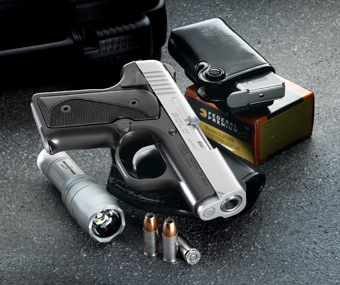
SigSauer has the Sig 290, Taurus has the Slim, Ruger has the LC9, and now Kimber has the Solo Carry. Of course, Kel-Tec and Kahr both have had single-stack ultra-compact polymer 9mm’s for some time now. As can be expected with a pistol this size, they are all chasing the concealed carry market and especially for those who want more power than is available from the .380 cartridge.

This is what Michael Bane has defined as Gun Culture 2.0. That is, those who have come to guns not through growing up in a hunting family – Gun Culture 1.0 – but as a result of the concealed carry movement. They tend to be somewhat younger and more budget conscious. Bane felt it was this group more than any others who were responsible for the great sales of the .380s such as the Ruger LCP.

Kimber formally introduced the Solo Carry and Solo Carry Stainless on Friday. It was to my mind a stealth introduction. Unlike the marketing hype that Ruger indulged in when introducing the LC9, the Kimber introduction was without much fanfare. Frankly, I only heard about it because of an email from Iain Harrison of Crimson Trace.

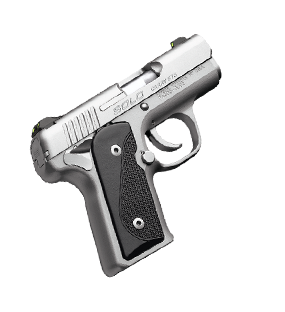
Kimber Solo Carry

The Solo Carry and the Solo Carry Stainless are both single-action striker-fired pistols weighing in at 17 ounces. This puts it at the same weight as the Ruger LC9 but lighter than the Sig P290 and Taurus Slim. Unlike all the other micro-nines mentioned above, both pistols have an aluminum alloy frame with a stainless steel slide. The only other micro-nine that I can find that isn’t polymer is the Rohrbaugh R9.

You can see the 1911 influence on these pistols with their ambidextrous thumb safety as well as the ambidextrous magazine release. The thumb safety is not some little lever but what appears to be a scaled down version of the Kimber 1911’s thumb safety. Sights are three-dot with the rear sight being dovetailed into the stainless slide. Grips are also removable. Currently, the pistol ships with a 6-round magazine but a 8-round magazine is reported to be available in the future.

Kimber Solo Carry Stainless

The Kimber1911 blog has an extensive review of the Solo Carry, many more pictures, and has the video shown below.

Crimson Trace will be making LaserGrips for the Solo Carry as opposed to a LaserGuard. From their press release:

Building on the success of its laser sights for the hot compact pistol market, Crimson trace proudly introduces the latest addition to its portfolio with instinctively activated Lasergrips for Kimber’s new, innovative compact 9mm carry pistol – The Solo. The result of painstaking and exhaustive engineering, these are the thinnest Lasergips yet, bringing the decisive advantage of laser sighting without adding any bulk to this compact package.

“We’ve been working with Kimber for over a year to develop a set of Crimson Trace grips befitting of the quality and innovation that is the new Solo,” said Kent Thomas, Director of Marketing for Crimson Trace. “By partnering with one of the world’s best firearm manufacturers since the inception of the project, we are able to offer both of CTC and Kimber consumers the finest laser sighting systems as soon as ground breaking new models such as the Solo are introduced.”

Available directly from Crimson Trace or as an option from Kimber, the Solo Carry Lasergrips are zeroed at the factory, offer a four hour battery life as well as the most powerful laser permitted by law. The popular rosewood finish seen on Kimber’s Crimson Carry is also incorporated into this model, offering a subtle contrast to the pistol’s stainless or two-tone finish.

In terms of price, the Solo Carry’s MSRP is $725 which makes it a bit cheaper than the Kahr PM9. However, that puts it $250-300 more than the rest of the field (the Sig doesn’t have a price yet). That said, for anyone who wants a micro-nine and doesn’t want a “plastic” pistol, I think they will pay the premium to get the Solo Carry.

I look forward to actually handling and firing this pistol. A head to head comparison with the other micro-nines would be very interesting.

UDPATE: MSRP of the Sig P290 is $758 according to ToddG. He also links to a place where you can win one!