Comment Period On Multi-Rifle Sales Ends Feb. 14th

The NRA-ILA sent this out this evening urging everyone to comment on the proposal to require FFL’s in the Southwest border states to report multiple purchases of semi-automatic rifles in a caliber greater than .22 and which have a detachable magazine.

Act Immediately to Block ATF Long Gun Sales Reporting!

Thursday, February 10, 2011

If you’re one of the nearly 71 million Americans who live in the four southwest border states, some of your gun purchases could soon be reported to the federal government. And whether you live in one of those states or elsewhere, your help is needed now to stop the federal government’s plan to register Americans’ gun purchases.

The Bureau of Alcohol, Tobacco, Firearms and Explosives is demanding the authority to require all of the 8,500 firearm dealers in California, Arizona, New Mexico and Texas to report all sales of two or more semiautomatic rifles within five consecutive business days, if the rifles are larger than .22 caliber and use detachable magazines. For example, a dealer would have to tell the government every time a deer hunter in Sacramento or Amarillo finds a good deal on a pair of semi-auto .30-06s like the popular Remington 7400.

The ATF has no legal authority to demand these reports, and the flood of new paperwork will waste scarce law enforcement resources that should be spent on legitimate investigations.

Unfortunately, there are only a few days left to comment on this proposal. Comments will be accepted until Monday, February 14. Every concerned gun owner’s voice should be heard on this critically important issue.

Please send your comments today. Be sure to refer to the December 17, 2010 “Notice of Information Collection Under Review: Report of Multiple Sale or Other Disposition of Certain Rifles.” You can submit your comments to:

OMB
Office of Information and Regulatory Affairs
Attention: Department of Justice Desk Officer
Washington, DC 20503

Please send a copy of your comments to:

Barbara A. Terrell
Firearms Industry Programs Branch
Bureau of Alcohol, Tobacco, Firearms and Explosives
99 New York Avenue, N.E.
Washington, DC 20226.

Barbara.Terrell@atf.gov
Fax: (202) 648–9640

You don’t need to reinvent the wheel with your own comments. The NRA’s comments can be found here. While their comments are nine pages long, you can take one or two items that you wish to emphasize and go from there. There is nothing wrong with a little cutting and pasting. That is the beauty of word processing software.

Earlier this week, Gunleaders.com reported that during the original comment period ATF received only 9 comments in favor of the proposal were received as compared to hundreds in opposition. They also have a copy of the letter they sent which is less comprehensive than the NRA’s letter. You may prefer to use their comments as the starting point for your comments.

HR 591 – McCarthy’s Latest Gun Control Bill

Rep. Carolyn McCarthy introduced HR 591 yesterday. It would “require criminal background checks on all firearms transactions occurring at gun shows.” The text of the bill has not yet been published.

As of yesterday, it had only one co-sponsor – Rep. David Cicilline (D-RI).

While the text of the bill hasn’t been received yet, I am presuming that this is an effort by McCarthy to play off of Mayor Bloomberg’s so-called sting operation at a Phoenix gun show in January. What makes a private sale made in the vicinity of a gun show different from any other private sale between lawful individuals is a question that only the gun controllers can answer.

When the full text is published, I will post it here.

In other McCarthy news, her magazine ban bill, HR 308, seems to have reached a high-watermark in terms of co-sponsors. It remains at 65 and has remained that way since January 26th. Of course, this number could change if President Obama were to make some forceful statement in support of the bill. And pigs could fly, too, I suppose.

Second Castle Doctrine Bill Introduced In North Carolina

A second (and stronger) Castle Doctrine bill has been introduced in the North Carolina General Assembly. This bill expands the castle doctrine to include your vehicle. More importantly, it introduces a “stand your ground” provision if one is attacked in any location where you have the right to be.

According to correspondence with Paul Valone, head of Grass Roots North Carolina, this bill was modeled on the State of Florida’s Castle Doctrine bill.

The primary sponsors of this bill are all Republicans. They represent a diverse group including a police officer (Hilton), a retired Clerk of Superior Court (Randleman), a retired Marine (Cleveland), and a medical social worker (Brown).

HOUSE DRH30070-LH-51 (01/19)
Short Title: Castle Doctrine.

Sponsors:
Representatives Hilton, Randleman, Cleveland, and R. Brown (Primary Sponsors).

A BILL TO BE ENTITLED

AN ACT to provide when the use of force or the use of deadly force is justifiable in defense of self, others, or one’s home or vehicle, or in preventing the commission of a forcible felony, and to provide immunity from criminal prosecution and civil action in those circumstances.

The General Assembly of North Carolina enacts:

SECTION 1. Chapter 14 of the General Statutes is amended by adding a new Article to read:

“Article 62.

“Justifiable Use of Force.

“§ 14‑470. Definitions.

The following definitions apply in this Article:
(1) Criminal prosecution. – The term includes arresting, detaining in custody, and charging or prosecuting the defendant.

(2) Deadly force. – Force that is likely to cause death or great bodily harm. The term includes the following: (i) the firing of a firearm in the direction of the person to be arrested, even though no intent exists to kill or inflict great bodily harm and (ii) the firing of a firearm at a vehicle in which the person to be arrested is riding. The term does not include the discharge of a firearm, which is loaded with a less‑lethal munition, by a law enforcement officer or correctional officer during and within the scope of his or her official duties.

(3) Dwelling. – A building or conveyance of any kind, including any attached porch, whether the building or conveyance is temporary or permanent, mobile or immobile, which has a roof over it, including a tent, and is designed to be occupied by people lodging therein at night.

(4) Forcible felony. – Treason; murder; manslaughter; rape, sexual offense, sexual battery; robbery; burglary; arson; kidnapping; aggravated assault; felonious stalking; malicious use of explosive or incendiary device; and any other felony which involves the use or threat of physical force or violence against any individual.

(5) Law enforcement officer. – Any person employed or appointed as a full‑time, part‑time, or auxiliary law enforcement officer, correctional officer, probation officer, post‑release supervision officer, or parole officer.

(6) Less‑lethal munition. – A projectile that is designed to stun, temporarily incapacitate, or cause temporary discomfort to a person without penetrating the person’s body.

(7) Residence. – A dwelling in which a person resides either temporarily or permanently or is visiting as an invited guest.

(8) Vehicle. – A conveyance of any kind, whether or not motorized, which is designed to transport people or property.

“§ 14‑471. Use of force in defense of person.

A person is justified in using force, except deadly force, against another when and to the extent that the person reasonably believes that the conduct is necessary to defend himself or herself or another against the other’s imminent use of unlawful force. However, a person is justified in the use of deadly force and does not have a duty to retreat if either of the following applies:

(1) He or she reasonably believes that such force is necessary to prevent imminent death or great bodily harm to himself or herself or another or to prevent the imminent commission of a forcible felony; or

(2) Under the circumstances permitted pursuant to G.S. 14‑472.

“§ 14‑472. Home protection; use of deadly force; presumption of fear of death or great bodily harm.

(a) A person is presumed to have held a reasonable fear of imminent peril of death or great bodily harm to himself or herself or another when using defensive force that is intended or likely to cause death or great bodily harm to another if both of the following apply:

(1) The person against whom the defensive force was used was in the process of unlawfully and forcibly entering, or had unlawfully and forcibly entered, a dwelling, residence, or occupied vehicle, or if that person had removed or was attempting to remove another against that person’s will from the dwelling, residence, or occupied vehicle.
(2) The person who uses defensive force knew or had reason to believe that an unlawful and forcible entry or unlawful and forcible act was occurring or had occurred.

(b) The presumption set forth in subsection (a) of this section does not apply if any of the following apply:

(1) The person against whom the defensive force is used has the right to be in or is a lawful resident of the dwelling, residence, or vehicle, such as an owner, lessee, or title holder, and there is not an injunction for protection from domestic violence or a written pretrial supervision order of no contact against that person.
(2) The person sought to be removed is a minor child or minor grandchild or is otherwise in the lawful custody or under the lawful guardianship of the person against whom the defensive force is used.
(3) The person who uses defensive force is engaged in a forcible felony or is using the dwelling, residence, or occupied vehicle to further a forcible felony.
(4) The person against whom the defensive force is used is a law enforcement officer, as defined in G.S. 14‑470, who enters or attempts to enter a dwelling, residence, or vehicle in the lawful performance of his or her official duties and the officer identified himself or herself in accordance with any applicable law or the person using force knew or reasonably should have known that the person entering or attempting to enter was a law enforcement officer.

(c) A person who is not engaged in an unlawful activity and who is attacked in any other place where he or she has a right to be has no duty to retreat and has the right to stand his or her ground and meet force with force, including deadly force if he or she reasonably believes it is necessary to do so to prevent death or great bodily harm to himself or herself or another or to prevent the commission of a forcible felony.

(d) A person who unlawfully and by force enters or attempts to enter a person’s dwelling, residence, or occupied vehicle is presumed to be doing so with the intent to commit an unlawful act involving force or violence.

“§ 14‑473. Use of force in defense of others.

A person is justified in the use of force, except deadly force, against another when and to the extent that the person reasonably believes that the conduct is necessary to prevent or terminate the other’s trespass on, or other tortious or criminal interference with, either real property other than a dwelling or personal property, lawfully in his or her possession or in the possession of another who is a member of his or her immediate family or household or of a person whose property he or she has a legal duty to protect. However, the person is justified in the use of deadly force only if he or she reasonably believes that such force is necessary to prevent the imminent commission of a forcible felony. A person does not have a duty to retreat if the person is in a place where he or she has a right to be.

“§ 14‑474. Immunity from criminal prosecution and civil action for justifiable use of force.

(a) A person who uses force as permitted in G.S. 14‑471, 14‑472, or 14‑473 is justified in using such force and is immune from criminal prosecution and civil action for the use of such force, unless the person against whom force was used is a law enforcement officer, as defined in G.S. 14‑470, who was acting in the performance of his or her official duties and the officer identified himself or herself in accordance with any applicable law or the person using force knew or reasonably should have known that the person was a law enforcement officer.

(b) A law enforcement agency may use standard procedures for investigating the use of force as described in subsection (a) of this section, but the agency shall not arrest the person for using force unless it determines that there is probable cause that the force that was used was unlawful.

(c) The court shall award reasonable attorneys’ fees, court costs, compensation for loss of income, and all expenses incurred by the defendant in defense of any civil action brought by a plaintiff if the court finds that the defendant is immune from prosecution as provided in subsection (a) of this section.

“§ 14‑475. Use of force by aggressor.

The justification described in G.S. 14‑471, 14‑472, and 14‑473 is not available to a person who is doing any of the following:

(1) Is attempting to commit, committing, or escaping after the commission of a forcible felony.

(2) Initially provokes the use of force against himself or herself unless one of the following situations exists:
a. The force is so great that the person reasonably believes that he or she is in imminent danger of death or great bodily harm and that he or she has exhausted every reasonable means to escape such danger other than the use of force which is likely to cause death or great bodily harm to the assailant.
b. In good faith, the person withdraws from physical contact with the assailant and indicates clearly to the assailant that he or she desires to withdraw and terminate the use of force, but the assailant continues or resumes the use of force.

“§ 14‑476. Defense to civil action for damages; party convicted of forcible or attempted forcible felony.

(a) It shall be a defense to any action for damages for personal injury or wrongful death, or for injury to property, that such action arose from injury sustained by a participant during the commission or attempted commission of a forcible felony. The defense authorized by this section shall be established by evidence that the participant has been convicted of such forcible felony or attempted forcible felony, or by proof of the commission of such crime or attempted crime by a preponderance of the evidence.

(b) Any civil action in which the defense recognized by this section is raised shall be stayed by the court on the motion of the civil defendant during the pendency of any criminal action which forms the basis for the defense, unless the court finds that a conviction in the criminal action would not form a valid defense under this section.

(c) In any civil action where a party prevails based on the defense created by this section:
(1) The losing party, if convicted of and incarcerated for the crime or attempted crime, shall, as determined by the court, lose any privileges provided by the correctional facility, including, but not limited to the following:
a. Canteen purchases.
b. Telephone access.
c. Outdoor exercise.
d. Use of the library.
e. Visitation.
(2) The court shall award a reasonable attorneys’ fee to be paid to the prevailing party in equal amounts by the losing party and the losing party’s attorney; however, the losing party’s attorney is not personally responsible if he or she has acted in good faith, based on the representations of his or her client. If the losing party is incarcerated for the crime or attempted crime and has insufficient assets to cover payment of the costs of the action and the award of fees pursuant to this subdivision, the party shall, as determined by the court, be required to pay by deduction from any payments the prisoner receives while incarcerated.
(3) If the losing party is incarcerated for the crime or attempted crime, the court shall issue a written order containing its findings and ruling pursuant to subdivisions (1) and (2) of this subsection and shall direct that a certified copy be forwarded to the appropriate correctional institution or facility.

(d) A law enforcement officer is not liable in any civil or criminal action arising out of the use of any less‑lethal munition in good faith during and within the scope of his or her official duties.”

SECTION 2. G.S. 14‑51.1 is repealed.

SECTION 3. This act becomes effective December 1, 2011, and applies to offenses committed on or after that date. Prosecutions for offenses committed before the effective date of this act are not abated or affected by this act, and the statutes that would be applicable but for this act remain applicable to those prosecutions.

UPDATE: Grass Roots North Carolina sent out an alert this evening regarding this bill – HB 74 – and the other one – SB 34 – which was introduced a few days earlier.

WHAT MAKES HB 74 BETTER?

Last Friday, the NRA issued an alert backing SB 34, sponsored by Senators Andrew Brock, Doug Berger and Kathy Harrington. While the pro-gun sponsors have the best of intentions, SB 34 and its companion bill, HB 52, (Reps. Tim Spear, Bill Owens and Jim Crawford) are dangerously flawed.

SB 34 and HB 52 are substantially similar to SB 928, which passed the Senate in the last session but was killed in the House when Rep. Deborah Ross and former Rep. Hugh Holliman (who was defeated by GRNC in the last election) denied it a committee hearing.

The problem is that SB 928 passed the gun-hostile Senate in a greatly weakened fashion: Although the original Edition 1 offered victims protection both inside and outside the home, particularly in motor vehicles, the amended Edition 2 offered protection ONLY WITHIN THE HOME, meaning it offered little beyond present law.

By contrast, HB 74 is the result of longstanding collaboration between Rep. Hilton and GRNC. Drafted by GRNC in 2005, it was substantially improved by Hilton and legislative staff in the 2009-2010 session, when it was introduced as HB 1131.

The bottom line is that while SB 928 might have been the best bill attainable in the last, gun-hostile session of the legislature, you have worked hard to produce a pro-gun majority this year in both chambers, and you deserve better.

ADDITIONAL PROTECTIONS OF HB 74:

* Better definitions, including defense against “forcible felonies;”
* Presumption of reasonable fear to victims of carjackings;
* “Stand your ground” protection: No duty to retreat when attacked outside the home; and
* Better protection against lawsuits: If attackers or survivors file malicious lawsuits which are thrown out of court, they would bear the full cost of litigation, freeing crime victims of tens of thousands of dollars in legal fees.

Stratfor On The 90% Myth

Mexico’s Gun Supply and the 90 Percent Myth is republished with permission of STRATFOR.


Mexico’s Gun Supply and the 90 Percent Myth
By Scott Stewart

For several years now, STRATFOR has been closely watching developments in Mexico that relate to what we consider the three wars being waged there. Those three wars are the war between the various drug cartels, the war between the government and the cartels and the war being waged against citizens and businesses by criminals.

In addition to watching tactical developments of the cartel wars on the ground and studying the dynamics of the conflict among the various warring factions, we have also been paying close attention to the ways that both the Mexican and U.S. governments have reacted to these developments. Perhaps one of the most interesting aspects to watch has been the way in which the Mexican government has tried to deflect responsibility for the cartel wars away from itself and onto the United States. According to the Mexican government, the cartel wars are not a result of corruption in Mexico or of economic and societal dynamics that leave many Mexicans marginalized and desperate to find a way to make a living. Instead, the cartel wars are due to the insatiable American appetite for narcotics and the endless stream of guns that flows from the United States into Mexico and that results in Mexican violence.

Interestingly, the part of this argument pertaining to guns has been adopted by many politicians and government officials in the United States in recent years. It has now become quite common to hear U.S. officials confidently assert that 90 percent of the weapons used by the Mexican drug cartels come from the United States. However, a close examination of the dynamics of the cartel wars in Mexico — and of how the oft-echoed 90 percent number was reached — clearly demonstrates that the number is more political rhetoric than empirical fact.

By the Numbers

As we discussed in a previous analysis, the 90 percent number was derived from a June 2009 U.S. Government Accountability Office (GAO) report to Congress on U.S. efforts to combat arms trafficking to Mexico (see external link).

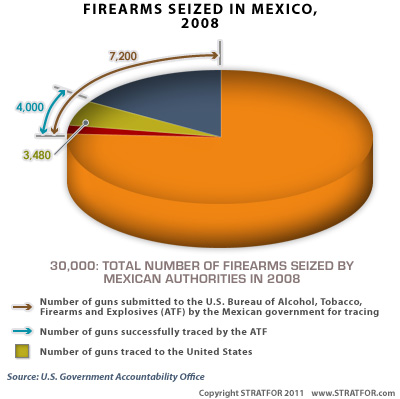
According to the GAO report, some 30,000 firearms were seized from criminals by Mexican authorities in 2008. Of these 30,000 firearms, information pertaining to 7,200 of them (24 percent) was submitted to the U.S. Bureau of Alcohol, Tobacco, Firearms and Explosives (ATF) for tracing. Of these 7,200 guns, only about 4,000 could be traced by the ATF, and of these 4,000, some 3,480 (87 percent) were shown to have come from the United States.

This means that the 87 percent figure relates to the number of weapons submitted by the Mexican government to the ATF that could be successfully traced and not from the total number of weapons seized by Mexican authorities or even from the total number of weapons submitted to the ATF for tracing. In fact, the 3,480 guns positively traced to the United States equals less than 12 percent of the total arms seized in Mexico in 2008 and less than 48 percent of all those submitted by the Mexican government to the ATF for tracing. This means that almost 90 percent of the guns seized in Mexico in 2008 were not traced back to the United States.

The remaining 22,800 firearms seized by Mexican authorities in 2008 were not traced for a variety of reasons. In addition to factors such as bureaucratic barriers and negligence, many of the weapons seized by Mexican authorities either do not bear serial numbers or have had their serial numbers altered or obliterated. It is also important to understand that the Mexican authorities simply don’t bother to submit some classes of weapons to the ATF for tracing. Such weapons include firearms they identify as coming from their own military or police forces, or guns that they can trace back themselves as being sold through the Mexican Defense Department’s Arms and Ammunition Marketing Division (UCAM). Likewise, they do not ask ATF to trace military ordnance from third countries like the South Korean fragmentation grenades commonly used in cartel attacks.

Of course, some or even many of the 22,800 firearms the Mexicans did not submit to ATF for tracing may have originated in the United States. But according to the figures presented by the GAO, there is no evidence to support the assertion that 90 percent of the guns used by the Mexican cartels come from the United States — especially when not even 50 percent of those that were submitted for tracing were ultimately found to be of U.S. origin.

This point leads us to consider the types of weapons being used by the Mexican cartels and where they come from.


Types and Sources of Guns

To gain an understanding of the dynamics of the gun flow inside Mexico, it helps if one divides the guns seized by Mexican authorities from criminals into three broad categories — which, incidentally, just happen to represent three different sources.

Type 1: Guns Legally Available in Mexico

The first category of weapons encountered in Mexico is weapons available legally for sale in Mexico through UCAM. These include handguns smaller than a .357 magnum such as .380 and .38 Special.

A large portion of this first type of guns used by criminals is purchased in Mexico, or stolen from their legitimate owners. While UCAM does have very strict regulations for civilians to purchase guns, criminals will use straw purchasers to obtain firearms from UCAM or obtain them from corrupt officials. Cartel hit men in Mexico commonly use .380 pistols equipped with sound suppressors in their assassinations. In many cases, these pistols are purchased in Mexico, the suppressors are locally manufactured and the guns are adapted to receive the suppressors by Mexican gunsmiths.

It must be noted, though, that because of the cost and hassle of purchasing guns in Mexico, many of the guns in this category are purchased in the United States and smuggled into the country. There are a lot of cheap guns available on the U.S. market, and they can be sold at a premium in Mexico. Indeed, guns in this category, such as .380 pistols and .22-caliber rifles and pistols, are among the guns most commonly traced back to the United States. Still, the numbers do not indicate that 90 percent of guns in this category come from the United States.

Additionally, most of the explosives the cartels have been using in improvised explosive devices (IEDs) in Mexico over the past year have used commercially available Tovex, so we consider these explosives to fall in this first category. Mexican IEDs are another area where the rhetoric has been interesting to analyze, but we will explore this topic another time.

Type 2: Guns Legally Available in the U.S. but Not in Mexico

Many popular handgun calibers, such as 9 mm, .45 and .40, are reserved for the military and police and are not available for sale to civilians in Mexico. These guns, which are legally sold and very popular in the United States, comprise our second category, which also includes .50-caliber rifles, semiautomatic versions of assault rifles like the AK-47 and M16 and the FN Five-Seven pistol.

When we consider this second type of guns, a large number of them encountered in Mexico are likely purchased in the United States. Indeed, the GAO report notes that many of the guns most commonly traced back to the United States fall into this category. There are also many .45-caliber and 9 mm semiautomatic pistols and .357 revolvers obtained from deserters from the Mexican military and police, purchased from corrupt Mexican authorities or even brought in from South America (guns made by manufacturers such as Taurus and Bersa). This category also includes semiautomatic variants of assault rifles and main battle rifles, which are often converted by Mexican gunsmiths to be capable of fully automatic fire.

One can buy these types of weapons on the international arms market, but one pays a premium for such guns and it is cheaper and easier to simply buy them in the United States or South America and smuggle them into Mexico. In fact, there is an entire cottage industry that has developed to smuggle such weapons, and not all the customers are cartel hit men. There are many Mexican citizens who own guns in calibers such as .45, 9 mm, .40 and .44 magnum for self-defense — even though such guns are illegal in Mexico.

Type 3: Guns Not Available for Civilian Purchase in Mexico or the U.S.

The third category of weapons encountered in Mexico is military grade ordnance not generally available for sale in the United States or Mexico. This category includes hand grenades, 40 mm grenades, rocket-propelled grenades, automatic assault rifles and main battle rifles and light machine guns.

This third type of weapon is fairly difficult and very expensive to obtain in the United States (especially in the large numbers in which the cartels are employing them). They are also dangerous to obtain in the United States due to heavy law-enforcement scrutiny. Therefore, most of the military ordnance used by the Mexican cartels comes from other sources, such as the international arms market (increasingly from China via the same networks that furnish precursor chemicals for narcotics manufacturing), or from corrupt elements in the Mexican military or even deserters who take their weapons with them. Besides, items such as South Korean fragmentation grenades and RPG-7s, often used by the cartels, simply are not in the U.S. arsenal. This means that very few of the weapons in this category come from the United States.

In recent years the cartels (especially their enforcer groups such as Los Zetas, Gente Nueva and La Linea) have been increasingly using military weaponry instead of sporting arms. A close examination of the arms seized from the enforcer groups and their training camps clearly demonstrates this trend toward military ordnance, including many weapons not readily available in the United States. Some of these seizures have included M60 machine guns and hundreds of 40 mm grenades obtained from the military arsenals of countries like Guatemala.

But Guatemala is not the only source of such weapons. Latin America is awash in weapons that were shipped there over the past several decades to supply the various insurgencies and counterinsurgencies in the region. When these military-grade weapons are combined with the rampant corruption in the region, they quickly find their way into the black arms market. The Mexican cartels have supply-chain contacts that help move narcotics to Mexico from South America and they are able to use this same network to obtain guns from the black market in South and Central America and then smuggle them into Mexico. While there are many weapons in this category that were manufactured in the United States, the overwhelming majority of the U.S.-manufactured weapons of this third type encountered in Mexico — like LAW rockets and M60 machine guns — come into Mexico from third countries and not directly from the United States.

There are also some cases of overlap between classes of weapons. For example, the FN Five-Seven pistol is available for commercial purchase in the United States, but the 5.7×28 armor-piercing ammunition for the pistol favored by the cartels is not — it is a restricted item. However, some of the special operations forces units in the Mexican military are issued the Five-Seven as well as the FN P90 personal defense weapon, which also shoots the 5.7×28 round, and the cartels are obtaining some of these weapons and the armor-piercing ammunition from them and not from the United States. Conversely, we see bulk 5.56 mm and 7.62 mm ammunition bought in the United States and smuggled into Mexico, where it is used in fully-automatic AK-47s and M16s purchased elsewhere. As noted above, China has become an increasingly common source for military weapons like grenades and fully automatic assault rifles in recent years.

To really understand Mexico’s gun problem, however, it is necessary to recognize that the same economic law of supply and demand that fuels drug smuggling into the United States also fuels gun smuggling into Mexico. Black-market guns in Mexico can fetch up to 300 percent of their normal purchase price — a profit margin rivaling the narcotics the cartels sell. Even if it were somehow possible to hermetically seal the U.S.-Mexico border and shut off all the guns coming from the United States, the cartels would still be able to obtain weapons elsewhere — just as narcotics would continue to flow into the United States from other places. The United States does provide cheap and easy access to certain types of weapons and ammunition, but as demonstrated by groups such as the Revolutionary Armed Forces of Colombia, weapons can be easily obtained from other sources via the black arms market — albeit at a higher price.

There has clearly been a long and well-documented history of arms smuggling across the U.S.-Mexico border, but it is important to recognize that, while the United States is a significant source of certain classes of weapons and ammunition, it is by no means the source of 90 percent of the weapons used by the Mexican cartels, as is commonly asserted.

Five Questions

As I reported yesterday, the Department of Justice has replied to Senator Grassley’s letter. The letter was a classic of bureaucratic stonewalling and avoidance.

In a further report on the letter, the AP has this response from Grassley’s office which indicates they are not giving up based on one letter saying “back off” from an Assistant AG.

Grassley spokeswoman Beth Pellett Levine said the Justice Department denied one aspect of allegations presented by whistleblowers and promised to give the senator a briefing. “However, the briefing has still not occurred, and documents provided with the allegations are not consistent with that denial,” she said. “There are many specific questions that need to be answered in full by the Justice Department as soon as possible.”

Mike Vanderboegh has posted five questions that he received from one of his insider sources regarding the letter from Assistant AG Welch. The questions, if asked in a Congressional hearing under oath, are sure to make those in charge at both ATF and DOJ squirm.

1. Has the gun used to murder Border Patrol agent Brian Terry been identified? If so, on what evidentiary basis, including ballistic evidence. If the gun has been identified, the two key questions: (A) has this gun ever been traced before? (B) if so, what do the traces show?

2. What are the locations in Mexico where “gunwalked” firearms were recovered?

3. Were any “gunwalked” firearms used to murder anybody in Mexico? If so, who? Again the Goat (Copulation) questions: (A) have any of these guns ever been traced before? (B) if so, what do the traces show?

4. Did Assistant Attorney General Lanny A. Breuer attend any meetings at which Project Gunrunner was discussed in full or in part? If so, provide (1) the date of the meeting or meetings, (2) names of all persons who attended each meeting or meetings, and (3) the unredacted write-ups of what was discussed at each meeting or meetings, as well as private, unpublished notes, e-mails and any other documents that contain information about each meeting or meetings.

[nota bene: I am making a distinction here between ATF and DOJ as institutions, in asking these questions]

5. For each of the 274 firearms recovered in Mexico, describe the extent, if any, to which Mexican authorities were advised these firearms had been transported to Mexico with the knowledge of ATF.

From what we have seen and heard, “Project Gunwalker” isn’t pretty. I think the answers to these questions aren’t going to be pretty either.

I want to repeat what I said yesterday after this affair. It wasn’t the Watergate break-in that doomed Richard Nixon, it was the cover-up. While the mainstream press is less likely to put pressure on the Obama Administration now than the Washington Post was with Richard Nixon in 1972-74, we have the Internet now and we don’t have to rely on the press doing their job. As David Codrea and Mike Vanderboegh have shown, we can do it for them.

DOJ Stonewalls Grassley On Project Gunwalker

Assistant Attorney General Ronald Weich has responded to the letters sent by Sen. Chuck Grassley (R-IA) concerning “Project Gunwalker” according to an AP report in the Arizona Republic. In essence, he denies everything and tells Grassley to have the whistle-blowers give their information to him.

The U.S. Justice Department denied a claim made to lawmakers that two guns sold in purchases sanctioned by federal firearms agents were later used in a shootout that left a Border Patrol agent dead near the Arizona-Mexico border.

Assistant U.S. Attorney General Ronald Weich said in a letter obtained Tuesday by The Associated Press that the claim that firearms agents sanctioned or knowingly allowed the sale of assault weapons to straw buyers who then brought them to Mexico is false. Such a claim was made about guns used by bandits in the Dec. 14 fatal shooting of Border Patrol agent Brian A. Terry.

Thanks to David Codrea the letter is now available on Scribd. As David notes in his National Gun Rights Examiner column, ATF has “lawyered up”.
atf_(2)

Mike at Sipsey Street Irregulars obtained a copy of the letter. He asked his contacts for their opinions of it. One of his contacts had this to say about it.

I’m on my way to (REDACTED), but quickly:

1. Denial of the allegation in absolute terms is intended to stop this from going anywhere.
2. Being pleased to Dog & Pony show “what’s working well with our program” while obviating all the negative possibilities is the usual plan for ANY kind of Congressional testimony. In other words, controlling the agenda.
3. In case #2 isn’t clear, DOJ is clear about saying any OTHER questions about Project Gunrunner are not on the table is out and out stonewalling. It also means that if any such questions are asked, DOJ will refuse to answer them.
. . . But this is standard coverup material that even a boy of 8 would laugh at. Entirely predictable, however; DOJ wants to stop this in its tracks before it fucks up Foreign Relations.

The Mexicans may get bought off or promised to be bought off; and may be exercising “leverage” about this to get political power or concessions or both from Uncle Sam. Gonna be vicious politics, but we already knew that.

If one reads the forum postings by disgruntled ATF agents at CleanUpATF.org, you get the feeling that ATF is in much more trouble on this matter (and others) than the media and DOJ would have you believe.  Here are a couple posts from just yesterday that cast extreme doubt on assertions in the letter from Asst. AG Weich:

After the Tucson shooting which killed 6, wounded Congresswoman Gabriel Giffords and dozens of others; within hours investigators at all levels of law enforcement publicly discussed the crime, the suspect, the motive, the timeline and the weapon used in graphic detail on national media outlets.

This was an ongoing and complex criminal investigation being lead by the FBI, was it not? We can assume that the investigation is still ongoing.

So why all the secrecy and information lockdown on Agent Terry’s murder? What is different about the two events short of the event itself? Why is one event so openly detailed and the other is so cloaked in secrecy?

Could it be that the difference is ATF and the FBI have dirty fingers in the Terry homicide and they don’t in the Tucson shooting investigation? Could it be that attorneys are telling investigators to not say ANYTHING? These are not an unfair questions.

Go to Webster’s and look up the definition of “coverup”. There should be a picture of the ATF seal next to it. Also look up “retaliation”, “mismanagement”, “blind defense of crimes”. Pictures of ATF’s various “repeat offenders” (I stole that perfect description from Onesparkz, below) should be next to those also.

The “true believer” mentality of some ATF managers and more critically the corrupt defense ATF’s attorneys routinely prove agency bosses should be examined in this probe. Some ATF managers willingness to lie about their ill deeds and ATF’s attorneys eagerness to ignore and protect their clients lies and crimes should be closely examined in the Senate probe. ATF attorneys have long shown their willingness to simply disregard the facts of allegations and counter attack the accuser. The Gillett retaliation is one small and single example of ATF managements “above the law” means and methods of handling ATF’s business. Ken Melson and crew do not run ATF, the risk averse and liability frightened attorneys do.

ATF has long known the corrupt nature of Gillett and have continually defended him, protected him, ignored his crimes, promoted him, and left him in position to carry on his bad acts.

Melson, Hoover, Chait and crew are so shell shocked they can’t use the washroom without first speaking to counsel to get a determination from the attorneys if it is OK.

The public who pays the salaries of these people with their taxes and who trust and expect ATF to administer a federal law enforcement agency to the very highest standards needs and deserves to know the truth. Why the deception at ATF?

Because the truth of how ATF is managed is appalling, disgusting, sickening, etc. Look up those definitions too. Those are the descriptions used by ATF field agents who work for these unethical and immoral “leaders”. ATF and people who work for it, the public who it serves, the industry it monitors and regulates all deserve much better than what we are getting.

As the historical truth on all of these people and their management tactics is further uncovered the tolerance and support of their conduct is going to shock the taxpayers and Congress.

And the second post:

Another point for Senator Grassley to examine. This is telling.

The ATF Phoenix Field Division management staff has perfected the unethical and probably illegal habit of hiding their investigations from all eyes that they don’t want on their failed work by classifying them “6e Grand Jury Protected”. This is done by simply clicking the “6e” box in Nforce and what this does is prevent anyone not on the 6e list from examining or accessing the investigative reports, etc.

“6e” are the Grand Jury Rules of Secrecy and they are continually abused by Newell and Gillett to prevent others from examining or questioning their failures. I believe that abuse of the 6e rule is considered Contempt of Court and can be charged as a crime.

Gillett has become so abusive of this process (with Newell’s support) that he routinely locks out headquarters personell, intelligence officers and staff, and even his own investigating agents. He only opens the case files to the people he personally approves or trusts. He treats ATF investigations as if he owns them personally and no one else has the right to see them without his blessing.

What cases has Gillette classified 6e over his tenure as a supervisor? What cases has he instuctucted his subordinates to classfy as 6e? How many of these case have actually involved the Grand Jury?

What have Newell and Gillett been hiding all these years?

The use of the grand jury secrecy rules is a very effective means to prevent Congressional investigators from finding out the truth. As detailed on the Internet last fall, grand jury proceedings can be perverted by prosecutors to such an extent that attorneys can’t even publicly discuss their own amicus briefs.

DOJ, ATF, and those involved need to remember that it wasn’t the Watergate break-in that destroyed Richard Nixon. It was the cover-up.

UPDATE: Interesting post by “Doc Holladay” on CUATF this morning. “Doc” is one of the moderators there and is a frequent poster.  He asks some very pertinent questions about the stonewalling of Senator Grassley.

Did our Director seriously Lawyer up? Why do Mueller and Napalitano respond directly to Congress when challenged, BUT ATFs Director hides behind a misleading half response crafted by some hack DOJ attorney? This is bad. We will be dissecting Mr. Melsons (or in this case, Mr. Weichs response)shortly. Was there some point of national security Senator Grassley was requesting? I wonder if Melson, Hoover, Chait, McMahon or even our Intel Guru DAD Martin were even monitoring this case since there was so much controversy over Newells actions? Surely they were reviewing N Force at least monthly and being briefed. They were weren’t they?

From Another Era

This brings back memories! I remember playing with that Mattel “Tommy Gun” as a kid. We liked this version for playing war as it seemed more like the real one.

Notice that the crook in the window has a Walter P.38 and is played by the same actor who played Otis in the Andy Griffith Show.