
NSSF On Traditional Ammunition

The National Shooting Sports Foundation took exception to the comments of a Minnesota DNR employee’s attack on traditional ammunition. By traditional, I mean ammo that contains lead. Here is their response.

Earlier this month at a Minnesota Association of Conservation Professionals event, a Minnesota DNR employee, Molly Tranel, used dubious science and questionable statistics to attack the use of traditional ammunition (ammunition containing lead-core components) by sportsmen and shooters.

In her presentation, Ms. Tranel implied that the use of traditional ammunition poses a danger to (1) wildlife, in particular raptors such as bald eagles, that may feed on entrails of unrecovered game left in the field and (2) that there is a human health risk from consuming game harvested using traditional ammunition. Perhaps most troubling is the depths to which agenda-driven researchers will stoop. In one slide an experiment where researchers “force-fed” lead pellets to doves is discussed. And hunters are the bad guys?

The National Shooting Sports Foundation (NSSF), the trade association for the firearms, ammunition, hunting and shooting sports industry, opposes efforts to ban or restrict the use of traditional ammunition unless there is sound science conclusively establishing an adverse impact on a wildlife population, the environment or on the human health of those consuming game harvested with traditional ammunition.

In recent years traditional ammunition has come under increased attack from anti-hunting groups. As such, when misinformation related to traditional ammunition surfaces, NSSF believes it must set the record straight. Let’s do that now:

With very limited exceptions, such as waterfowl and possibly the California condor, where, in the latter case the evidence of a causal connection to spent ammunition fragments is far from conclusive, there is simply no sound scientific evidence that the use by hunters of traditional ammunition is causing harm to wildlife populations. In the case of raptors, there is a total lack of any scientific evidence of a population impact. In fact, just the opposite is true. Hunters have long used traditional ammunition, yet raptor populations have significantly increased all across North America — a trend that shows no sign of letting up. If the use of traditional ammunition was the threat to raptor populations some make it out to be, these populations would not be soaring as they are.

Furthermore, it is the excise tax dollars (11 percent) manufacturers pay on the sale of ammunition – the very ammunition some choose to demonize – that is the primary source of wildlife conservation funding in the United States and the financial backbone of the North American Model of Wildlife Conservation. The bald eagle’s recovery, a truly great conservation success story, was made possible and funded by hunters using traditional ammunition. Not surprisingly, recent statistics from the United States Fish and Wildlife Service show that from 1981 to 2006 the number of breeding pairs of bald eagles in the United States increased 724 percent.

Needlessly restricting or banning traditional ammunition absent sound science will hurt wildlife conservation efforts – efforts such as those that aided recovery of the Bald Eagle – because fewer hunters will take to the field, thereby undercutting financial wildlife management resources. Alternatives to traditional ammunition are not economical. The higher costs associated with this ammunition will price many everyday consumers out of the market. This is evidenced by the low 1 percent market share of metallic nontraditional ammunition –neither its higher cost, performance or benefits are justified.

Also necessary to clarify is the notion that consuming game harvested with traditional ammunition poses a human health risk. This unjustified fear stems from a politically-motivated dermatologist in North Dakota who, in 2008, claimed to have collected from food pantries packages of venison that contained fragments from lead bullets. Many people became concerned and some officials overreacted to the allegations made by the dermatologist, who sits on the board of the Peregrine Fund, that consuming game posed a human health risk.

The state of North Dakota failed to conduct its own study. Instead, it merely accepted the lead-contaminated samples hand-picked by the dermatologist and submitted those samples to a lab in Iowa for testing. Based on those test results, North Dakota health officials ordered state food pantries to destroy all donated venison and to stop accepting further donations. The Iowa lab official in charge of the testing, Rick Kelly, was highly critical of North Dakota, “I think North Dakota is drawing the wrong conclusions. We did what they asked, but they did not take an arbitrary sample.” And the least fortunate among us were deprived of a high-protein, low-fat, organic food source.

To put this issue in perspective, consider this statement from the Iowa Department of Public Health (IDPH), a state agency that has tested the blood lead level of Iowa residents for over 15 years: “IDPH maintains that if lead in venison were a serious health risk, it would likely have surfaced within extensive blood lead testing since 1992 with 500,000 youth under 6 and 25,000 adults having been screened.” Iowa has never had a case of a hunter having elevated lead levels caused by consuming harvested game.

A study from 2008 by the U.S. Centers for Disease Control and Prevention (CDC) on blood lead levels of North Dakota hunters confirmed that consuming game harvested with traditional ammunition does not pose a human health risk. Calls to ban or restrict the product by groups opposed to traditional ammunition, like the Peregrine Fund, and anti-hunting groups, like the Humane Society of the United States (HSUS), are scientifically unfounded and nothing more than a scare tactic to advance their agenda. In looking more closely at the CDC study results, perhaps most telling is the fact that the average lead level of the hunters tested was lower than that of the average American. In other words, if you were to randomly pick someone on the street, chances are they would have a higher blood lead level than the hunters in this study. Studies regarding the use of lead in other applications have no application when considering the use and utility of lead in ammunition for hunting, on shooting ranges or for self-defense.

The science of wildlife biology and conservation is based on managing populations of species, not on preventing harm to individual members of a species. Absent sound scientific evidence demonstrating a wildlife population or human health impact arising from the use of traditional ammunition, there is no justification for banning its use.
NSSF On Threat Of Mexican Lawsuit

The National Shooting Sports Foundation responded to reports that the Mexican government will seek to sue American gun manufacturers for the violence in Mexico. The NSSF says, in essence, not so fast amigo – but politely. They remind President Calderon that the overwhelming majority of the firearms seized in Mexico do not come from the United States.

This week a Mexican official confirmed that President Felipe Calderon’s government has hired U.S. trial lawyers to investigate possible litigation against U.S. gun manufacturers and firearms retailers, seeking to hold these lawful companies responsible for the criminal misuse of firearms in Mexico. Though the Protection of Lawful Commerce in Arms Act, signed into law in 2005 by then President George W. Bush, prevents such frivolous lawsuits, the mere threat demands a response.

The National Shooting Sports Foundation (NSSF), the trade association for the firearms industry, respects the work of President Calderon to willingly take on his country’s powerful drug cartels; however, we are disappointed that he would seek to hold law-abiding American companies responsible for crime in Mexico. This is especially troubling given investigative reports that show more than 80 percent of the firearms recovered in Mexico do not come from the United States. The most recent of these reports, from the independent research group STRATFOR, determined that less than 12 percent of the guns Mexico seized in 2008 came from the United States.

Furthermore, according to the Bureau of Alcohol, Tobacco, Firearms and Explosives (ATF), firearms traced in Mexico were originally sold at retail not recently, but, on average, 14 years earlier. This is completely inconsistent with any notion that a flood of newly purchased firearms are being illegally smuggled over the border. And let’s not forget that no retail firearm sale can be made in the U.S. until after an FBI criminal background check of the purchaser has been completed.

Exacerbating misconceptions about the firearms used by Mexican drug cartels, even mainstream publications such as the Washington Post, repeat erroneous information. For example, in today’s editorial the paper stated that Mexican drug cartels are “snapping up the military-style machine guns available in U.S. gun shops.” The fact is that machine guns are heavily regulated and virtually never sold at retail in the United States.

Still, in response to concerns over the violence in Mexico, ATF conducted more than 2,000 inspections of firearms dealers along the border. The result? Not a single dealer was charged with committing any crime and only two (or 0.01%) had their licenses revoked for unknown reasons that could have nothing to do with the cartels illegally obtaining firearms from retailers in the United States.

While these ATF inspections were clearing the law-abiding retailers’ good names, which were being smeared by many in the mainstream press and anti-gun officials in both the United States and Mexico, as many as 150,000 Mexican soldiers defected to work for the drug cartels, bringing their American-made service-issued firearms with them.

Perhaps the Mexican government should seek to file suit against their military personnel actively engaged in such illegal conduct.

Members of the firearms industry take seriously the criminal acquisition and misuse of their products. This is why our industry has for more than a decade partnered with the ATF in a national campaign to make the public aware that it is a serious crime to straw purchase a firearm. The program, called Don’t Lie for the Other Guy, is now funded completely by members of the firearms industry and also helps ATF to educate firearms retailers – whom ATF considers the first line of defense – to better detect and prevent illegal straw purchases.

The firearms industry is one of America’s oldest and most-storied entities. We played a prominent role in America’s westward expansion, continue to serve as the Arsenal for Democracy and support the conservation of America’s wildlife and great outdoors. We are also one of the most regulated industries in the world. From production to distribution, distribution to sale, everything we as an industry do is overseen by the United States government.

Again, we applaud President Calderon for taking steps to stop the cartels when past Mexican administrations paid only lip service and allowed rampant corruption to fester. Still, it is wrong for anyone to blame America’s firearms industry for the problems Mexico is currently facing.

Interesting In A Rifle Geek Sort Of Way

I never quite understood how mil-dot scopes worked. I assumed – wrongly – that it had something to do with the military. Actually, the mil is short for milliradians and has more to do with geometry as with the military.

Ryan Cleckner of the NSSF explains how to use a mil-dot scope to estimate distance as well as how to do the calculations. Ryan was a sniper with the 1st Battalion of the 75th Ranger Regiment. I think when it comes to sniping he might know a thing or two.

The video is about 20 minutes long but I found myself watching the whole thing.

Get Your Eyes On Target Faster

The NSSF has been putting out a lot of instructional videos lately. One of the latest is how to get your eyes on target faster when wingshooting. After seeing the video the thought came to me that the techniques as well as the mechanics of how the eye works would apply for more than wingshooting. If the target – or bad guy – is moving, how the eye acquires the target is going to be the same whether you are using a shotgun, an AR-15, or a Glock.

The Month After Tucson

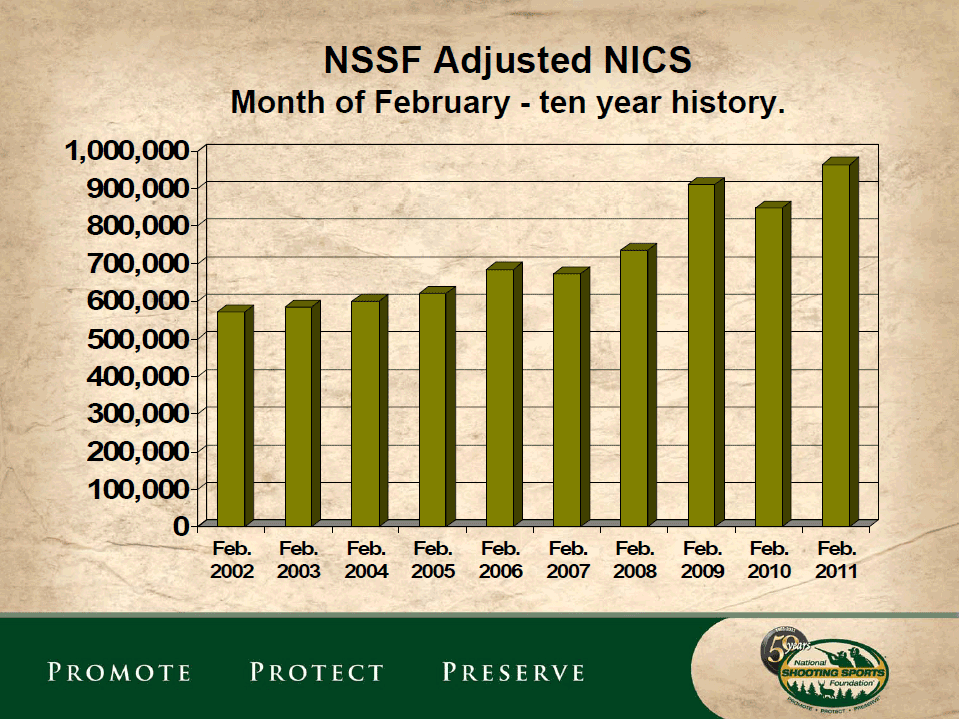
NSSF is reporting that the adjusted NICS checks for the month of February 2011 are up 13.6% over the previous year.

The February 2011 NSSF-adjusted National Instant Criminal Background Check System (NICS) figure of 963,746 is an increase of 13.6 percent over the NSSF-adjusted NICS figure of 848,036 from February 2010. For comparison, the unadjusted February 2011 NICS figure of 1,463,138 is an increase of 18.2 percent over the unadjusted NICS figure of 1,237,617 from February 2010. The adjusted NICS data was derived by NSSF by subtracting out all NICS purpose code permit checks used by several states such as Kentucky, Iowa and Utah for CCW permit application checks as well as checks on active CCW permit databases. While not a direct correlation to firearms sales, the NSSF-adjusted NICS data provides a more accurate picture of current market conditions.

Courtesy of NSSF

The raw data directly from the FBI can be seen here. It breaks out NICS checks by state.

Looking at the bar chart above, you can see the spike in sales in February 2009 as compared to February 2008. I think it can be reasonably assumed that this is due to the spike in gun sales nationwide beginning with the election of President Barack Obama. The heavy surge in gun sales has moderated by February 2010 as the fear over new gun control measures has started to abate. However, after the shootings in Tucson and the clamor for more gun control, NICS checks (and presumably sales) surge even higher than after the election of Obama.

Looking at the raw numbers, some states like Georgia, North Carolina, Pennsylvania, and Texas show increases of more than 10,000 checks over  the January 2011 numbers. While past history tends to show more sales in February than in January (due, in part, I presume to leftover bills from Christmas), the increases this year are substantially more than in previous years.

NSSF Opposes Nominee Tied To Eliot Spitzer

The NSSF released this about an hour ago on their blog about Caitlin Halligan who is nominated as a Circuit Judge for the U.S. Court of Appeals for the District of Columbia.

The Senate Judiciary Committee is slated to vote later today on the nomination of Caitlin Halligan to the U.S. Court of Appeals for the District of Columbia. Ms. Halligan previously served as Solicitor General under then-New York State Attorney General Eliot Spitzer while he was suing members of the firearms industry. As New York’s Solicitor General, Halligan signed the brief in People of the State of New York v. Sturm, Ruger & Co, Inc., et al arguing that the lawful and highly regulated sale of firearms somehow created a ”public nuisance.” The New York appellate decision roundly rejected her arguments and upheld the dismissal of the case. Later, she filed an amicus brief in City of New York v. Beretta U.S.A. Corp. in support of the Giuliani/Bloomberg lawsuit against members of our industry arguing that the Protection of Lawful Commerce in Arms Act (PLCAA) was unconstitutional. Every appellate court in the nation has rejected that argument and not a single federal court judge has ever agreed, not even Brooklyn, N.Y., federal court judge Jack B. Weinstein whose ruling Halligan was seeking to have overturned.

Her specious arguments as Solicitor General in support of baseless lawsuits designed to destroy America’s firearms industry raise important questions about whether Ms. Halligan is qualified to serve as a federal appellate court judge.

Unfortunately, the Senate Judiciary Committee has held the vote on Halligan and approved her nomination by a 10 to 8 vote. I am presuming it was along party lines. Of the votes taken during their business meeting, the vote on Halligan was the only one with a roll call vote. If her nomination is to be stopped, it will be on the floor of the Senate.

NSSF Releases Letter Opposing Multi-Rifle Sale Reporting

From the NSSF:

The National Shooting Sports Foundation (NSSF) sent a letter yesterday to the Bureau of Alcohol, Tobacco, Firearms and Explosives (ATF) and the Office of Management and Budget commenting on ATF’s proposal to require as part of a year-long “pilot program” that federally licensed firearms retailers in Texas, New Mexico, Arizona and California report to ATF the multiple sales of certain rifles (Federal Register, December 17, 2010).

In its letter, NSSF explains that it respectfully disagrees with ATF’s proposal because Congress has not provided ATF the legal authority under the Gun Control Act to impose this reporting requirement and, perhaps more importantly, because NSSF believes that this reporting requirement will actually make it more difficult for firearms retailers to help law enforcement since illegal firearms traffickers will easily modify their illegal schemes to circumvent the new reporting requirement.

While NSSF opposes ATF’s proposal, it remains committed to strongly encouraging all firearms retailers to contact ATF whenever they suspect an illegal straw purchase or other efforts to acquire firearms for illegal purposes.

The NSSF’s letter can be found here.

I found this part of their letter particularly interesting.

The information collection request published by ATF in the Federal Register (75 Fed. Reg. 79021, Dec. 17, 2010) is inconsistent with public statements by ATF (See remarks by Acting ATF Director Ken Melson, December 20, 2010 at http://www.atf.gov/press/releases/2010/12/122010-hdqrts-melson-webcast.html, “ATF Remarks”) and subsequent news reports. First, the information collection request itself applies to all federal firearms licensees everywhere in the United States. It is not geographically limited to licensed firearms dealers located in Texas, New Mexico, Arizona and California (See ATF Remarks, supra). The notice does not say the collection of information will be for one year, as stated by Acting Director Melson.

The notice also underestimates the burden on licensees. ATF appears assume that only one form per dealer will be filled out per year. Not basis is set forth for this conclusion and we are left to speculate. The time estimate of 12 minutes we believe underestimates the burden on small dealers especially those that have not sold handguns and are not familiar will completing the multiple sales form for handguns. The burden and cost to dealers is also not limited to filling out the form itself. ATF underestimates the burden and cost to dealers – particularly small dealers – to implement processes to ensure compliance wit this new reporting requirement, e.g. that one employee doesn’t accidentally sell and fail to report a perfectly legal rifle to a customer to whom another employee sold a rifle within the five day window.

Buyers will no longer be protected by FOPA. Never before, not even in situations where demand-letters have been permitted, has the required information included the identity of the transferors. Blaustein & Reich, Inc. v. Buckles, 365 F.3d 281 (4th Cir. 2004).

Illinois Senators Send Letter Supporting Andrew Traver

It has been a while since we have had any news to report on Andrew Traver – President Obama’s anti-gun nominee to be Director of the Bureau of Alcohol, Tobacco, Firearms, and Explosives. Thanks to Senators Dick Durbin (D-IL)  and Mark Kirk (Rino-IL), we have something. They sent a joint letter yesterday to Obama expressing their support for Traver.

In a press release that announcing the letter, they urged the NRA to reconsider it opposition to Traver and give him a second look. A different version of the release sent to local newspapers gives the impression that Traver’s nomination was supported by NSSF.

Traver’s efforts to combat gangs and violent crime in Illinois have drawn bipartisan praise, and his efforts to work cooperatively with the firearms industry have been applauded by industry leaders such as National Shooting Sports Foundation Senior Vice President Lawrence G. Keane.

This is incorrect and NSSF has posted a demand for a retraction on their website which could explain the different versions of the press release.  Neither NSSF nor Larry Keane have endorsed Andrew Traver to head ATF and they object to the phrasing of the letter to Obama. The full text of the letter from Durbin and Kirk is below.

February 4, 2011

The Honorable Barack Obama
President of the United States
The White House
Washington, D. C.

Dear Mr. President:

We commend you for nominating Andrew Traver to be Director of the Bureau of Alcohol, Tobacco, Firearms and Explosives (ATF). ATF has been without a Senate-confirmed Director since 2006, and this lack of leadership has hampered our nation’s efforts to combat street gangs and drug cartels and to keep guns out of the hands of criminals. It is long past time for the ATF Director position to be filled, and we believe the record will show that Mr. Traver is the right man for the job.

ATF is a major federal law enforcement agency with approximately 5,000 officers and field division offices located in 25 U.S. cities and 5 foreign countries. While ATF has a dual role as regulator of the U.S. firearms industry and as primary enforcer of federal firearms laws, ATF performs other vital missions critical to our homeland security. For example, the agency plays leadership roles in combating Mexican drug cartels, coordinating the federal law enforcement security response to potential attacks involving weapons of mass destruction, and investigating incidents involving explosives and arson. ATF additionally serves as a key partner in efforts to combat the violent street gangs that plague many of America’s cities. It is critical that the agency have a Director who can manage the agency’s operations and carry out these functions effectively.

We believe Mr. Traver is an exceptional nominee for ATF Director. A Navy veteran and a cancer survivor, Mr. Traver is a 23-year veteran of ATF who served for the last four years as Special Agent in Charge of the ATF Chicago Field Division. Under his leadership, the ATF Chicago Field Division has spearheaded major investigations and enforcement actions against numerous Chicago-area street gangs, including the Latin Kings, the Gangster Disciples, and the Aurora Insane Deuces. Mr. Traver’s efforts to combat gangs and violent crime in Illinois have drawn bipartisan praise, and his efforts to work cooperatively with the firearms industry have been applauded by industry leaders such as National Shooting Sports Foundation Senior Vice President Lawrence G. Keane. We know Mr. Traver personally and can vouch that he is a no-nonsense, results-oriented leader who takes seriously his commitment to enforcing the laws on the books.

We are aware that the National Rifle Association issued an early initial statement opposing his nomination. We believe the NRA should take the opportunity to hear Mr. Traver present his case for confirmation and to permit a review of his qualifications by the Senate Judiciary Committee. The NRA commendably waited until after hearings had taken place before taking a position on the nominations of Sonia Sotomayor and Elena Kagan to the Supreme Court. As a veteran and decorated federal law enforcement officer, Mr. Traver deserves similar respect for the service he provided the nation in and out of uniform.

It is crucial to the security of our nation and our citizens that we enable ATF to effectively carry out its mission and enforce the law. We will urge our colleagues to judge Andrew Traver’s nomination on the merits and are confident that they will find him to be an outstanding nominee. He has served his country and Illinois with distinction and we believe the record will show he deserves to be confirmed.

Sincerely,

Richard J. Durbin         Mark Kirk

NSSF On The ATF Shotgun Study

The NSSF released this today. I think they got it right where they say it isn’t for the Federal government to decide an event is sporting if the participants consider it a sport.

The National Shooting Sports Foundation (NSSF) is currently reviewing the recently released study by ATF on the importability of shotguns. NSSF will be submitting comments to ATF by the May 1, 2011 deadline. NSSF’s initial reaction to the study is that if the shooting public deems a certain activity to be “sporting” through participation, even if that sport is new and seems unconventional to the uninitiated, NSSF does not believe the federal government should say that the firearms law abiding citizens use to participate in that shooting sport activity are neither “particularly suitable for nor readily adaptable to generally recognized sporting purposes” pursuant to the Gun Control Act of 1968. Many new sport shooting disciplines have arisen since 1968 and have enjoyed significant participation. The federal government ought not to be making subjective decisions about what lawful shooting activities it considers a sport.

The safe and responsible participation in new and evolving sporting events does not result in injury. The possession of firearms in the hands of law abiding Americans for any lawful purpose, including but not limited to sports shooting, does not cause crime.

The Supreme Court’s decisions in Heller and McDonald make clear that the exercise of the fundamental individual right to keep and bear arms for self defense protected by the Second Amendment does not hinge on whether one will use the firearm to participate in an activity the government deems to be sufficiently sporting. The shotguns this study would ban from importation are also suitable for self protection including home defense.

NSSF believes the time has come for Congress to re-examine the so-called “sporting purpose” test as a criteria for importing a firearm into the United States.

NSSF 50th Anniversary Video

The National Shooting Sports Foundation, sponsor of the SHOT Show, released this video today in honor of their 50th anniversary. You know you are getting old when you have a hard time conceiving that something started (or a person born) anytime in the Sixties could be 50 years old! It just doesn’t seem right.