
O, The Things College Professors Worry About

Inside Higher Ed is an online news source that deals with higher education. In addition to the job postings and university news items, they often publish essays and blogs from college professors about the trials and tribulations of life in academia. Yesterday they published an essay by Dr. Nate Kreuter entitled, “On Guns in My Classroom.”

What makes Dr. Kreuter’s essay particularly relevant to me is that he is an Assistant Professor of English at Western Carolina University. This is the same university at which I earned my master’s degree and at which I teach as an adjunct instructor in the College of Business.

Campus

As you can see from the photo above, WCU is nestled in a valley in the Great Smoky Mountains in a rather idyllic setting. While a bit isolated, it still can see its share of crime. There have been rapes on campus and there have been assaults. Indeed, in my university email this morning I received a notice from the University Police of a burglary of an occupied dorm room. Under North Carolina law that constitutes first-degree burglary which formerly was a capital crime.

So what is causing Dr. Kreuter to lose sleep? Is it about his effectiveness as a teacher and whether his students are actually learning? Is it about whether or not he will get tenure in a few years? Is it the fear that he won’t be able to protect his students if a mass shooter wants to perpetuate another Virginia Tech type massacre?

No. What is causing Dr. Kreuter to lose sleep and to write an angst filled essay is the mere thought that the North Carolina General Assembly might approve legislation allowing concealed carry on campus for students, staff, and faculty. Nevermind that the General Assembly has never had such a bill come before them and nevermind that it is still a felony under North Carolina law to merely even possess a firearm on campus unless you are law enforcement.

Then, among many other things, I wondered what I would do if the state allows guns on university campuses.

The idle fantasy of quitting one’s job is normal and healthy and sometimes even savory. That’s what I’ll do, I thought. If the state lets students carry guns onto campus I’ll just quit. It’s that simple. I’ll just quit. The hell with it. I’m not living that way. I could quit and feel principled and self-righteous.

Nobody depends on me. I don’t even have a dog. I could just quit. The Boarder (his cat) would be fine, and any number of ex-girlfriends have made clear that while I am no longer welcome, they would be happy to have him back in their lives at any time. He is the more charming of our pair, and he and I both know it. I could pawn him off, sell what little I own, and live on nothing. I could drift.

I have no delusions. It won’t matter if I quit. A hundred applicants will line up for my job. And there is nothing easier for a politician to ignore or dismiss than the principled stand of a nobody constituent. But I will quit.

I find his whole essay ludicrous and filled full of naive delusions. What makes it even worse is that Dr. Kreuter is a gun owner and writes in this essay about going grouse hunting.

I’ve talked to some of my students at WCU about firearms and concealed carry. I don’t include it in my lectures but if someone brings it up after class I don’t shy away from the discussion. The students who brought up the topic were responsible and mature. It wasn’t like they were going to shoot me or anyone else if I gave them a bad grade.

Dr. Kreuter needs to grow up and realize that the real world can be a dangerous place. Moreover, that danger doesn’t come from a properly licensed student or faculty member who has undergone training and a background check. Unfortunately, even at Western, I fear that Dr. Kreuter has many colleauges that feel as he does and not as I do.
Doing Something

The constant refrain that we’ve heard every minute of every day since Newtown from the gun prohibitionists, the politicians, and the mainstream media is that we must do something, we must “demand a plan”, we must pass a law. Josh Felker of LoneStar Handgun in Schertz, Texas decided to do something but it isn’t what the gun prohibitionists and their political and media allies are advocating.

Mr. Felker offered 400 slots in his Texas CHL classes free to teachers in Texas. The teachers in Texas took him up on the offer and all were booked within 24 hours.

From the San Antonio Express-News:


Middle school teacher Kim Williams traveled from Houston to cash in on Saturday’s free concealed handgun licensing course offered to educators after the mass shootings at a Connecticut elementary.

“I feel the need to be proactive,” Williams, 38, said during a break in the 10-hour class at LoneStar Handgun.

“I’m entrusted to the care and safety of over 100 students. I want to be prepared, if and when things go that way,” said the long-time employee of the Cypress-Fairbanks Independent School District.

Felker is trying to build momentum to get Texas laws and policies changed to allow teachers who are Texas CHL holders to be allowed to carry on campus. Gov. Rick Perry (R-TX) is one of those who supports this move.

According to Felker’s site, Dury’s Gun Shop in San Antonio will pay for a CHL class for any Texas teacher who purchases a handgun from them. While I don’t know for sure, I imagine other Texas instructors and gun shops are making similar offers to Texas teachers. I certainly hope so.

Josh Felker and these teachers are making a positive contribution to keeping kids safer in Texas classrooms. Experience has shown that active shooters tend to be cowards and kill themselves when confronted by an armed person as was the case in the Portland, OR mall shooting.

Lisa’s Dilemma

Poor little Lisa. She has to decide if she wants to be governor or to satisfy the Chicago Democrats who have been some her biggest supporters.

Lisa is, of course, Illinois Attorney General Lisa Madigan. She is also the eldest daughter of Michael Madigan who is Speaker of the Illinois House of Representatives.

The decision Lisa must make is whether or not to appeal the decision of the 7th Circuit Court of Appeals in the cases of Moore v. Madigan and Shepard v. Madigan to the United States Supreme Court. The court’s decision mandates some sort of concealed carry law in Illinois in 180 days.

An interesting article in today’s St. Louis Post-Dispatch puts it this way:


Now Madigan, a Chicago Democrat who is widely viewed as a governor-in-waiting, faces a dilemma that is unique to Illinois: If she sides with gun-control advocates and appeals the ruling to the U.S. Supreme Court, she could deepen her party’s north-south regional rift while losing support from pro-gun downstate Democrats.

But if she lets the ruling stand, she could inadvertently end up as the face of concealed carry in Illinois, tarnishing her shining image with her core base of anti-gun Chicago Democrats.

While Chicago Democrats tend to be uniformly in the gun prohibitionist camp, it is important to remember in Illinois that downstate Democrats tend to be pro-gun rights. The concealed carry law that fell just a few votes short last year in the Illinois General Assembly had substantial support from Democrats outside of Chicagoland.

Downstate Democrats such as St. Sen. Bill Haine (D-Alton) are urging Madigan to leave things stand as it will hurt Democrats if she appeals. A number of Illinois political scientists agree with Haine.

“This has been the most divisive issue between Chicago and downstate,” said state Sen. Bill Haine, D-Alton, a gun-rights advocate. He argues that it’s both in Madigan’s political interest and the state’s interest to let the ruling stand, which would mean Illinois would have to create a concealed carry law within 180 days.

“An appeal certainly doesn’t serve (Madigan’s) interests personally. Many people downstate would not understand,” Haine said. “They would conclude that this is just more Chicago politics.”

Chris Mooney, political scientist at the University of Illinois at Springfield, agrees.

“If she makes a federal case out of it, so to speak, there may be alienation of the Democratic Party downstate. That’s probably her biggest problem with pursuing this,” Mooney said. “The party made some progress downstate (in the last election). They want to be seen as more inclusive and not as ruling everything from Chicago.”

With an appeal, Madigan could also face the risk of a high-profile defeat in the nation’s highest court.

“Number one, you’re going to lose,” says John Jackson, political scientist at Southern Illinois University Carbondale. “There’s almost no chance the Supreme Court of the United States, as it’s currently composed, is going to overturn (the ruling).

“The smartest thing (for Madigan) to do,” he said, “is to leave it alone. There’s some voters in Chicago who might not like it … but I think they’re starting to realize they’ve lost the battle.”

Chicago Democrats such as House Majority Leader Barbara Flynn Currie (D-Chicago) and Gov. Pat Quinn are urging Madigan to appeal.

Madigan herself has stayed quiet on her plans saying she is just studying the decision.

Part of me hopes that Madigan does appeal. The other part of me wants to see shall-issue concealed carry in Illinois sooner than later. On Saturday I will be driving to St. Louis and will go through Illinois. My hope is that by next Christmas I won’t have to disarm when I cross the Ohio River at Paducah, Kentucky and enter Illinois. I guess I have a dilemma, too.

Just Like Clockwork

It didn’t take long for the Chicago Sun-Times to call upon Illinois Attorney General Lisa Madigan to appeal the 7th Circuit Court of Appeals ruling in the joint cases of Moore v. Madigan and Shepard v. Madigan.

In their lead editorial today entitled “Madigan should appeal gun ruling”, the Sun-Times opines:

Illinois’ status as the only state that does not allow the carrying of concealed loaded guns was threatened Tuesday when a federal appeals court gave the state 180 days to change its law.

But that doesn’t mean Illinois should immediately allow anyone who feels like it to start toting a pistol.

Illinois Attorney General Lisa Madigan, who said Tuesday that she is reviewing her options, should appeal the overbroad ruling by the 7th Circuit Court of Appeals. And if the courts won’t extend the deadline while considering the appeal, the Legislature will have to craft a law that meets the court’s standards while providing as many protections as possible for citizens who don’t carry guns.

The Legislature might even be able to find a way to continue banning concealed carry while rewriting the law to satisfy the appeals court, which said the current law doesn’t rest on sufficient justification. Short of that, the Legislature could consider a narrowly crafted law, such as that in New York, which has concealed carry in theory but does not grant many permits.

Reading the full editorial, one can’t help but get the feeling that the editors of the Sun-Times are the residents of the 35th floor of the Park Tower of whom Judge Posner said had less need for concealed carry than people living in rough neighborhoods.

Frankly, I hope Ms. Madigan does pull an “Adrian Fenty” and appeal the ruling. Without the hubris of former Washington, DC Mayor Adrian Fenty, we would never have had the Heller decision confirming the Second Amendment protects an individual right. Likewise, without cases like this one being appealed, we will never get a decision from the Supreme Court on the right to carry outside the home.

Every Picture Tells A Story, Part Two (Repost)

The gun prohibitionists are already saying that blood will run in the streets when the Illinois General Assembly crafts some form of concealed carry legislation in accordance with today’s ruling by Judge Richard Posner of the 7th Circuit Court of Appeals.

“As the dissenting opinion points out, the two judges who threw out
Illinois’ law did not take account of the danger to the public from
stray bullets, and they ignored the Illinois legislature’s determination
that carrying weapons has been shown to escalate violence,” said Lee
Goodman, an organizer with the Stop Concealed Carry Coalition.

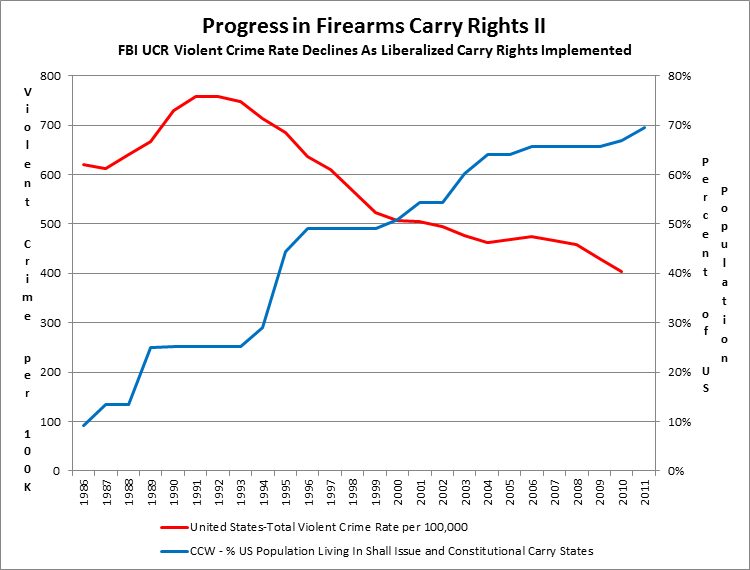
If Lee had taken the time to examine the graphic below, he would see that there is no positive correlation between less-restrictive (legal) carry (shall issue and constitutional issue) and increased violent crime. Let’s face it – Chicago already has concealed carry by thugs and criminals. The only ones prohibited from protecting themselves are honest, law-abiding citizens.

This was originally posted on Dec. 21, 2011.

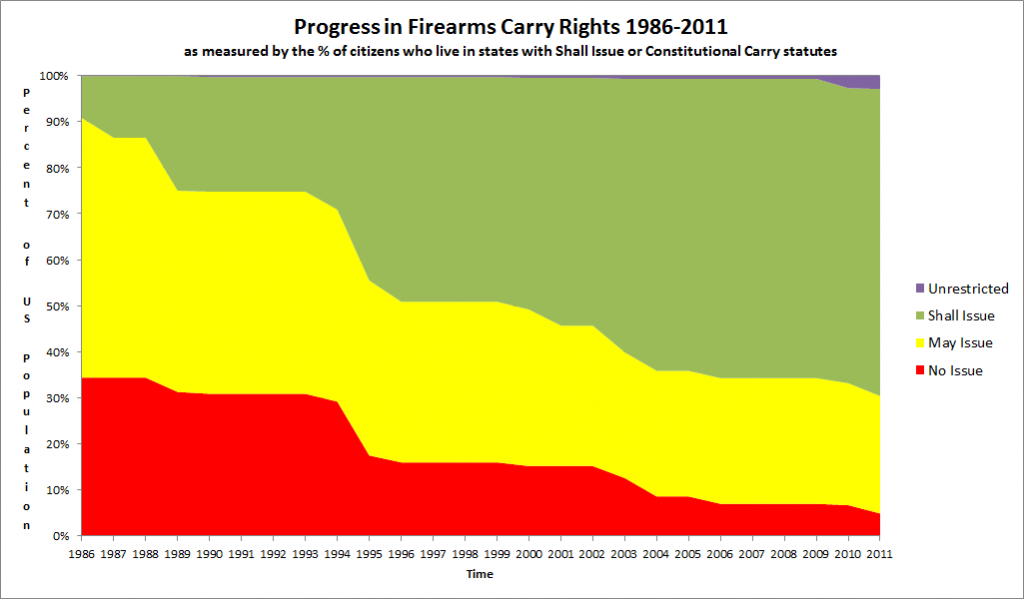
In October, I posted a graphic developed by Rob Vance that showed the progress in the growth of firearms carry rights from 1986 through 2011 as a percentage of the U.S. population. In 1986, 90% of the U.S. population lived in states that severely restricted carry rights or had none at all. Today, over two-thirds of Americans live in states with either shall-issue carry or constitutional carry. The conclusion was that shall-issue is the new norm.

Recently, the FBI released its Uniform Crime Reports statistics. Rob generated a new graph plotting these violent crime rates against the growth of less-restrictive firearm carry rights over the period of 1986 through 2011.

The data used to generate this graph is available here in Google documents. As I said in the original post, unlike the gun prohibitionists, we publish our data for the world to see. The data used comes from three sources: the FBI Uniform Crime Reports, the U.S. Census, and www.gun-nuttery.com/rtc.php which tracked the changes in carry laws over time.

Rob had the following conclusions after examining the data:

Violent crime is a complex issue, but national data is clear that there is no positive correlation between liberalized concealed carry laws and increased violent crime.

The “blood in the streets” or “Wild West” scenarios just don’t play out. To be fair, state level data is highly variable, so some caution needs to be exercised in drawing conclusions.

Rob is very explicit that there is no positive correlation between violent crime and liberalized carry laws rather than a proven negative correlation. He feels that it will take more rigorous statistical analysis before this negative correlation could be said to be proven.

The results here are reinforced by the study done by Linoge at Walls of the City which compared violent crime rates and firearm ownership. In that study, Linoge did find a relatively strong negative (-0.605) correlation between violent crime and firearm ownership.
 
While violent crime did not go down as sharply as the progress in carry rights rose, one thing that needs to be kept in mind is that while shall-issue may be the new norm that right is not extended to all locations. Bars, restaurants, government buildings, post offices, and many parks are still off-limits to concealed carry. I think this will become the next battleground for concealed carry. Interestingly enough, restrictive states like California actually have fewer restrictions on where one may carry.

As an example of the battle for fewer restricted locations, one need look no further than here in North Carolina. This session of the General Assembly changed the law concerning concealed carry in state, municipal, and county parks. It is now allowed everywhere with the exception of a local opt-out for “recreational facilities”. As might be expected, some locales are trying to push the limit on what is considered a recreation facility far beyond what was intended by the General Assembly.

Shall-issue may be the new norm but the fight will continue.

NOTE: If you click on the graphic, you can view it in its full original size.

Every Picture Tells A Story (Repost)

This was originally posted on October 6, 2011. In honor of the 7th Circuit’s ruling in Shepard v. Madigan and Moore v. Madigan, I thought it would be useful to repost it. Sometime in the next 180 days or less, the percentage of US citizens in the “red zone” will decrease. This assumes, of course, that the State of Illinois does not appeal this ruling. Now it is up to the citizens of Illinois and their elected representatives as to whether or not they move to the yellow zone or the green zone. Here’s hoping for the green zone.

I have some of the best readers in the world. One such reader is Rob Vance of California. He works in the software industry and must analyze data on a regular basis. The graphic below is as a result of his sitting down and examining U.S. Census data alongside a state’s policy on discrete or concealed carry of firearms.

The data used to generate this graphic is available here in Google Documents. Unlike the gun prohibitionists, we publish our data for the world to see. With regard to the data and methodology, Rob had this to say:

The graph maps the change in the legal status of concealed carry permits by state over time based on data found at www.gun-nuttery.com/rtc.php and the US Census Bureau (percentage of total US population by state). Classification of carry rights status was divided into four groups 1) Unrestricted 2) Shall issue 3) May issue and 4) No issue.

A couple of things about the graph and the supporting data. For population values, I used census data. 1980 -> 2010. The annual values (percent of total population by state) are rolled forward – e.g. 1980 census for years 1980- 1989, and so on. With respect to the rounding error the effect of total error is limited to a couple of tenths of a percent.

If you examine the spreadsheet with the data values you will see that a may-issue state like Hawaii is classified as a No-issue state. While you could argue that Hawaii should be listed as may-issue or conversely a state like New Jersey should also be added to the No-issue list, it doesn’t change the trends shown.

As to the conclusions that you can draw from this graph and the data, Rob had this to say:

1) In the early 1980s 90% of Americans lived in states that actively suppressed self-defense rights by severely limiting concealed carry of firearms by citizens.

2) By 2010, 2/3’s of Americans lived in states where law abiding citizens could conceal carry if they met minimal standards, and in some states (4 by 2011) needed NO state permission at all to concealed carry. A total of 41 states are now shall-issue or have unrestricted concealed carry status.

3) Few states moved from no issue to may issue. Rather when states made policy changes, they made the jump from no-issue to shall-issue all at once (again, with a couple of exceptions).

4) 30% of the citizens in the US STILL live under state governments that are hostile to the interests of their citizens in self-defense as measured by access to shall-issue (or unrestricted) concealed carry.

5) We’re down to the hard cases now – states where politicians are deeply invested in denying armed self-defense to otherwise law abiding citizens. California, Illinois and New York are where the population numbers are in terms of resistance to 2nd Amendment rights (and yes, there are a few others like New Jersey, Massachusetts, Hawaii, etc.).

If I may add a couple of other things, I’d say that shall-issue is the new norm in 2011 as opposed to no-issue or severely restricted may-issue back in 1986. The other thing I would add is that the experience with shall-issue concealed carry in the early adopting states like Florida paved the way for its adoption elsewhere. That is, people applying for concealed carry licenses are law-abiding citizens who have taken the responsibility seriously. Unlike what the Violence Policy Center would have you believe, the streets are not running with blood nor have they.

I would like to thank Rob for taking the time and making the effort to put his together. It is great research and his efforts are much appreciated.

CCW Is On The Ballot In Randolph County, Illinois

The voters in Randolph County, Illinois will see a ballot measure dealing with concealed carry in November. It is an advisory vote that will carry no legal weight but it certainly will carry a lot of symbolic weight.

The very last item on the ballot is an advisory question that asks: “Shall any individual who is not prohibited from possessing firearms under the law be allowed to conceal, possess, carry and or transport firearms in any manner free from infringement?


Randolph County resident Arlyn Fisk he says if it were legal, he might not carry a firearm on his hip all the time, but he’d like to have the right to do so.


“I believe it to be a second amendment right to any citizen of the United States, provided they’re upstanding and law abiding,” said Fisk. “But we’re in the only state in the union that doesn’t allow concealed carry.”


That’s why Fisk and others passed petitions around town to get this on the ballot and put the issue to Randolph County voters.


“I think this is going to pass overwhelmingly, but we’ll see,” said Randolph County Board chairman Terry Luehr. Luehr says if the advisory question does pass it won’t mean Randolph county residents can start carrying concealed firearms.


“We can’t pass any laws on the county that supersedes the state,” said Luehr. “So even if this passes on the county ballot, it doesn’t really mean anything.”

As Mr. Fisk notes that even if the vote is advisory, it will put politicians on notice especially if it gets the expected high level of support.

Randolph County is located south-east of St. Louis and is the only Illinois county that has parts of its territory on the western side of the Mississippi River. It is also home to the World Shooting and Recreational Complex in Sparta.

KFVS12 News

Important Update On CCW At GRPC In Orlando – It’s Legal In The Hotel

Thanks to the industrious work of Miko Tempski, Board Member of the CCRKBA, we have the definitive answer on whether the Hyatt Regency Orlando Airport is considered a part of the airport for concealed carry purposes.

It is not!

Miko receved the following from the Orlando Police Department’s airport division a few minutes ago:

 From: John O’Grady
Subject: Fwd: Airport Firearms Carry and attached hotel
To: miko.temski

Mr. Tempski, I am in receipt of the below email request. In short you are correct in y
our interpretation of the FSS. The Hyatt Hotel is it’s own property so legally carrying a weapon is OK. Carrying a firearm in the terminal is prohibited. If you have any other questions or concerns please contact me directly.

Regards, John O’Grady Orlando Police Department Division Commander Orlando International Airport

Thus while you can’t legally carry within the airport terminal, you can carry in the hotel itself. I just confirmed with the hotel that it can be accessed without entering the terminal.

Thanks again to Miko for getting a definitive answer from law enforcement. I should know not to trust public affairs and marketing!

UPDATE: Thanks to Markofafreeman in the comments below we have some directions on how to enter the hotel if you are driving without entering the terminal: If you drive, go up to the 4th floor parking, following the signs for
the Hyatt. As advertised, the entrance is right there and you don’t need
to enter via the terminal.

Carrying Concealed At The Gun Rights Policy Conference

A comment to a post by Miguel at GunFreeZone.net started me looking into Florida’s concealed carry laws and prohibited locations. The Gun Rights Policy Conference will be held at the Hyatt Regency Orlando Airport which is located in the main terminal of the Orlando Airport. I confirmed with the Hyatt that they are actually considered part of the airport terminal (or so the Front Desk said).

According to Florida Statue Section 790.06 (12)a, you are prohibited from carrying in the following locations:

(12)(a) A license issued under this section does not authorize any person to openly carry a handgun or carry a concealed weapon or firearm into:

1. Any place of nuisance as defined in s. 823.05;
2. Any police, sheriff, or highway patrol station;
3. Any detention facility, prison, or jail;
4. Any courthouse;
5. Any courtroom, except that nothing in this section would preclude a judge from carrying a concealed weapon or determining who will carry a concealed weapon in his or her courtroom;
6. Any polling place;
7. Any meeting of the governing body of a county, public school district, municipality, or special district;
8. Any meeting of the Legislature or a committee thereof;
9. Any school, college, or professional athletic event not related to firearms;
10. Any elementary or secondary school facility or administration building;
11. Any career center;
12. Any portion of an establishment licensed to dispense alcoholic beverages for consumption on the premises, which portion of the establishment is primarily devoted to such purpose;
13. Any college or university facility unless the licensee is a registered student, employee, or faculty member of such college or university and the weapon is a stun gun or nonlethal electric weapon or device designed solely for defensive purposes and the weapon does not fire a dart or projectile;
14. The inside of the passenger terminal and sterile area of any airport, provided that no person shall be prohibited from carrying any legal firearm into the terminal, which firearm is encased for shipment for purposes of checking such firearm as baggage to be lawfully transported on any aircraft; or
15. Any place where the carrying of firearms is prohibited by federal law.

If the Hyatt Regency is legally part of the terminal at the Orlando Airport, carrying concealed even with the proper license/permit is forbidden. People traveling to the conference who would normally be carrying should be aware of this. I knew you couldn’t carry in the bar portion of restaurants but I didn’t know about the airport portion of the law.

If you have any different information as to the status of the Hyatt Regency Orlando Airport, please share it in the comments below.

UPDATE: I just spoke with Vera of the Public Affairs Department of the Orlando International Airport regarding this issue. I asked specifically whether the Hyatt Regency was considered part of the main terminal for the purposes of concealed carry. She replied, “It is in the airport.” Unless we hear differently from the Orlando Police Department, I would operate under the presumption that concealed carry is not allowed at the Hyatt Regency.  See my separate update – the Orlando PD, airport division says the hotel is a private holding and is NOT part of the airport for CCW purposes.

The Kids Are Alright

With apologies to Who fans, there is another set of kids that are alright.

The Scribe is the student-run newspaper at the University of Colorado at Colorado Springs. Their editorial board published an unsigned editorial yesterday saying that the university went too far with their new regulations concerning concealed carry on campus.

Recently, the University of Colorado Boulder and University of Colorado Colorado Springs amended their student housing contracts and issued new rules for athletic and cultural events, banning weapons in freshman dorms and at ticketed events.

Though meant to promote safety on campus, the new rules are likely at odds with state law, are inconsistent with the university’s overall policy allowing concealed weapons on campus and create a dangerous situation for students.

These students get it!

The editors call the policy of banning firearms in freshman dorms a policy in search of a problem. They note that most freshmen are under 21 and would not qualify for a concealed carry permit in Colorado. Moreover, the policy only impacts residents and not visitors who can still carry concealed under university policy and state law.

They think that the university rules governing freshman dorms and ticket events should be consistent with the rules governing concealed carry in all the other areas of campus.

They conclude:

It is similarly unjustified for the university to attempt to limit where on campus a student or faculty member may carry a concealed weapon. Trying to regulate firearms under housing contracts is equally fallacious.

For crowded events, the solution is simple: Only prohibit firearms if trained, armed officers are present and if electronic screeners make sure everyone entering is weaponless. Otherwise, the university has no grounds for stripping individuals of their constitutional rights.

While opponents of concealed carry may argue against the merits of allowing weapons in public areas, it is disingenuous to try and regulate the law’s applicability based on factors that the court did not consider.

These student journalists have a better grasp of reality than most of the so-called professionals in the mainstream media. With students like this, there is some hope for the media.