Kachalsky Has Cert Denied By SCOTUS

In the list of orders issued today by the US Supreme Court was an order of certiorari denied for Kachalsky et al v. Cacace et al. This was the case from New York which challenged the Sullivan Law and its restrictions on carry.

As an article in Reuters notes, just because the Supreme Court didn’t grant cert to Kachalsky, doesn’t mean they won’t do it in another carry case. The twin Madigan cases from Illinois still could be appealed from the 7th Circuit as could Woollard from the 4th Circuit. As Sebastian notes, there could be a number of reasons the Court didn’t want to take up this case. One of his commenters notes that Adam Winkler speculated the Court didn’t want to take up the issue while the gun issue is in the news and before Congress.
It could be. 
Still I’m a little disappointed that the Supreme Court didn’t take up the issue now regardless of why they didn’t. It would have been interesting to have been a fly on the wall while the Justices were debating whether to take the case.

Support For Kachalsky Petition From States


Attorney Generals from 20 states have filed an amicus brief in support of the Second Amendment Foundation’s petition for a Writ of Certiorari before the US Supreme Court. This brief is in addition to supporting briefs from the NRA, the Cato Institute, and others.

BELLEVUE, WA – Twenty state attorneys general have filed an amicus brief to the U.S. Supreme Court in support of the Second Amendment Foundation’s petition for a Writ of Certiorari in a case challenging New York’s gun permitting statute, along with several other interested parties that have filed their own briefs.

The case is known as Kachalsky v. Cacace and was argued before the Second Circuit Court of Appeals. SAF is represented by attorney Alan Gura, who won both the Heller and McDonald Second Amendment cases before the Supreme Court.

“We are delighted at the support being shown by attorneys general in Alaska, Alabama, Florida, Oklahoma, Nebraska, New Mexico and 13 other states, and particularly for the leadership of Virginia Attorney General Kenneth Cuccinelli in bringing them all together,” said SAF founder and Executive Vice President Alan Gottlieb. “This case is all about an individual’s right to carry a firearm outside the home for personal protection, and it is gratifying to see so much support.”

In addition to the brief filed by the attorneys general, supporting amicus briefs have also been filed by the Center for Constitutional Jurisprudence represented by former Attorney General Edwin Meese III, the National Rifle Association represented by former Solicitor General Paul D. Clement, plus the American Civil Rights Union, Academics for the Second Amendment, Cato Institute, the Second Amendment Preservation Association, New Jersey Second Amendment Society and Commonwealth Second Amendment, Inc.

“This is an important case,” Gottlieb said, “and that’s why so many parties are interested and supportive of our issue.”

SAF and the five individual plaintiffs are challenging whether the state can arbitrarily restrict the Second Amendment right to bear arms outside the home by requiring people to prove a special need to the satisfaction of a government official.

“Our case is about equal protection and the arbitrary authority of government officials to essentially decide on a whim whether average citizens can have the means of self-defense outside the confines of their home,” Gottlieb said. “Most crimes happen away from the home, and it is in public places and on public streets where a citizen is most likely to encounter a life-threatening situation where he or she might have to defend themselves.”

UPDATE: Dave Hardy of the Of Arms and the Law blog has links to all the pro-Kachalsky amicus briefs. You can find them here.

I Just Shake My Head

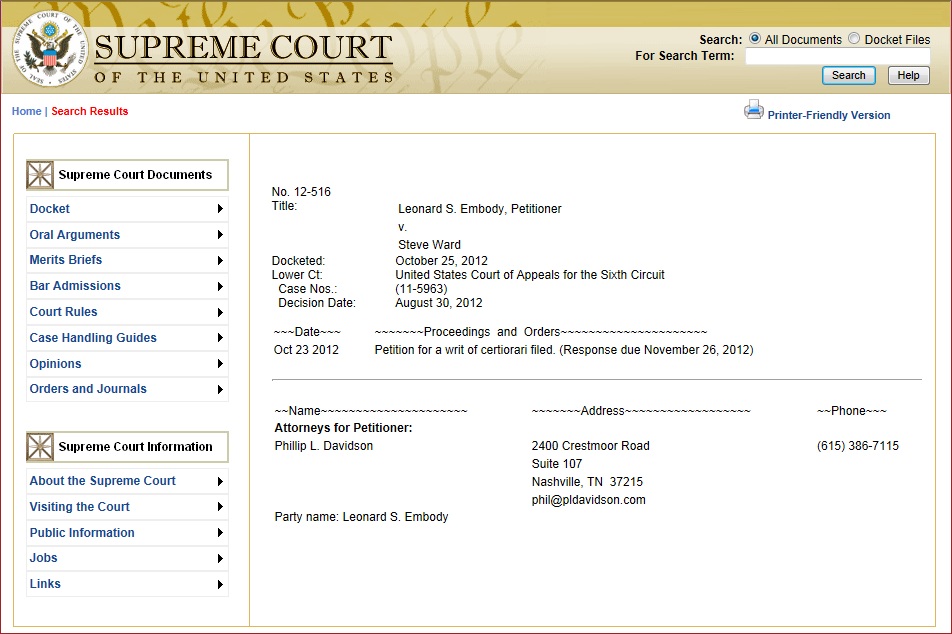
Yesterday I received an email from Leonard Embody with a link to the picture below.

Obviously, he wasn’t happy with how the US District Court for the Middle District of Tennessee and the 6th Circuit Court of Appeals treated his original complaint (they both dismissed it) and now is seeking a writ of certiorari from the US Supreme Court. His petition can be found here.

I am sure Mr. Embody believes he is right and believes his cause is noble. However, as the longshoreman-philosopher Eric Hoffer noted in his book The True Believer, nothing is as dangerous as the true believer. The danger here is to our Second Amendment rights for this is a case that the gun prohibitionists would love to use in their efforts to stamp out carry outside the home.

Fortunately, the Supreme Court receives many cases and accepts few. The odds that this is the carry case accepted by the Supreme Court are infinitesimally small for which we all should be grateful.

UPDATE: Dave Hardy at Of Arms and the Law provides his take on Embody’s quest. Make sure to read the comments as well. As Dave notes:

It was lucky — actually, luck had little to do with it, it appears to
have been SAF’s strategy as amicus — that the Second Amendment didn’t
take any damage.

CCRKBA Says Justice Steven’s Comments Illustrate Importance Of This Election

Retired Supreme Court Justice John Paul Stevens was the speaker at a luncheon sponsored by the Brady Campaign on Monday. In his speech, he said he was astounded that Congress hadn’t taken steps to address “gun violence” (sic).

In reaction and to illustrate the importance of this election for both the Second Amendment and the future direction of the Supreme Court, Alan Gottlieb of the Citizens Committee for the Right to Keep and Bear Arms released this statement:

BELLEVUE, WA – Monday’s high-profile prodding by retired Supreme
Court Justice John Paul Stevens for Congress to do something, and for
presidential candidates to say something, about gun control proves the
importance of who is in the White House and the U.S. Senate to make and
confirm high court nominations, the Citizens Committee for the Right to
Keep and Bear Arms said today.

Reuters reported that the retired justice was the speaker at Monday’s
luncheon hosted by the anti-gun Brady Campaign to Prevent Gun Violence.
Stevens wrote dissenting opinions on both the 2008 Heller ruling and
the 2010 McDonald decision, both of which affirmed that the Second
Amendment protects an individual civil right to keep and bear arms.

“In both of his dissents,” noted CCRKBA Chairman Alan Gottlieb,
“Justice Stevens contended that the right to keep and bear arms was
limited to state militia service. It was, and remains, an astonishing
position on a fundamental civil right.

“What Justice Stevens’ speech clearly underscores,” he continued, “is
the critical importance of who is president, not just for the next four
years, but whenever a vacancy occurs on the high court. Imagine if
Justice Stevens’ opinion had prevailed.”

Stevens’ dissent in the Heller case was heavily criticized by the
majority opinion, written by Justice Antonin Scalia. The majority ruling
described Stevens’ arguments as “simply wrong,” and at one point – when
addressing Stevens’ history of the Second Amendment – said that he
“flatly misreads the historical record.”

“Stevens’ replacement on the Supreme Court was liberal Elena Kagan,”
Gottlieb noted. “A liberal, anti-gun majority could easily narrow,
rather than expand, the scope of our Second Amendment. That’s why it is,
and always will be, important for gun owners to have a pro-gun-rights
president and pro-gun majority in the Senate, especially on the
Judiciary Committee.”

To see more on Steven’s speech, Sebastian at Shall Not Be Questioned has video of the event.

Supreme Court Says No To Sean Masciandaro’s Appeal

In their orders released today, the Supreme Court denied Sean Masciandaro’s writ of certiorari without any comment. He had appealed to the Supreme Court from the 4th Circuit Court of Appeals which had punted the case.

Mr. Masciandaro was originally convicted of possessing a firearm on National Park Service property when he had stopped to take a nap before continuing his drive home. At the time of his arrest this was illegal but the law changed before he went to trial. Nonetheless, under existing precedent, this was valid even though it was no longer illegal.

As the Christian Science Monitor noted about this denial of certiorari:

Lawyers for a Virginia man had asked the justices to examine a question left largely unresolved in the high court’s two prior landmark rulings identifying the scope and substance of Second Amendment protections. The question is: Does the Second Amendment guarantee a right to bear arms in public for personal protection?

The court dismissed the case in a one-line order without comment. The action leaves lower court rulings intact and postpones the prospect of high court clarification on a key gun rights issue.

On one hand, I am sorry that the Supreme Court did not take this opportunity to clarify their rulings in Heller and McDonald. On the other hand, this opens the door for the Supreme Court to consider some of the cleaner cases working their way through the lowers courts.

By cleaner I mean ones that do not involve a criminal conviction but rather deal with the denial of permits or state laws that deal with carry. Some of these better cases include Woollard v. Sheridan in Maryland, Bateman v. Perdue in North Carolina, and  Kachalsky v. Cacace in New York. These three, I should note, are all Second Amendment Foundation cases with Alan Gura as the lead attorney.

For Once, Michelle Obama Is Correct

In a speech to campaign donors this weekend, First Lady Michelle Obama said something with which all of us in the pro-gun rights movement can agree. She said the Supreme Court is at stake in 2012.

Michelle Obama spoke on Friday night at the Providence, R.I., home of Joseph Paolino Jr., a former mayor of the city. About 220 people were scheduled to attend, and the event was expected to raise more than $300,000 for the president’s re-election campaign.

Obama told those in attendance that “we stand at a fundamental crossroads for our country. You’re here because you know that in just 13 months, we’re going to make a choice that will impact our lives for decades to come.” After addressing issues like health care and the economy, she invoked the appointments of Justices Elena Kagan and Sonia Sotomayor.

Sandy Froman, former President of the National Rifle Association, made similar comments about what is at stake in the 2012 election at the Gun Rights Policy Conference in Chicago. However, she said it would be our gun rights and that we should “pray for the five.”

Just as important will be the Presidential appointments at the District and Appeals Court levels.  Using the example of President Bill Clinton, Ms. Froman said that a 2-term President will get to appoint almost 50% of the Federal judiciary. Can you imagine how many anti-gun judges Obama could appoint in a second term?

Supreme Court Opens October Term

The U.S. Supreme Court opened its October Term today. While it will have contentious cases dealing with ObamaCare, gay marriage, and Arizona’s immigration on the docket, only one – at best – Second Amendment case might be heard this year.

In their Orders released this morning, the Supreme Court denied certiorari for Williams v. Maryland. This was the case appealed from the Maryland Court of Appeals involving Charles Williams who had legally purchased a pistol in that state and who was arrested while transporting the pistol from his girlfriend’s home to his own. He was sentenced to a year in prison for unlawful transportation of a firearm without a permit.

The Maryland Court of Appeals opinion said, in essence, that there was no right to the Second Amendment outside the home. The decision included gems such as this:

it is clear that prohibition of firearms in the home was the gravamen of the certiorari questions in both Heller and McDonald and their answers. If the Supreme Court, in this dicta, meant its holding to extend beyond home possession, it will need to say so more plainly.

And this:

We shall hold that Section 4-203(a)(1)(i) of the Criminal Law Article, which prohibits wearing, carrying, or transporting a handgun, without a permit and outside of one’s home, is outside of the scope of the Second Amendment.

With Williams gone, this leave Masciandaro v. United States still open. It was docketed in June of this year on appeal from the 4th Circuit Court of Appeals. The Solicitor General’s Office was granted an extension of time to file a response to Sean Masciandaro’s petition until October 11th.

The Masciandaro case involves the arrest of Sean Masciandaro for possession of a firearm on National Park Service property. He had been driving home, felt himself falling asleep at the wheel, and pulled over to catch a little rest. Unfortunately, it was on Park Service property and he was arrested by U.S. Park Police after being informed of it by Mr. Masciandaro himself. Congressional action changed the law after his arrest but before his trial.

The Second Amendment Foundation has filed an amicus brief in this case authored by Alan Gura.

We will have to wait to see whether the Supreme Court grants certiorari in this case or not. In the meantime, the Wall Street Journal has a good video summation of what to expect in this term.

WaPo Notices Second Amendment Cases

Robert Barnes, writing in the Washington Post, recognizes that there are a number of Second Amendment cases working their way through the lower courts including two that have been appealed to the Supreme Court. Unfortunately he buys the Brady Campaign’s argument that Second Amendment cases have been continually losing in the lower courts since the Heller and McDonald decisions.

A funny thing has happened in the three years since gun-rights activists won their biggest victory at the Supreme Court.

They’ve been on a losing streak in the lower courts.

Barnes makes reference to the so-called report put out by the Brady Center in July titled “Hollow Victory?” In it, the Brady Center argues that the lower courts have held that “the Second Amendment does not interfere with the people’s right to enact legislation protecting families and communities from gun violence.”

Both Barnes and the Brady Center ignore the 7th Circuit’s decision in Ezell v. City of Chicago which was an unequivocal win for the Second Amendment and which may be the tool needed to get some sort of carry law passed in Illinois.

That said, the article does do a decent job of exploring two cases that might be granted certiorari by the Supreme Court. The cases are a Maryland case challenging a conviction for carrying or transporting with a permit and a Virginia case involving possession of a firearm in a National Park.

The Maryland case – Williams v. Maryland – is brought by Charles Williams who is contesting his 2008 conviction for violating Maryland’s law against wearing, carrying, or transporting a firearm in public without a permit. He was traveling from his girlfriend’s house to his own with a legally purchased gun. However, he does acknowledge that he hadn’t applied for a permit. He is being represented by attorney Stephen Halbrook who contends that the Maryland law is so restrictive that “ordinary people” can’t get the permit. This, he says, clearly violates the Supreme Court’s decisions in Heller and McDonald. This case comes on appeal from the Maryland Court of Appeals which is that state’s highest court.

Meanwhile, in Virginia, Sean Masciandaro was convicted and fined for having a loaded firearm in the trunk of his car on National Park Service property. While this has not been a crime since 2010, it was still prohibited when Mr. Masciandaro pulled off the George Washington Parkway to take a nap rather than fall asleep at the wheel of his car. Unfortunately, the GW Parkway runs through Theodore Roosevelt Island N.P. Moreover, when woken from his nap by park police because he was illegally parked, he answered honestly when asked if he had any more weapons than a knife that was in open view.

Masciandaro appealed his conviction to the 4th Circuit Court of Appeals where it was upheld. He is now appealing to the Supreme Court. According to Supreme Court case filings, he filed an in forma pauperis petition and has been assigned a Federal Public Defender in the case. The Second Amendment Foundation has filed an amicus brief supporting Mr. Masciandaro that was written by Alan Gura.

The article concludes with a brief discussion of the conflicting views about the right to carry for self-defense outside the home.

While the Brady Center trumpets Scalia’s finding that there is no right to “carry any weapon whatsoever in any manner whatsoever and for whatever purpose,” the Second Amendment Foundation takes that as confirmation that “there is a right to carry at least some weapons, in some manner, for some purpose.”

The latter argument is in a brief supporting Masciandaro’s appeal written by Alan Gura, who argued the Heller case. He said the case provides a perfect chance to “clarify” for recalcitrant lower courts that the Second Amendment “applies beyond the threshold of one’s home.”

But if neither Williams nor Masciandaro strikes the court as the right opportunity for the next round of Second Amendment jurisprudence, Gura assures that there are more cases on the way.

Mr. Gura along with the Second Amendment Foundation has done a good job in making sure that many more (good) cases are on the way! And to be fair, the NRA has done its part as well.

– Posted using BlogPress from my iPad

Chicago Loses, McDonald (and America) Wins

In a 5-4 decision, the Supreme Court held for Otis McDonald and his fellow plaintiffs. They reversed and remanded the case back to the 7th Circuit Court of Appeals.

As SayUncle noted, “Chicago, Welcome to America”.

I’ll have more later with a complete roundup of comments from around the blogosphere.

This makes Alan Gura two and oh in the Supreme Court.