NSSF Sues Sunnyvale, California Over New Gun Ordinance

The National Shooting Sports Foundation, US Firearms Company LLC, and Eric Fisher filed a lawsuit Monday in Santa Clara County (California) Superior Court seeking to enjoin the enforcement of a new gun ordinance. The ordinance requires sellers of ammunition to keep logs of purchasers, bans magazines that hold more than 10 rounds of ammunition, and requires the reporting of a firearms theft to the police within 48 hours. The ordinance was passed in a special city election with great support from Mayor Bloomberg’s Illegal Mayors.

The lawsuit contends that the ordinance violates both state and Federal laws as well as being preempted by California state law dealing with firearms. The plaintiffs are seeking a temporary restraining order, a preliminary and permanent injunction, and a writ of mandate prohibiting its implementation as well as requiring notice to the police that the law is invalid.

The NSSF’s release on the lawsuit is below:

NEWTOWN, Conn. — the National Shooting Sports Foundation (NSSF), the trade association for the firearms industry, has filed a lawsuit against the City of Sunnyvale, Calif. and the Sunnyvale City Council to prevent an ordinance passed in November from being enforced that is detrimental to responsible and law-abiding firearms retailers doing business within city limits.

In the complaint, NSSF and U.S. Firearms Company LLC, a local retailer, are challenging portions of the city’s newly enacted gun-control ordinance that violates and is preempted by state and federal law and that imposes an onerous regulatory burden on firearms retailers including requirements that they keep ammunition sales logs and personal information on their customers and that expands and duplicates an existing reporting requirement for lost or stolen guns.

“Retailers in Sunnyvale must be federally licensed and already comply with a myriad of state and federal laws in operating their businesses. These businesses should be entitled to operate under the same rules, not a patchwork of different and conflicting local laws across California,” said Lawrence G. Keane, NSSF senior vice president and general counsel. “It is unjust to ask retailers within the Sunnyvale city limits to collect sensitive personal information from customers who easily can drive a few miles to a store in another city where such information is not required. Surely, no demonstrable public safety benefit is achieved and only law-abiding businesses are penalized.”

The lawsuit seeks to enjoin enforcement of the Sunnyvale ordinance.

The San Jose Mercury News reports that the NRA will be filing a similar lawsuit in Federal district court.

The NRA had threatened to sue even before Measure C was approved, and the group’s West Coast counsel, Chuck Michel, intends to file that federal lawsuit Monday, a spokesman for Michel said Tuesday. Michel last month filed an NRA-supported suit against San Francisco over a similar ban on high capacity magazines.

But Sunnyvale taxpayers won’t foot the bill because of the offer of (San Francisco law firm) Farella Braun + Martel to defend the city against the gun-related lawsuits for free.

Farella Braun + Martel has 137 attorneys and is headquartered in San Francisco with a satellite office in Napa Valley. The Legal Center to Prevent Gun Violence (sic), formerly the Legal Center Against Violence, gave them their “Outstanding Pro Bono Contribution” award in 2009 and 2010.

NSSF’s Lawsuit Against Connecticut’s SB 1160 Dismissed

Chief District Court Judge Janet Hall dismissed the National Shooting Sports Foundation’s lawsuit which sought an injunction against Connecticut’s new gun control law on Monday. Hall, a Clinton appointee, dismissed the case under Rule 12(b)(1) of the Federal Rules of Procedure which states that a plaintiff must have standing to bring a case. She agreed with the State of Connecticut’s claim that the NSSF did not have standing to challenge SB 1160.

The case which was brought in July of this year sought to have Connecticut’s draconian gun control law – SB 1160 – invalidated because the state did not follow its own legislative rules when it claimed an “emergency certification” exemption. Normally a bill in Connecticut must be available to be read by state legislators for two legislative days before it can be voted upon. An exemption can be granted in emergency situations if the Speaker of the House and the Senate President Pro Tem certify in writing the necessity for the emergency exemption along with the supporting facts. In this case while they did certify the emergency they failed to state any facts to support their certification. (See items 18 through 33 in the plaintiff’s complaint.)

Judge Hall states that the NSSF would have standing to challenge the gun control law’s impact on its members but not to challenge the defects in the legislative process that led to the bill being passed. She found that the NSSF’s complaint was a “generally available grievance against government” which other courts have found not to confer standing.

Here,
the
claimed
pecuniary injury
make
s
NSSF a
proper party to
challenge gun control legislation. That injury, however,
does
not make
NSSF

or any
other
member of the public
aggrieved
only incidentally
by
procedurally defective
legislation

into a proper party to challenge
the
defects
in legislative process.

Judge Hall goes on to say:

Because
the pecuniary injury asserted as the basis for NSSF‟s standing is
unrelated to
the rights of democratic participation in the legislative process that NSSF
seeks to vindicate, the court lacks the authority to adjudicate the
claims put forward in
this
case
. Accordingly,
the case must be dismissed
for lack of standing.

She concludes by granting the state’s motion to dismiss and by stating that based upon the NSSF’s written and oral pleadings that they “would be unable to replead to satisfy the standing requirement.”

The NSSF is reportedly studying the decision and weighing its options.

Gun Sales Are Seeking A New Normal

The National Shooting Sports Foundation has released its adjusted-NICS figures for the month of November 2013.  It shows a drop of 14.2% from November 2012. 

The November 2013 NSSF-adjusted National Instant Criminal Background Check System (NICS) figure of 1,308,100 is a decrease of 14.2 percent compared to the NSSF-adjusted NICS figure of 1,525,177 in November 2012. For comparison, the unadjusted November 2013 NICS figure of 1,805,759 reflects a 9.6 percent decrease from the unadjusted NICS figure of 1,997,703 in November 2012. NSSF-adjusted NICS for November 2013 is the second highest on record — an 18.8% increase over November 2011.

In many ways this really shouldn’t be surprising. While the peak in November 2012 was pre-Newtown, it reflects the uncertainty for gun owners of another presidential term for Barack Obama. If you look in the chart below of the adjusted NICS checks for the month of November going back to year 2000, you see definite spikes in 2008 and 2012.

 As I wrote last month, gun sales as reflected in the adjusted-NICS checks are trending towards a new normal. They are coming off their post-Newtown peaks but are still at a much higher overall level than they were pre-Newtown. Firearms manufacturers are still trying to catch up with the demand and are working through their backlog of orders. Tom Taylor of Mossberg confirmed this last Sunday on Tom Gresham’s Gun Talk in the first hour of the show.

NICS checks are an indicator of trends in gun sales but are not perfectly correlated with them. This is because many states use the NICS database for initial and continuing checks on their concealed carry permit holders. Moreover, in many states such as North Carolina, a concealed handgun permit substitutes for a NICS check.

Trigger Finger Discipline

The National Shooting Sports Foundation has released another of their training tips videos. This one is with Adam Painchaud of the Sig Sauer Academy. In this video, Adam demonstrates a training technique for working on your trigger finger discipline so that you will press and not jerk the trigger.

He is using a single action pistol but it would work with any pistol that doesn’t have a magazine disconnect. Adam starts by loading a round in the chamber and then removing the magazine. He then takes an aimed shot and then lets the trigger reset. The shooter follows this up with a dry fire aimed shot. If your front sight wobbles on the dry fire shot, you have found your accuracy problem.

Fat Chance Of This Happening

According to the National Shooting Sports Foundation’s Bullet Points for November 18th, a coalition of groups has requested that Attorney General Eric Holder apply the “‘sporting purposes’ exemption to the definition of armor piercing ammunition set forth in the Gun Control Act of 1968 (GCA).”

The letter accuses ATF of sitting on petitions from ammunition manufacturers for exemptions for ammo made from materials such as brass and copper. While these materials fail the composition test set forth by the Gun Control Act of 1968, the law does provide an exemption for products clearly intended for sporting purposes. Long range target shooting and hunting would both clearly be sporting purposes.

The letter from these groups (seen below) makes a good case for why such ammo should be granted an exemption. That said, I don’t think there is a chance in hell of Eric Holder pushing ATF to act on these petitions. Not only is Holder anti-gun, he tries to portray himself as pro-cop which would cause him to rule out any ammo that could be considered “armor piercing”. It is a sham but it is what it is.

October NICS Show Slight Decline

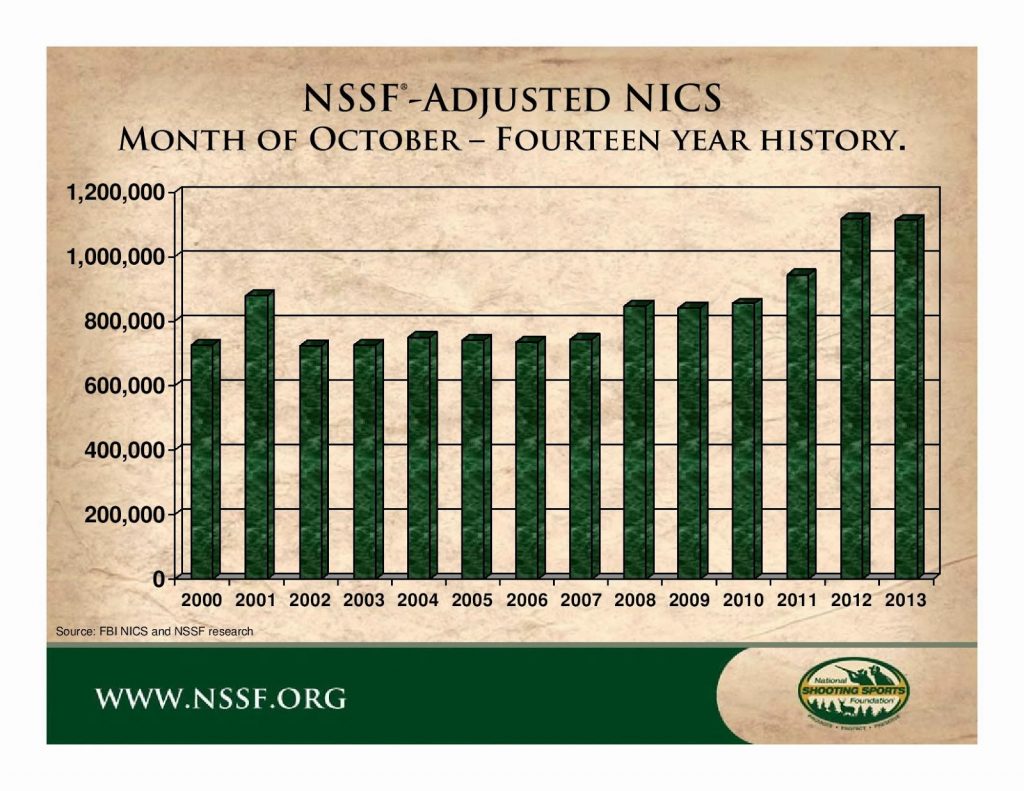
The October 2013 NSSF-adjusted NICS checks are in and they show a slight decline from the same month in 2012. Nonetheless, if you look at the chart of NSSF-adjusted NICS checks for the last 14 years, both 2012 and 2013 are substantially higher than prior years.

From the NSSF:

The October 2013 NSSF-adjusted National Instant Criminal Background Check System (NICS) figure of 1,113,818 is a decrease of 0.5 percent compared to the NSSF-adjusted NICS figure of 1,118,994 in October 2012. For comparison, the unadjusted October 2013 NICS figure of 1,679,099 reflects a 4.6 percent increase from the unadjusted NICS figure of 1,604,743 in October 2012.

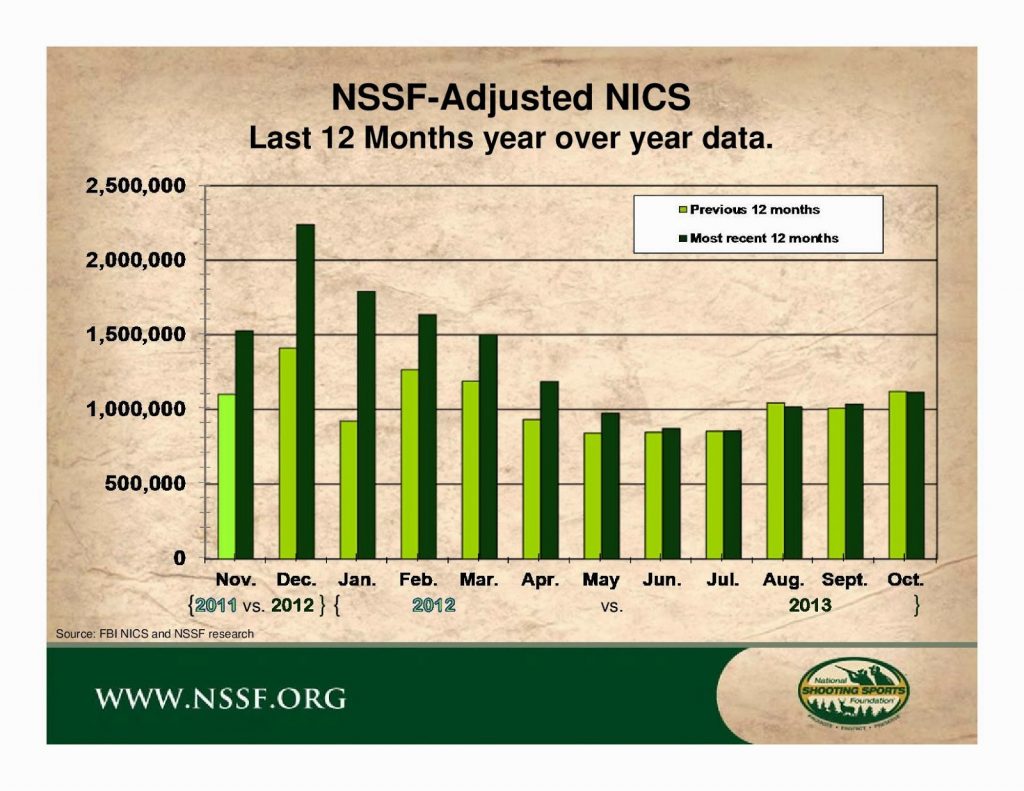
The next chart is quite interesting. It shows the last 12 months of year over year data. You can see the spike in December 2012 and January 2013 presumably caused the shooting in Newtown and the attendant rise in the call for more gun control. After that, it follows the more normal curve of trending down towards summer and then starting to show a rise as the hunting season arrives.


 As the distance from the tragedy in Newtown has grown, the year over year gains have diminished until in August and October they actually show decreases. I think that we are at a new normal with some months being higher and some months being less.That said, the slight increases and decreases will be at a much higher base than pre-2012.

While the NSSF-adjusted NICS checks are not a perfect correlation for gun sales, they are a good indicator of them. For the firearms industry the great growth spurts may be over and their backlogs decreasing but they are still producing at a level that is significantly higher than in the past.

Back From Hiatus

The NSSF-adjusted NICS checks rebounded from their August doldrums to again post a 2.7% gain for this September over previous September.

The September 2013 NSSF-adjusted National Instant Criminal Background Check System (NICS) figure of 1,034,701 is an increase of 2.7 percent compared to the NSSF-adjusted NICS figure of 1,007,259 in September 2012. For comparison, the unadjusted September 2013 NICS figure of 1,392,423 reflects a 4.0 percent decrease from the unadjusted NICS figure of 1,450,737 in September 2012.

 The beginning of the fall hunting season may have provided some of the stimulus for this growth as may the recent clamor for gun control after the recent Navy Yard shootings.

NICS checks are an indicator but not a direct correlation with firearms sales. Many states use the NICS checks for concealed carry background check purposes. Moreover, in many states such as North Carolina, the concealed carry permit itself substitutes for the NICS check.

About Those ATF e-Forms? Fuhgeddaboudit

According to a release sent out by the National Shooting Sports Foundation late yesterday afternoon, the BATFE’s e-Forms system will be down for the duration of the “shutdown”. More on that below:

NSSF has learned that the ATF e-Forms system is going offline and will be unavailable due to the ongoing federal shutdown. This service will remain offline during the duration of the shutdown.

As we reported Monday:

  • The FBI’s NICS Section is maintaining normal business hours.

  • The ATF Office of Enforcement Programs and Services (EPS), which includes the imports, firearms technology, NFA branches, the licensing center and firearms industry programs branch now processing marking variances, is effectively shut down, operating with minimal staff.

  • The State Department’s Directorate of Defense Trade Controls (DDTC) is accepting licenses, but only acting on them in genuine emergency situations.

  • The Commerce Department Bureau of Industry and Security (BIS) is no longer accepting export license applications, classification requests (CCATS), encryption reviews, encryption registrations or advisory opinion requests. Similarly, BIS will not be issuing any final determinations. All pending export license applications, commodity classification requests, encryption reviews, encryption registrations and advisory opinion requests will be held without action by BIS until the shutdown ends.

NSSF will continue to update the industry as additional details on the government shutdown become available

Bullet Trace

In the latest training tips video from the National Shooting Sports Foundation, NSSF’s Dave Miles discusses long range shooting with Rod Ryan of Storm Mountain Training. In particular, they discuss trace or the wake of a bullet as it pushes through the air. If you watch the video below carefully, you can see the actual trace or path of the bullet. Having a spotter watch the trace will allow you to make the necessary corrections for long range shooting.

That Reminds Me

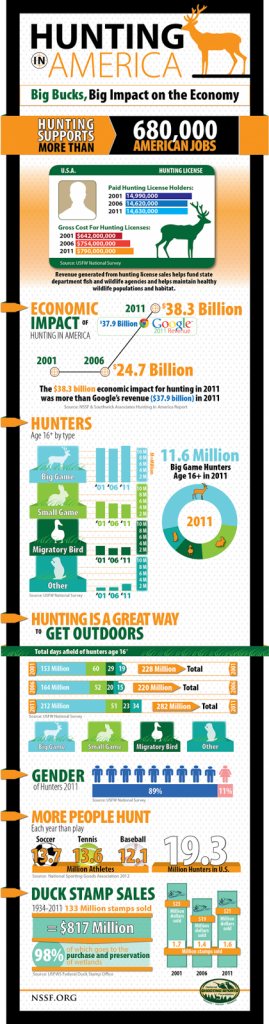
I haven’t bought my NC Sportsmans License yet this year. Even if I don’t get out hunting I do try to buy one to help support the NC Wildlife Resources Commission. In North Carolina, the Sportsmans License cover you for everything from fishing to big game hunting. The only thing it doesn’t cover is the Federal Duck Stamp and fishing in coastal waters.

The National Shooting Sports Foundation just published a new infographic that presents the economic impact of hunters and hunting. The estimated impact of hunting in America is greater than the revenue generated by Google – $38.3 billion versus $37.9 billion.