
 by
by One of the perennial seminars offered at the Safari Club International Convention is on how to travel safely and legally with firearms. As with past years, this seminar was offered as a panel discussion.
The panelists were:
- Bob Keagy – SCI Travel with Firearms Subcommittee Chair
- Barbara Crown – SCI Hunter Information Service Liaison
- Craig Boddington – author and well-known hunter
- Jacky Keith – Esplanade Travel
- Anne Gaines-Burrill – Hunter’s Support and Travel
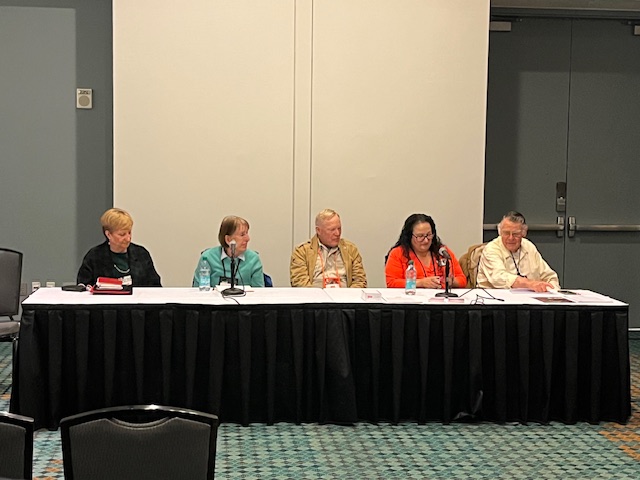
Bob Keagy acted as the moderator for the seminar. He noted in his opening comments that his first guided hunt was in 1962 out of Jackson Hole, Wyoming. He went on to say that hunters who travel with firearms will have to deal with numerous types of bureaucracies both at home and abroad. Keagy’s general advice was to do one’s homework, use the expertise of your guide or outfitter, and to use SCI travel database for country and airline regulations.
Next up was Craig Boddington who brought over 40 years of experience to the table and who has hunted in over 50 countries. His first admonition was to ask your outfitter whether you could bring your own firearms. The follow-up question to your outfitter was whether they had firearms available for you to use.
Craig then went on to add a number of points:
- You need to understand the laws in the country to which you are traveling
- The easiest countries to hunt with your own firearm are South Africa, Namibia, and Zimbabwe
- Your up-to-date CBP Form 4457 is your proof that you own the firearm, optics, and accessories
- Include your firearm and optic on the Form 4457. It serves to show the rest of the world you have a “permit” from the USA
- Have a secure case that is in good shape. Every lockhole must have a lock.
- Know the TSA and airline rules so you can talk the agents through the rules. Have a copy of them with you.
- Within the US, your limit on ammunition is 11 lbs or 5 kg.
- Some airlines allow you to put ammo in the gun case while some do not. Craig puts his ammo box in his duffle.
- In the European Union, you will be charged a handling fee for your firearms for each airport
- Always keep your ammo in original factory boxes with the caliber matching that of the box. This is true even if handloads.
- If traveling to a country where you haven’t been before, he suggest using a travel agent
- Avoid short connections. Allow four hours minimum in between connections
- Turkey doesn’t allow you to use the outfitter or PH’s firearm
- If you are taking a suppressor, not only put it on the CBP Form 4457 but take a copy of your tax stamp
- Traveling through multiple countries on your trip can be problematic.
- Finally, your ammo box doesn’t have to be complicated. He uses the plastic ammo cans that can be found at Cabelas, BassPro, and even Harbor Freight.
Following Craig was Barbara Crown of SCI’s Hunter Information Services. She said that as a member of SCI you have access to an entire range of information on airline regulations on travel with firearms. Checking it myself just now I see that it goes from Greece’s Aegean Airlines to Canada’s WestJet.
Barbara went on to emphasize that permits and forms are for a specific firearm. For example, if the permit says it is for a Browning .30-06, you can’t substitute your Remington 700 in .30-06. With regard to the Form 4457, she said only to use the one without an expiration date on it. If you are hunting in Mexico, know that they track your optics as closely as your firearms. With regard to Canada, be aware of their banned list.
Jacky Keith of Esplanade Travel has been working as a travel agent for over 50 years. She strongly suggested using a qualified travel agent. She noted that many can be called or emailed anytime especially if you run into difficulties. She urged that hunters use travel agents that are specialists in working with hunters that travel with firearms. Finally, she suggested travel insurance so that your hunt is insured.
The final speaker was Anne Gaines-Burrill of South Africa. Her company provides meet and greet services. She made the following points regarding South Africa:
- Firearms permits should be pre-issued. It is required in every city except Johannesburg
- You should have a separate CBP Form 4457 for your suppressor
- South Africa wants your Form 4457 issued in the year of the hunt. You may have a perfectly valid one from last year but the South African police are sticky about it.
- No one under the age of 21 can bring in a firearm unless exceptions are made
- Have a separate policy insuring your firearm.
- Medical evacuation insurance is an essential – use Ripcord or Global Rescue
In the Q&A that followed, a representative from Silencer Central had some advice if you are traveling with a suppressor. You should know that eight states ban them including Illinois, New Jersey, New York, and California which have major airline hubs. If transiting through those states and you are delayed, do not take possession of the suppressor from the airlines. Let it remain “in transit”. He also said you should have a copy of your tax stamp as well as your trust document if the suppressor is on a trust. When filling out your CBP Form 4457, you should put the suppressor in your name and not that of the trust.
I am not a world-class hunter who has traveled to many countries on hundreds of hunts. However, I did hunt twice in South Africa last year. On one trip I took my own firearms and on the other I used the camp rifle. In the end, I think the cost worked out about the same. I had to rent the camp gun which was the equivalent or a bit more than the cost of SAPS permits and using RiflePermits.com. The other issue for any hunter is the fit of the firearm and the eye relief of the scope. The camp rifle and scope were not perfect but they worked. On that trip I was traveling standby so taking my own firearm could have turned out to be a nightmare. The bottom line is that both methods work. You just need to figure out what works best for you and use the advice of the experts above.