Now that Senate Majority Leader John Thune has kowtowed to the Left’s Deep State Operative aka the Senate Parliamentarian on needed reform to the National Firearms Act, it is time for Plan B.
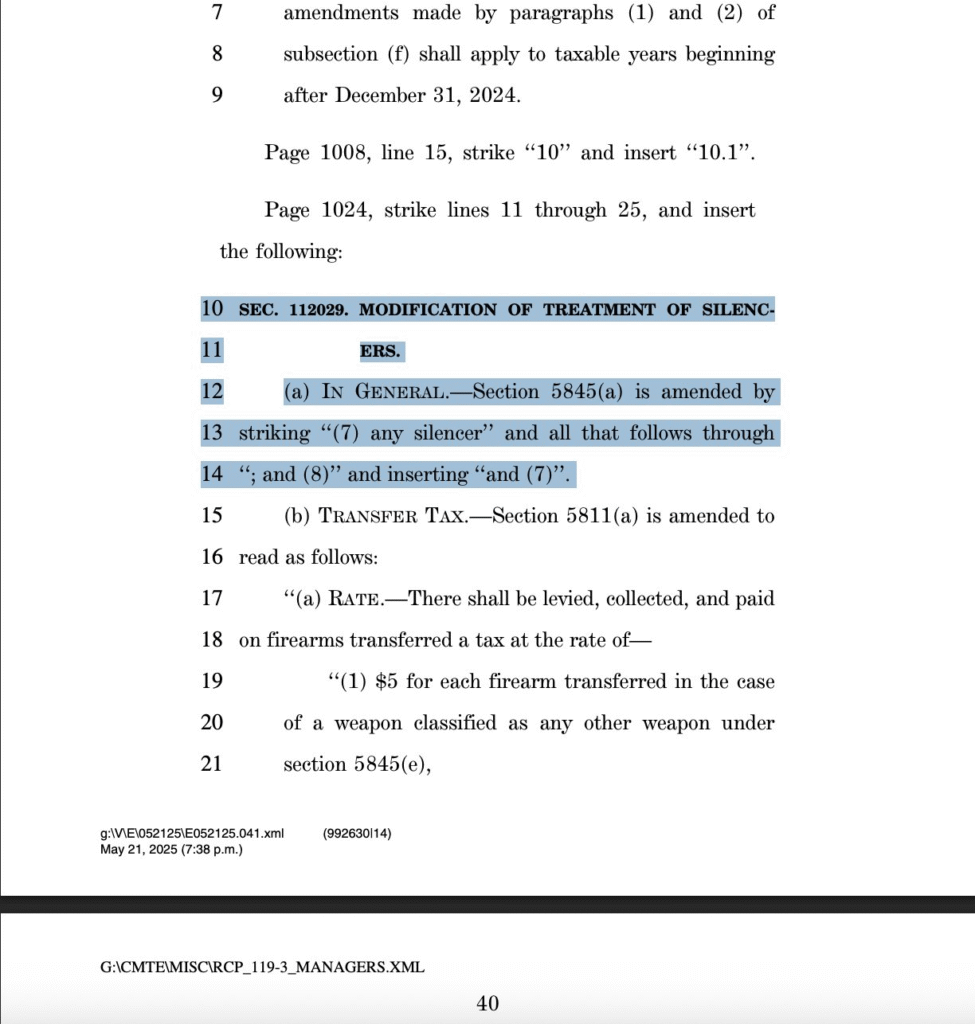
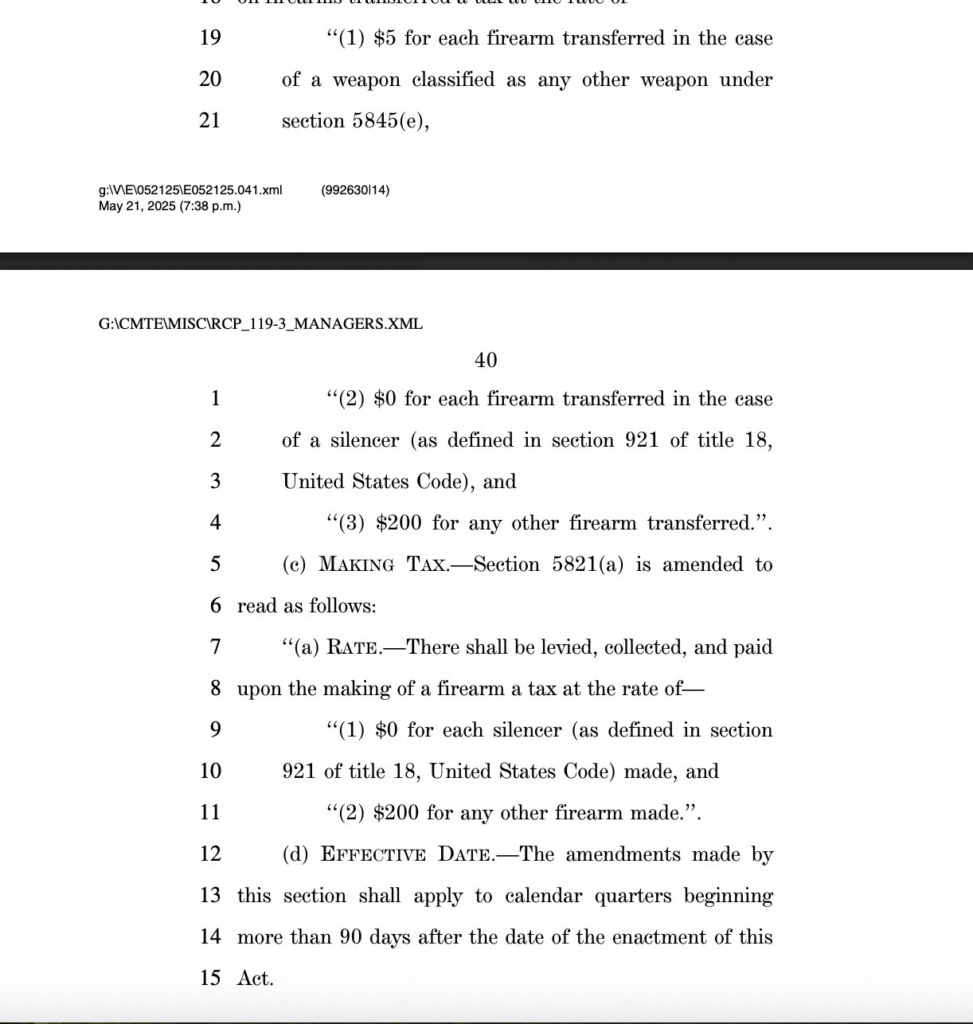
According to a text I received this morning from John Commerford, Executive Director of the NRA-ILA, the tax on silencers, short barreled rifles and shotguns, and any other weapons has been lowered to zero dollars in the text of the bill. Additionally, they will be exempted from the excise taxes of the Pittman-Robertson Act. However, all of these items will still be subject to all the laws and regulations of the National Firearms Act including registration. This also means you have to ask ATF for a “mother, may I” permission slip to cross state lines even temporarily with your short barreled rifle or shotgun. Silencers and AOWs are exempt from that requirement.
As my friend Miggy Gonzalez said on Facebook, “We were hoping for a free steak dinner, but we are getting a side of large fries for a Happy Meal instead.”
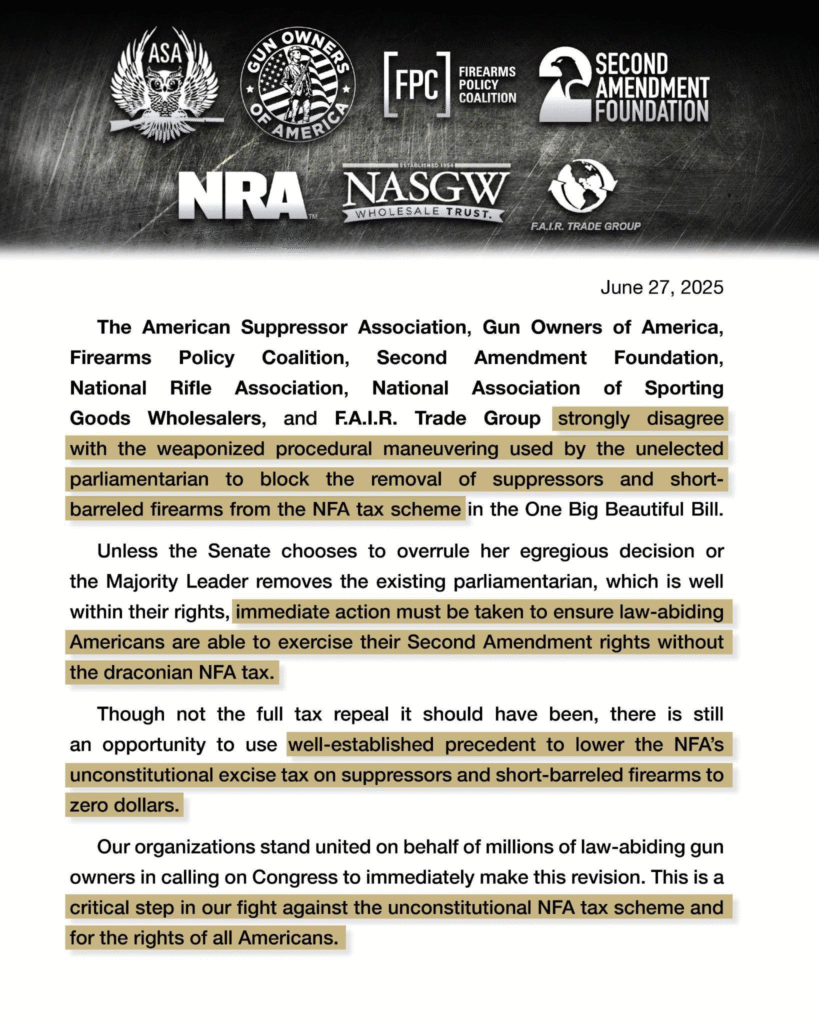
A coalition of the groups fighting for NFA reform which included the NRA, the American Suppressor Association, GOA, SAF, FPC, and others released this statement yesterday.
The bottom line is ain’t nobody that happy on our side of the fence while the other side is enjoying the fact that their Deep State Operative came through for them. That, and as Diamondback notes, John Thune is a “Temu knockoff of Mitch McConnell.” You would think that with how Elizabeth McDonough just dissed the entire GOP majority of the Senate Finance Committee that the Republicans might show more spine and less squishiness. A guy can dream, right?
Harold Lasswell was one of the icons of political science of the 20th century. Not content to be one of the founding fathers of political psychology and policy sciences, he was one of the earliest to recognize that mass communications was worthy of scholarly study. Long before modern political science devolved into trendy genres like feminist theory, queer theory, and fill in the blank theory, Lasswell was studying propaganda and had invented content analysis to search for patterns within it.
Lasswell wrote over 30 books and somewhere near 250 scholarly journal articles. This is a massive output by any measure. That said, the one book that always caught my attention was an early work entitled, Politics: Who Gets What, When, and How. (#commission earned). This is because I have always had a Lasswellian view of politics at its most basic. It is about the fight by both the elites and the masses to see who gets the spoils along with the countervailing fight by their opponents to keep the spoils for themselves. You can gloss up politics with all sorts of theories but it always comes back to power and the spoils that come with it.
This morning we learned of the infuriating ruling by the Senate Parliamentarian, an appointed and not elected official, that the inclusion of parts of the Hearing Protection Act and the SHORT Act violated the so-called Byrd Rule. This was notwithstanding that the US argued that the National Firearms Act did not violate the Second Amendment because it was a “revenue measure” in US v Miller. The Parliamentarian, Elizabeth McDonough, argued the NFA was a regulation and not a tax which is utter bovine manure.
I see Thune as acting like Kevin Bacon’s character in the movie Animal House. What Thune seems to forget that he would not even be Senate Majority Leader if gun owners had not provided the margin of victory in key Senate races in states like Ohio, Pennsylvania, and Montana.
The question is what to do now as well as what not to do. Gun owners should not do is be like Oliver asking for more. It is time we stop groveling!
The first thing we should be doing is calling our US Senators and letting them have it for kowtowing to the parliamentarian appointed by none other than Harry Reid. Call 202-224-3121 and ask for the offices of your two senators. Keep the pressure up and let them know that merely stripping the NFA reform provisions out of the Big Beautiful Bill is not going to cut it. Here is the list of those up for reelection in 2026. They should be the first targets of your call.
Here are the options as I and others see them:
Do nothing – definitely possible given the Senate
Fire Elizabeth McDonough – probably not going to happen
Have J. D. Vance overrule McDonough as President of the Senate – possible
Leave the regulatory aspects of the NFA in place and lower the tax to zero or $1 – wimpy but likely
Rewrite the provisions to try and get past the parliamentarian – maybe
Set the tax at $1 and preempt all the state’s that ban NFA items – suggested by Kostas Moros
Stephen Gutowski of The Reload thinks that McDonough will neither be fired nor overruled. His argument is that doing so may endanger the sacred tradition of the fillibuster.
While the Majority Leader can fire the parliamentarian or the Vice President can overrule their decisions, there are good reasons that’s happened so rarely. It all has to do with the filibuster. Since reconciliation is a special Senate process designed to allow budget bills to avoid the 60-vote filibuster threshold–but only budget bills. So, the process is designed to root out anything that doesn’t primarily have a budget impact.
In other words, the process is designed to protect the legislative filibuster.
He very well may be correct. Stephen goes on to add that if McDonough is overruled or fired by the Republicans it will be due to other items stripped out of the bill and not the NFA items. In other words, no matter how important these items are to the gun community – and they are – they just don’t seem that important to the Republican senators.
That is a perception that needs to be changed. The time for going before Congress on bended knee is over. Every 2A organization from the NRA to state level groups needs to mobilize their members to say hell no. As I said in the beginning referring to Harold Laswell, politics is who gets what, when, and how.
The Senate Finance Committee amendments are the best as they remove suppressors, short barreled rifles, short barreled shotguns, and any other weapons from the NFA. In addition, there is language that will satisfy state requirements requiring registration or licensing under the NFA.
Call the U.S. Senate switchboard operator at (202) 224-3121 to connect with your state’s U.S. Senators – tell them once again to pass the Finance Committee’s firearm and related tax reforms in full.
As I have said from the beginning, you don’t get what you don’t ask for – or in this case, demand. While it may be more that we expect to get, we still should get something if only the suppressor portion.
PS: Regular blogging will resume. The Complementary Spouse and I just spent 9 days in Alaska seeing the sights and visiting my cousin Ginny.
Now that the House of Representatives has approved the One Big Beautiful Act aka the budget reconciliation bill with the removal of suppressors from the National Firearms Act, it is time to move on to the Senate. As someone noted elsewhere, closed mouths never get fed.
Some will argue that we should not request the inclusion of the SHORT Act as well as other parts of the Hearing Protection Act. That is, we should take removal of suppressors from the National Firearms Act and leave it at that. I disagree. In any sort of bargaining – political or economic – it is customary to start from a position asking for everything you want and then some. If you end up getting more than you hoped for, that is a plus. If you end up getting what would satisfy you, then you’ve won. In this case, that would mean suppressors out of the National Firearms Act. Having SBRs and SBSs removed would be a plus.
I had a long conversation with Knox Williams who is the Executive Director of the American Suppressor Association. We discussed the issue raised by how laws are written in many states regarding suppressors and other NFA arms. For example, North Carolina classifies suppressors as “weapons of mass destruction.” If that is not a case of hyperbole I don’t know what is! However, we are allowed to have them if they are held in compliance with 26 U.S.C. Chapter 53, §§ 5801-5871. Section 3 of the Hearing Protection Act would provide that compliance. Knox said that given this section of the bill deals with the Internal Revenue Code that it should pass muster under the Byrd Rule. If the Senate Parliamentarian disagrees, then VP J.D. Vance as President of the Senate can overrule her. Knox also noted that the sponsor of the Hearing Protection Act in the Senate was Sen. Mike Crapo (R-ID) who chairs the Senate Finance Committee. Sen. Lindsey Graham (R-SC) who chairs the Senate Budget Committee has signed on to the bill as a co-sponsor.
The National Coalition of Gun Rights Groups has created both an open letter to Senators and a petition urging inclusion of the HPA and the SHORT Act in the final version of the budget reconciliation bill. We are asking that state level gun rights groups, gun clubs, hunting groups, and legislators sign on to the open letter. For groups signing on to the letter, we have automated the process unlike the House version where you had to email J. R. Hoell of the New Hampshire Firearms Coalition. We had over 100 groups and representatives sign on the House letter and we really should surpass that number.
In addition, individuals can sign on to the petition using the same link.
I would like to note two things before concluding. First, the anti-rights gun control industry and their minions in Congress are against this proposal. As I pointed out in their responses, they have resorted to lies, hyperbole, and fabrications. Second, this is an independent and organic effort that has arisen from the grass roots. It was neither conceived nor organized by any of the major gun rights groups. This is not meant as a criticism of those groups who, like us, have been in the fight to remove suppressors from the NFA. Instead, it is an affirmation that the pro-rights grass roots can come together as “We, the People” and demand change without being led from above unlike the other side.
No, you can’t always get what you want You can’t always get what you want You can’t always get what you want But if you try sometime you’ll find You get what you need
The House of Representatives passed One Big, Beautiful Bill aka the budget reconciliation bill very early this morning. It passed 215-214 with 2 Republicans voting no and 1 voting present. Included in the bill was a provision that removed suppressors from the National Firearms Act.
We wanted to get both the Hearing Protection Act and the SHORT Act in the final bill as sent to the Senate. We only got the Hearing Protection Act provision which removed suppressors from the National Firearms Act.
Is this a loss?
The answer is an unequivocal no.
As any trader in a Third-World market would tell you, the bidding process begins by asking for more than you reasonably think you can get. By asking for both the HPA and the SHORT Act it gave us room to bargain. While we wanted both, getting suppressors removed from the National Firearms Act is much better than what the Ways and Means Committee was offering which was a reduction of the tax to zero but with suppressors remaining registered in the NFA. In my opinion, if we had started the negotiations with only asking for the Hearing Protection Act then we probably would have only gotten the reduction in tax.
This now goes to the Senate where we must fight to keep this provision in the bill. It, of course, has riled up the gun control industry but that was to be expected.
Provided this passes the Senate and suppressors are removed from the NFA in their entirety I expect to see an explosion in the sales of suppressors as well as court battles in those states like Illinois, New York, and California that ban suppressors. I look forward to the latter as it is hard to argue against something that reduces overall noise pollution and is backed as a health safety device by the medical community.
The quick answer to the headline is the House Rules Committee. They are scheduled to meet to discuss the budget reconciliation bill aka A Big, Beautiful Bill at 1am Eastern on Wednesday morning.
And here I have thought the House Budget Committee reconvening their markup meeting on the budget reconciliation bill at 10pm Sunday night was a bit unusual.
If you are awake and want to watch the sausage being – I mean legislation considered – there will be video.
In a tweet on X from Erich Pratt of Gun Owners of America which featured a video of an interview with Mr. Roy, it was noted that a lot of progress had been made on suppressors and they are still working of SBRs and SBSs.
We had a great day on Capitol Hill meeting with 2A champions about the fight to deregulate suppressors and short-barreled rifles.
Big thanks to @chiproytx for standing with gun owners and encouraging GOA members to tell their reps to support HPA & SHORT Act!
I guess we may know tomorrow morning when we get up to have our morning coffee.
While it appears that many state level groups and others such as GOA are going for the whole enchilada, i.e., SBRs, SBS, AND suppressors, it appears the NRA has given up on anything more than suppressors. This is from my reading of an alert sent out on Monday urging people to call representatives to push for the inclusion of suppressors in the bill. In my opinion – and it is only my opinion – this is a mistake as a win on the whole lot would galvanize the grass roots and mark the NRA as hard-core supporters of gun rights.
A number of state-level Second Amendment groups along with a few individuals have signed an open letter to Chairman Jodey Arrington (R-TX) of the House Budget Committee and Chairwoman Virginia Foxx (R-NC). The letter demands the inclusion of portions of both the Hearing Protection Act (HR 404) and the SHORT Act (HR 2395) into the budget reconciliation bill.
The signatories represent constituencies from coast to coast and North to South. I expect more groups to sign on to this letter as the evening progresses. I find it remarkable that this many groups can come together to sign this letter in little more than a day and a half.
If you represent an organization that ought to be a signatory to this letter, you can contact Rep. J. R. Hoell of New Hampshire at RepJRHoell@gmail.com to add your name and organization.
The letter has been updated to add elected officials to the list. Signatories are still being added and it is not too late to add your name to the list.
As someone commented on Reddit, “Closed mouths never get fed.” Meaning if we don’t ask or demand it, we will never get either the SHORT Act or the HPA. We may not get all we want but we would get nothing if we didn’t ask for it.
The budget reconciliation bill aka the One, Big Beautiful Bill failed in a vote of the House Budget Committee on Friday. The bill failed 16-21 as four Republicans joined with the Democrats to defeat the bill as written. It wasn’t just fiscal measures such as the tax cuts and credits for state and local property taxes that killed it. Another reason was the halfway measures regarding firearms related legislation included in the bill. In particular the bill did not remove suppressors, SBRs, and SBSs from the National Firearms Act. Instead it just lowed the tax on suppressors to zero but left the requirement that they be registered under the NFA in place.
The House Budget Committee reconvenes tonight at 10pm (weird time!) to reconsider the bill with potential amendments. Second Amendment activists, especially those at the grass roots level, are strongly asking that both the Hearing Protection Act and the SHORT Act be included in the final bill. The former would remove suppressors from the NFA while the latter would remove short barreled rifles and shotguns from the NFA along with making pistol braces legal by definition. As both measures are tax related, it is my understanding that they would not violate the so-called Byrd Rule.
North Carolinians should be aware that Representatives Chuck Edwards (R-NC-11), Tim Moore (R-NC-14), and Addison McDowell (R-NC-6) are all members of the House Budget Committee. The committee also includes 2A stalwarts such as Rep. Ben Cline (R-VA) who is the author of the Hearing Protection Act and Rep. Andrew Clyde (R-GA) who is the author of the SHORT (Stop Harassing Owners of Rifles Today) Act.
The House Budget Committee is accepting comments:
Individuals or organizations may submit a written statement for consideration by the Committee and for inclusion in the printed record. Any person(s) or organization(s) can submit written comments for the record here: Ryan.Bailey@mail.house.gov.
There is a joint letter being formulated that I will post later this evening. It is being signed by many in the 2A community.
In the meantime, here is the alert sent out by Grass Roots North Carolina asking people to contact their representatives and especially Rep. Virginia Foxx (R-NC-5) who chairs the House Rules Committee. It can also be the basis of your submission to the House Budget Committee.
DEMAND INCLUSION OF NFA REFORMS
WHAT IS HAPPENING?: Due to delays in passage of the budget reconciliation bill in Congress, there is an opportunity to make much needed reforms to egregious restrictions in the1934 National Firearms Act (NFA).
IMPACT: Specifically, reforms include removal of firearm suppressors from the NFA regulatory framework and changing the classification of short-barreled rifles (SBRs) and short-barreled shotguns (SBSs) which subjects them to the same onerous regulations as machine guns and other highly restricted devices. Many of us have been subject to these ridiculous restrictions of our constitutional rights.
IMMEDIATE ACTION REQUIRED!
IMMEDIATELY CONTACT Congresswoman Virginia Foxx (R-NC) and urge her to incorporate NFA Reforms into the budget reconciliation bill. Virginia Foxx D.C. Office: (202) 225-2017
Use your Congressional representatives contact form to submit the letter below:
DONATE TO GRNC: We are still low on funds after our highly successful election effort. Please donate by going to our website.
Suggested Subject: “Incorporate NFA Reforms into Reconciliation Bill”
As your constituent, I respectfully request immediate inclusion of portions of the Hearing Protection Act (H.R. 404) and the Stop Harassing Owners of Rifles Today (SHORT) Act (H.R. 2395) in the forthcoming reconciliation bill. These critical pieces of legislation address longstanding, unjust restrictions imposed by the National Firearms Act (NFA) of 1934 which infringe upon the Second Amendment rights of law-abiding Americans. The failure to incorporate these bills into the reconciliation package would represent a profound missed opportunity to restore individual liberty, protect public health, and uphold constitutional guarantees.
The Hearing Protection Act (H.R. 404), introduced by Representative Ben Cline (R-VA-06), seeks to remove firearm suppressors from the NFA’s burdensome regulatory framework, replacing it with a streamlined purchase process for typical accessories. Suppressors, contrary to popular misconceptions, do not silence firearms but significantly reduce noise levels, mitigating the risk of permanent hearing loss for shooters and hunters. The American Academy of Otolaryngology–Head and Neck Surgery has endorsed suppressors as effective tools for preventing hearing damage, a public health concern affecting millions of Americans. The current NFA requirements — including a $200 tax stamp for both manufacture and transfer of the devices, extensive paperwork, and excessive waiting times — serve no meaningful public safety purpose while imposing undue financial and administrative burdens on responsible citizens. With over 4.8 million suppressors in civilian circulation, their widespread use underscores the need for reform.
Similarly, the SHORT Act (H.R. 2395) addresses the arbitrary NFA classification of short-barreled rifles (SBRs) and short-barreled shotguns (SBSs), which subjects them to the same onerous regulations as transferable machine guns and other highly restricted devices. This outdated framework, rooted in 1930s-era fears of organized crime, lacks relevance in the modern context, where SBRs and SBSs pose no greater threat than standard rifles or shotguns. The SHORT Act would delist these firearms from the NFA, eliminating unnecessary barriers to ownership and ensuring that law-abiding Americans are not penalized for exercising their constitutional rights.
Language compliant with the U.S. Senate “Byrd rule” (2 U.S.C. 644) is circulating the Second Amendment community and should be incorporated in the current budget reconciliation package. The urgency of including this language in the reconciliation package cannot be overstated. Recent reports indicate that the House Ways and Means Committee has delayed action on both H.R. 404 and H.R. 2395, potentially due to lobbying efforts that prioritize commercial interests over the public good. Such delays are unacceptable, particularly when public sentiment, as reflected in numerous grassroots calls to action, overwhelmingly supports NFA reform. The reconciliation process offers a unique opportunity to bypass Senate filibuster constraints, ensuring that these common-sense reforms reach the House floor and become law. Failure to seize this moment risks further entrenching an antiquated and unconstitutional regulatory regime.
Opponents of these reforms, such as Michael Bloomberg’s “Everytown for Gun Safety,” argue that suppressor deregulation poses public safety risks by making gunfire less detectable. This claim is false and ignores the reality that suppressors reduce, but do not eliminate, firearm noise. Moreover, homemade suppressors are readily accessible to those with criminal intent.
The public safety argument against SBR deregulation is equally baseless, as these firearms are functionally identical to their longer-barreled counterparts. These objections, often rooted in fearmongering rather than evidence, should not override the constitutional rights of millions of Americans.
The Second Amendment unequivocally protects the right to keep and bear arms, and the NFA’s restrictive provisions—originally enacted to combat gang violence nearly a century ago—have long outlived their utility. The Hearing Protection Act and the SHORT Act represent measured, practical steps toward aligning federal law with contemporary realities and constitutional principles. Their inclusion in the reconciliation bill is not merely a policy preference but a moral and legal imperative.
I request that the House Committee on Rules and the committee on Budgets act decisively to ensure that broadly supported language of H.R. 404 and H.R. 2395 are incorporated into the reconciliation package in their entirety, without dilution or compromise. The American people deserve legislation that respects their rights, promotes public health, and dismantles unnecessary bureaucratic obstacles. I strongly urge you to heed the calls of millions of gun owners and Second Amendment advocates who have made their voices clear. The time for action is now.
Numerous parts of the SHARE Act had been passed in previous sessions of Congress but never made it to the President’s desk for signing. This included measures that would have allocated monies for target ranges, would have protected lead-based fishing tackle from lawsuits based on the Toxic Substances Control Act, and would have expanded fishing and hunting opportunities on Federal lands. There were, however, some major additions to the SHARE Act including rolling the Hearing Protection Act into it, replacing the sporting use test with an all lawful use test for non-NFA imports of firearms and ammunition, and prohibiting the BATFE from reclassifying popular rifle ammunition as armor piercing. Sebastian covers the addition of the Hearing Protection Act here and the hearing memo gives a good thumbnail outline of the details of the SHARE Act.
The lone opposition witness was to be former ATF Special Agent David Chipman who now works for Gabby Giffords’ American for Responsible Solutions. I’m sure his inclusion was aimed primarily at the Hearing Protection Act.
In support of the bill was to be Jeff Crane, President of the Congressional Sportsman’s Foundation; Rob Keck, Director of Conservation for Bass Pro Shops and former CEO of the National Wild Turkey Federation; and Jason Ouimet, Director of Federal Affairs for the NRA.
The Subcommittee staff prepared an interesting 38-page memo showing the changes in the legal language that would result from the passage of the SHARE Act as it now stands. The changes are color coded which makes for a quick way to see the addition and subtractions to the law. Additions are color-coded in yellow and deletions are in blue.
Passage of the SHARE Act in its entirety would be good for both Gun Culture 1.0 and 2.0. I’m sure the addition of the Hearing Protection Act and the replacement of the sporting use test are red flags for the gun prohibitionists but now is the time for the Republicans to step up and show they are worthy of the past support from the outdoor and shooting communities.
 by
by