 by
by Grass Roots North Carolina stepped up to be an amici in the amicus brief filed by Gun Owners of America and a number of other groups as well as three firearms manufacturers. This brief argued that AR-15s and similar semi-automatic rifles were in common use and should be protected under existing precedents. Further, it argued that the historical record is clear on dangerous and/or unusual. Finally, Viramontes and Grant are not about machine guns or military weapons.
From the amicus brief:
Ultimately, this case is about whether thegovernment gets to decide for “the people” which bearable “Arms” they may own. But the SecondAmendment leaves no room for the government toexercise such power: the right of the people to keepand bear Arms “shall not be infringed.” Whenlegislators and unelected judges override the people’soverwhelming choices, they in a very real way seizepower from the sovereign and transfer it togovernment, endangering the preservation of our “freeState.” The “assault weapons” bans under review areunconstitutional.
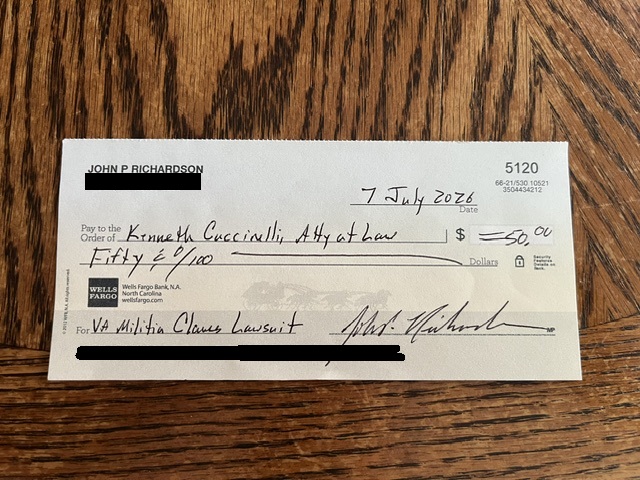
Meanwhile, Rights Watch International, the 501(c)3 sister organization to GRNC, was an amici on a brief authored by former Virginia Attorney General Ken Cuccinelli. They were joined in this brief by a number of individuals including my Paufellow NRA Directors Rob Beckman and Dennis Fusaro. Additionally, 10 other organizations joined with Rights Watch including the Ohio Rifle & Pistol Association, the New York State Rifle & Pistol Association, Florida Carry, and the Montana Shooting Sports Association.
This brief took a historical approach. It argues that the militia clause in the Second Amendment – “A well regulated Militia, being necessary to the security of a free State” – protects semi-automatic rifles because they are precisely the type of weapons of most use to the militia. When lower courts said bans of AR-15s were legal because they were “militaristic”, the courts had it exactly backwards.
The brief concludes:
Arms that bear a reasonable relationship to the preservation or efficiency of a well regulated militia — the ordinary individual arms suitable for the common defense and in common use by law-abiding citizens — lie at the core of the Second Amendment’s protection, and a State may not prohibit them. The historical tradition of regulating “dangerous and unusual weapons” is a tradition governing the manner of carrying arms and the genuinely exotic; it has never sustained, and does not now permit, a prohibition on
arms in common use. A prohibition imposed because those arms are useful for the common defense is contrary to the Second Amendment’s text, purpose, and history.
Paul Valone, President of Grass Roots NC and Rights Watch International, sent out an email on Sunday discussing the organizations participation in these and other amicus briefs. He took exception to those who argued GRNC and RWI are just in it for the money. He noted that RWI not only joined the militia clause brief but served as a fund-raising conduit for that effort. He goes on to point out a number of cases where GRNC and RWI joined amicus briefs. He concludes with a plea to help fund these efforts.
GRNC legal ACTION
State v. Ducker: At issue is increasing “over-criminalization” of relatively minor offenses which, in the founding days of our nation, would not have deprived citizens of their Second Amendment rights. In NC, for example, it is a felony to pick a Venus Fly Trap. The brief on our felony firearms law, written by attorney Tyler Brooks on behalf of GRNC, argues the NC Supreme Court should overturn a NC Court of Appeals decision against Eric James Ducker. The case is pending.
Missouri v. US: In defense of Missouri’s “Second Amendment Preservation Act,” which declares certain federal laws to be infringements on the Second Amendment rights of Missourians. The US filed litigation against MO under the supremacy clause. GRNC and RWI joined GOA and other amici, arguing the supremacy clause does not protect unlawful or unconstitutional federal actions. SCOTUS denied plaintiffs’ petition for certiorari (“cert”) in the case.
NJ v. Bondi: GRNC and RWI joined GOA and other amici on this case over New Jersey’s refusal to allow return of forced reset triggers (FRTs) after SCOTUS denied the ATF’s attempt to broaden the definition of “machine gun” in Garland v. Cargill and a national vacatur of the FRT rule by a 5th Circuit District Court judge. The case was voluntarily dismissed by the plaintiff states after ATF committed not to return FRTs in affected states.
NRA v. Glass: GRNC and RWI joined GOA and other amici on this case over Florida’s denial of 2nd and 14th Amendment rights of 18-to-20-year-olds to possess firearms. Unfortunately, SCOTUS denied the case cert.
S&W v. Mexico: GRNC and RWI joined GOA and other amici in this case to decide if Mexico can sue a US gun maker for shootings in Mexico on the theory that it should have done more to ensure its guns do not get sold to those who might bring them into Mexico to use in crimes. SCOTUS held Mexico’s complaint does not plausibly allege that the defendant gun manufacturers aided and abetted gun dealers’ unlawful sales of firearms to Mexican traffickers and that the Protection of Lawful Commerce in Arms Act bars the lawsuit.
US v. Brown: GRNC and RWI joined GOA and other amici in this case revolving on ownership of machine guns after Judge Reed Carlton in the 5th Circuit dismissed charges a Justin Bryce Brown, noting that that because 740,000 machine guns are owned by private citizens, the government failed to meet the standard that they are “unusual.” Elsewhere, in the 6th Circuit, a different case, US v. Jermain Brown, upheld conviction of the defendant for possession of “dangerous and unusual” weapons. The potential for a circuit split increases the chance that SCOTUS will take up the case.
US v. Peterson: GRNC and RWI joined GOA and other amici in this case revolving around possession of an unregistered suppressor. The 5th Circuit held that because possession of a suppressor under the 1934 National Firearms Act was essentially a “shall issue” scheme, possession of a suppressor not registered under the NFA was presumptively constitutional. Although SCOTUS denied the case cert, suppressors, short-barreled rifles, short-barreled shotguns, and “any other weapons” were later the subject of partially successful litigation.
Maryland Shall Issue v. Moore: GRNC joined GOA and other amici in this case revolving around Maryland’s handgun purchase permit system, initially ruled unconstitutional by a 3-judge panel of our own 4th Circuit Court of Appeals but later reversed and declared constitutional in an en banc (full) hearing of the 4th. Although SCOTUS denied cert, GRNC fortunately chose not to wait for this decision when we instead repealed our pistol purchase permit system.
These briefs cost serious money
Rights Watch International is GRNC’s educational and legal action arm, chartered as an IRS 501(c)(3) non-profit organization. That means it is not only tax exempt, but donations are tax deductible. And right now, RWI – which also helps GRNC underwrite the Remember in November voter education project through which we distribute up to 150,000 voter guides – is strapped for cash.
In my seminars, I teach that legal action is generally the last recourse because it is expensive and the outcome is uncertain. So, yes, I’m asking you to make a tax deductible donation to Rights Watch International by going to:
Far from being “in it for the money” like certain other organizations, GRNC and RWI use every dime of your hard-earned money to defend your rights. As an all-volunteer organization, we vow to use your money more efficiently and effectively than any other group.
There will be more briefs that need to be filed. There are magazine ban cases that are currently on hold before the SCOTUS as well as cases dealing with waiting periods, manufacturer liability, 3-D printing, and more. This does not even include the cases that are still sitting in both District and Circuit courts. All of these briefs take money and every donation of whatever size helps. One need only look at the Democrats and ActBlue to see how even the smallest donations can add up into serious money. Unlike the donations to ActBlue, your donation here goes to promote freedom and your gun rights.