Suppressor Steve

The Senate Finance Committee amendments are the best as they remove suppressors, short barreled rifles, short barreled shotguns, and any other weapons from the NFA. In addition, there is language that will satisfy state requirements requiring registration or licensing under the NFA.

 Call the U.S. Senate switchboard operator at (202) 224-3121 to connect with your state’s U.S. Senators – tell them once again to pass the Finance Committee’s firearm and related tax reforms in full.

As I have said from the beginning, you don’t get what you don’t ask for – or in this case, demand. While it may be more that we expect to get, we still should get something if only the suppressor portion.

PS: Regular blogging will resume. The Complementary Spouse and I just spent 9 days in Alaska seeing the sights and visiting my cousin Ginny.

On To The Senate

Now that the House of Representatives has approved the One Big Beautiful Act aka the budget reconciliation bill with the removal of suppressors from the National Firearms Act, it is time to move on to the Senate. As someone noted elsewhere, closed mouths never get fed.

Some will argue that we should not request the inclusion of the SHORT Act as well as other parts of the Hearing Protection Act. That is, we should take removal of suppressors from the National Firearms Act and leave it at that. I disagree. In any sort of bargaining – political or economic – it is customary to start from a position asking for everything you want and then some. If you end up getting more than you hoped for, that is a plus. If you end up getting what would satisfy you, then you’ve won. In this case, that would mean suppressors out of the National Firearms Act. Having SBRs and SBSs removed would be a plus.

I had a long conversation with Knox Williams who is the Executive Director of the American Suppressor Association. We discussed the issue raised by how laws are written in many states regarding suppressors and other NFA arms. For example, North Carolina classifies suppressors as “weapons of mass destruction.” If that is not a case of hyperbole I don’t know what is! However, we are allowed to have them if they are held in compliance with 26 U.S.C. Chapter 53, §§ 5801-5871. Section 3 of the Hearing Protection Act would provide that compliance. Knox said that given this section of the bill deals with the Internal Revenue Code that it should pass muster under the Byrd Rule. If the Senate Parliamentarian disagrees, then VP J.D. Vance as President of the Senate can overrule her. Knox also noted that the sponsor of the Hearing Protection Act in the Senate was Sen. Mike Crapo (R-ID) who chairs the Senate Finance Committee. Sen. Lindsey Graham (R-SC) who chairs the Senate Budget Committee has signed on to the bill as a co-sponsor.

The National Coalition of Gun Rights Groups has created both an open letter to Senators and a petition urging inclusion of the HPA and the SHORT Act in the final version of the budget reconciliation bill. We are asking that state level gun rights groups, gun clubs, hunting groups, and legislators sign on to the open letter. For groups signing on to the letter, we have automated the process unlike the House version where you had to email J. R. Hoell of the New Hampshire Firearms Coalition. We had over 100 groups and representatives sign on the House letter and we really should surpass that number.

In addition, individuals can sign on to the petition using the same link.

Use the link below to sign:

—-> Reform NFA Now! <——

I would like to note two things before concluding. First, the anti-rights gun control industry and their minions in Congress are against this proposal. As I pointed out in their responses, they have resorted to lies, hyperbole, and fabrications. Second, this is an independent and organic effort that has arisen from the grass roots. It was neither conceived nor organized by any of the major gun rights groups. This is not meant as a criticism of those groups who, like us, have been in the fight to remove suppressors from the NFA. Instead, it is an affirmation that the pro-rights grass roots can come together as “We, the People” and demand change without being led from above unlike the other side.

NRA Statement On One Big Beautiful Bill

This statement was released by the NRA on the passage of HR 1, “One, Big Beautiful Bill”, which included the removal of suppressors from the National Firearms Act.

This morning, the U.S. House of Representatives passed H.R. 1, the budget reconciliation bill known as the One, Big, Beautiful Bill Act, on a 215-214 vote. Included in the House’s reconciliation package was NRA-ILA’s number one legislative priority for the reconciliation fight – the full removal of suppressors from the National Firearms Act (NFA). This is a massive win for NRA members, law-abiding gun owners, and Second Amendment supporters in this country. The work continues, though, as the bill now heads over to the Senate for their consideration. Following the passage of H.R. 1 this morning, the NRA released the following statements from Doug and John:

“On behalf of the millions of NRA members, I thank Speaker Johnson and Republican House leadership for including a pro-gun victory in the One, Big, Beautiful Bill. Eliminating the onerous tax and regulations surrounding suppressor purchases would mark a significant and long-overdue reform. Despite the fearmongering from anti-gun activists, suppressors are important safety devices that protect the hearing health of gun owners and hunters. The NRA looks forward to working with the pro-gun majority in the U.S. Senate to see that this bill becomes law.” – Doug Hamlin, NRA EVP & CEO

“This morning, the U.S. House of Representatives passed President Trump’s One, Big, Beautiful Bill, which includes the complete removal of suppressors from the National Firearms Act (NFA). This represents a monumental victory for Second Amendment rights, eliminating burdensome regulations on the purchase of critical hearing protection devices. The NRA thanks the House members who supported this bill and urges its swift passage in the U.S. Senate.” – John Commerford, NRA-ILA Executive Director

We are grateful for all the NRA members who have been calling their members of Congress advocating for this change. NRA-ILA will keep you updated as the One, Big, Beautiful Bill continues through the legislative process.

One gentle reminder – it is not time to stop calling Congress and in particular your two US Senators. Tell them you want to have suppressors removed from the NFA. You might also say that it would be even better if they included the SHORT Act in the bill. You don’t get what you don’t ask for. The US Capitol switchboard number is (202) 224-3121. Ask to be connected to your Senator’s office.

Prohibitionists Gotta Lie, Example 3

Brady United considers suppressors to be dangerous accessories. The American Academy of Otolaryngology-Head and Neck Surgery disagrees and has endorsed their use as an effective means of reducing hearing loss.

From Kris Brown, President of Brady United:

“It is outrageous that the Trump administration and its allies in the House have advanced a bill that simultaneously puts countless lives at risk and gives a ‘big, beautiful’ gift to gun industry executives and any mass shooter or assassin who intends to take lives. We do not need to speculate about how dangerous this will be: In 2019, a shooter armed with a silencer killed 12 people in Virginia Beach, and most of the victims were unaware that a mass shooting was even taking place. Americans will die if this becomes law, hard stop.

This provision would allow anyone to buy or even 3D print a silencer without registration or even a simple background check. This flies in the face of almost 100 years of sensible regulation of silencers that has saved lives. If House leaders want to legislate actual changes to gun policies, they should hold public hearings on bills and not sneak devious provisions into a massive tax giveaway in the dark of night. Brady fiercely condemns the House bill and urges the Senate to reject any effort to put gun industry profits above American lives.”

Americans will die if this becomes law? What would the gun control industry do without hyperbole?

Hold public hearings on bills? What do you call the marathon sessions of the House Ways and Means, House Budget, and House Rules Committees? I guess they weren’t awake when their pet legislator Rep. Madeleine Dean (D-PA) railed on about silencers (starts at about 9:00 mark) and her desire to raise the tax exponentially. I consider that a public hearing even if you don’t.

Devious provisions? Given how public we on the pro-rights side have been about our advocacy for both the Hearing Protection Act and the SHORT Act, I hardly would call it devious. Devious implies that we went about this sneakily and that certainly is not the truth.

3D print a silencer? OMG! Why go to all that trouble when all you need to do is screw on the right sized oil filter.

The funny thing is that in countries that have the level of gun control that they desire for in the USA, you can pick up a silencer readily, cheaply, and without any government interference. Here is an example from the gun control paradise formerly known as Great Britain. Or in South Africa given how their president is making news by visiting the White House. I can assure you that transporting a firearm from one airport to another in South Africa is strictly controlled.

Prohibitionists Gotta Lie, Example 2

Our next example of prohibitionists lying about suppressors comes from the Cult of Personality known as Giffords.

Silencers, also known as “suppressors,” obstruct law enforcement efforts to quickly and effectively respond to active shooters since they make it more difficult to recognize the sound of gunfire and locate the source of gunshots. They also mask muzzle flash and reduce recoil, increasing the risk of multiple-casualty shootings. A silencer was used in the 2019 Virginia Beach shooting that killed 12 people. It has also been reported that the shooters in the 2022 Tops Friendly Market massacre in Buffalo, New York, and the 2023 Lewiston, Maine, shooting that murdered 18 people, had tried to purchase silencers, but were denied. 

“Instead of focusing on the safety of American families, House Republicans just gave gun industry CEOs a $1.5 billion tax break to help boost their bottom line. Silencers will only enable shooters to cause more violence and damage without being detected. Law enforcement has opposed efforts to make silencers more accessible for a reason—they’re dangerous and make their jobs harder. For a party that claims to ‘back the blue,’ House Republicans just gave dangerous people a big win and ignored the impact to public safety,” said GIFFORDS Executive Director Emma Brown. 

As I noted in my previous post, 130 decibels is the average of a suppressed gun shot from a 9mm Glock. That is the same amount of sound of a F-18 taking off from a carrier deck. More difficult to recognize the sound of gunfire? I don’t think so.

Reducing recoil and muzzle flash increase the risk of mass-casualty events? Are you kidding me? That has to be one of the more ludicrous arguments made by the prohibitionists.

Insofar as law enforcement opposing efforts to deregulate suppressors, the very article used by Giffords says just the opposite. It points out that the then head of the Fraternal Order of Police didn’t consider it a law enforcement problem. Using 7-8 year old articles regarding LEOs and suppressors to try and make your point just fails.

Prohibitionists Gotta Lie, Example 1

We expected the gun control industry to have a hissy fit if and when the House of Representatives voted to removed suppressors from the National Firearms Act. We were not disappointed.

From Everytown:

“There’s a reason silencers have been regulated for nearly a century: They make it much harder for law enforcement and bystanders to react quickly to gunshots,” said John Feinblatt, president of Everytown for Gun Safety. “In the name of gun industry profits, House Republicans are putting law enforcement and our communities at greater risk of being shot — all while gutting health care for millions of Americans.”

silencer is a device that helps dampen a firearm’s sound signature and eliminate its muzzle flash by allowing the hot gasses that follow a bullet down the barrel to expand and cool before hitting the air outside of the gun. Silencers work like car mufflers, but for firearms. As a result, it is more difficult for bystanders and police to identify that a gun has been fired or where gunshots originate.

Because of the danger they pose, silencers have been highly regulated since 1934. People who want to buy or build a silencer must first submit an application to the Bureau of Alcohol, Tobacco, Firearms and Explosives (ATF) with their fingerprints, a passport-style photo, and a $200 tax stamp — a fee that has not been raised or adjusted for inflation since 1934 — and undergo an enhanced background check. All of these requirements are now on the chopping block.

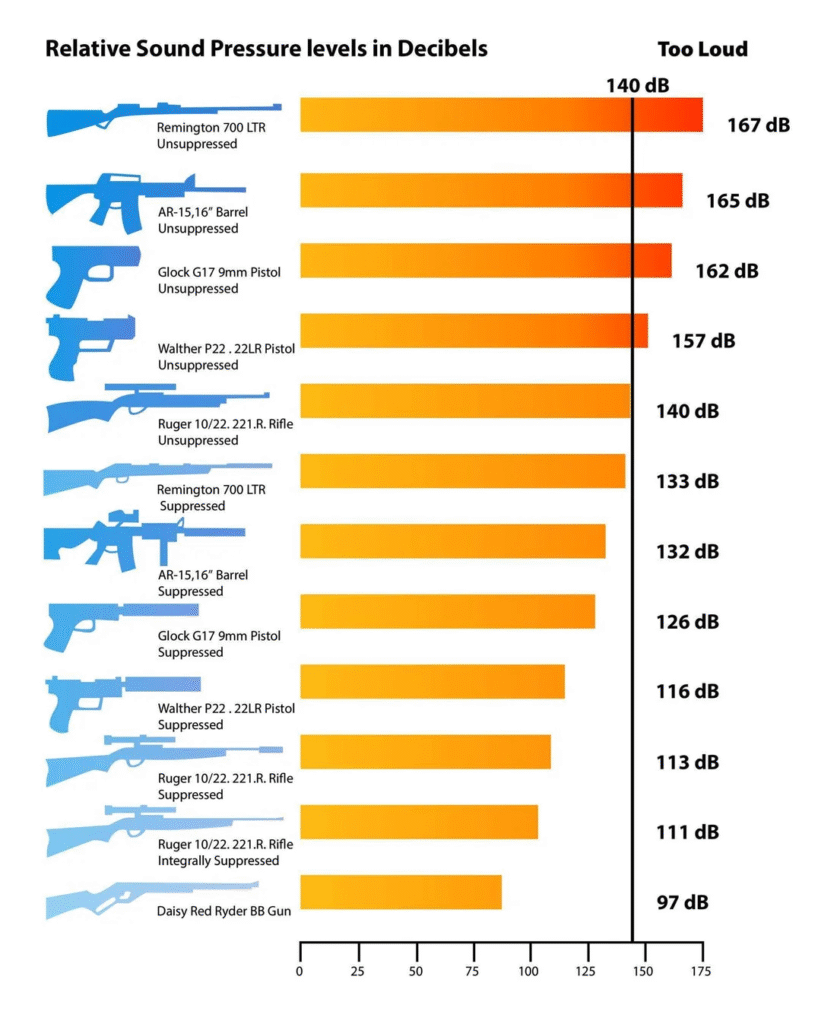
Suppressors reduce the report of a firearm by approximately 30 decibels. What does that mean in real terms. The chart below illustrates the decibel level of a suppressed and unsuppressed firearm.

The OSHA occupational noise standard for workers exposed to loud noises is 90 decibels average over an 8-hour work day.

As to the lie that police and bystanders would have a hard time identifying gun shots if a suppressed firearm was used, 130 decibels – or the approximate amount of a 9mm suppressed – is the sound level of a military jet taking off from a carrier deck and can cause harm to one’s hearing.

“You Can’t Always Get What You Want”

As Mick Jagger famously sung in the Rolling Stones’ classic hit:

No, you can’t always get what you want
You can’t always get what you want
But if you try sometime you’ll find
You get what you need

The House of Representatives passed One Big, Beautiful Bill aka the budget reconciliation bill very early this morning. It passed 215-214 with 2 Republicans voting no and 1 voting present. Included in the bill was a provision that removed suppressors from the National Firearms Act.

We wanted to get both the Hearing Protection Act and the SHORT Act in the final bill as sent to the Senate. We only got the Hearing Protection Act provision which removed suppressors from the National Firearms Act.

Is this a loss?

The answer is an unequivocal no.

As any trader in a Third-World market would tell you, the bidding process begins by asking for more than you reasonably think you can get. By asking for both the HPA and the SHORT Act it gave us room to bargain. While we wanted both, getting suppressors removed from the National Firearms Act is much better than what the Ways and Means Committee was offering which was a reduction of the tax to zero but with suppressors remaining registered in the NFA. In my opinion, if we had started the negotiations with only asking for the Hearing Protection Act then we probably would have only gotten the reduction in tax.

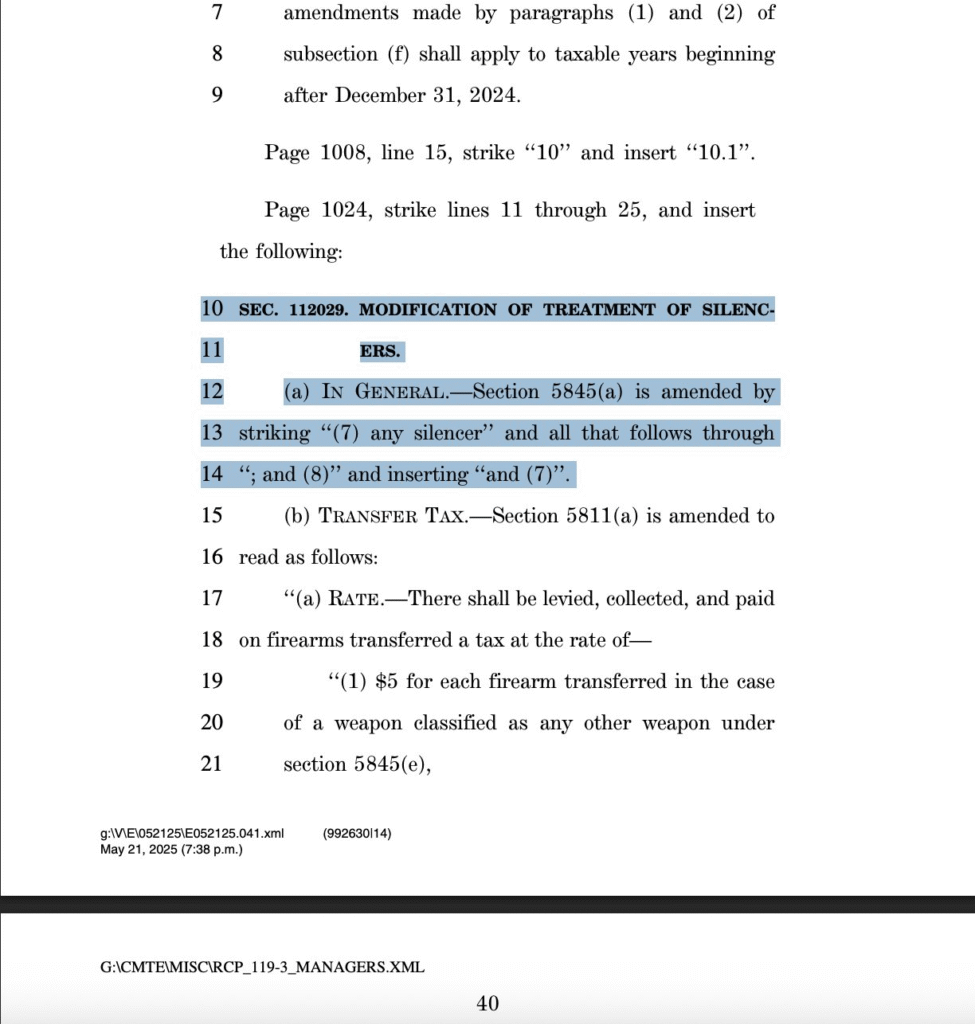
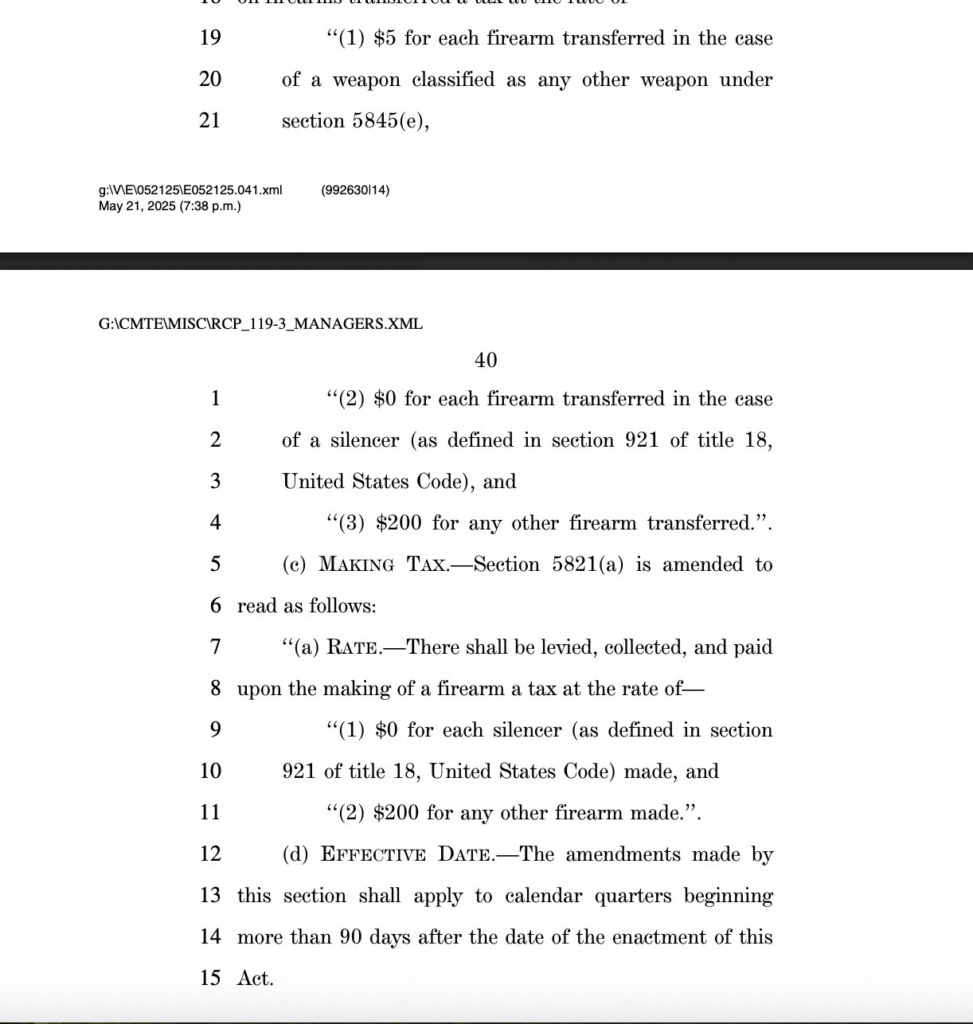
Thanks to a post by the American Suppressor Association, here is the final wording that the House voted to approve.

This now goes to the Senate where we must fight to keep this provision in the bill. It, of course, has riled up the gun control industry but that was to be expected.

Provided this passes the Senate and suppressors are removed from the NFA in their entirety I expect to see an explosion in the sales of suppressors as well as court battles in those states like Illinois, New York, and California that ban suppressors. I look forward to the latter as it is hard to argue against something that reduces overall noise pollution and is backed as a health safety device by the medical community.

Not Protected By The Second Amendment

In a decision issued this past Thursday, a panel on the Fifth Circuit Court of Appeals said that suppressors were not weapons protected by the Second Amendment. The case involved firearms dealer George Patterson of Jefferson Parish, Louisiana. The BATFE was investigating him for certain reporting violations and had obtained a search warrant of his premises. During their search, they found a suppressor made from a kit that was neither serialized nor registered in violation of 26 U.S.C. §§ 5841, 5861(d), and 5871. A grand jury indicted him on that charge and Patterson moved to have the indictment dismissed. He argued that the National Firearms Act’s registration requirements violated the Second Amendment. The US District Court for Eastern Louisiana dismissed his motion and he appealed to the 5th Circuit.

The opinion of the court was by Chief Judge Jennifer Walker Elrod who is a George W. Bush appointee. Interestingly, she also wrote the opinion for the en banc decision in Cargill v. Garland that found that bump stocks were not machine guns.

After examining a number of decisions in other circuits that had concluded that suppressors were not weapons, Elrod wrote:

A suppressor, by itself, is not a weapon. Without being attached to a firearm, it would not be of much use for self-defense. And unless a suppressor itself is thrown (which, of course, is not how firearms work), it cannot do any casting or striking.3 See United States v. Hasson, No. GJH-19-96, 2019 WL 4573424, at *4 n.5 (D. Md. Sept. 20, 2019) (noting that a suppressor “could be thrown at someone like a shoe or a baseball, which, most would agree, are not arms protected by the Second Amendment”). While a suppressor might prove useful to one casting or striking at another, that usefulness does not transform a gas dissipater into a bullet caster…And while possession of firearms themselves is covered by the plain text of the Second Amendment, possession of firearm accessories is not. Id. Accordingly, Peterson has not shown that the NFA’s registration scheme burdens a constitutionally protected right.

She also dismissed his argument that a suppressor should be considered a “‘‘proper accoutrements’ that render the firearm useful and functional'” per US v Miller noting that a firearm can still be fired absent a suppressor. His other argument pointed to Ezell v. Chicago but again Chief Judge Elrod dismissed that argument saying that the use of a suppressor is not necessary to the use of a firearm. Thus, she dismissed his appeal of the motion to dismiss from the District Court.

So this leads to the obvious question, if a suppressor is not considered a weapon and merely an accessory, then why is it regulated under the National Firearms Act of 1934? The obvious answer is that it should not be.

There are currently bills in both houses of Congress that would remove suppressors from the National Firearms Act. The first to be introduced was HR 404/ S364 – Hearing Protection Act. This bill introduced by Rep. Ben Cline (R-VA) and Sen. Mike Crapo (R-WY) would remove suppressors from the NFA, eliminate the $200 tax, prohibit states from imposing any taxes on their purchase other than normal sales taxes, and allow their sale with a simple background check. This bill is supported a number of organizations including  American Suppressor Association (ASA), the National Shooting Sports Foundation (NSSF), the National Rifle Association (NRA), the Congressional Sportsmen’s Foundation (CSF), and the Academy of Doctors of Audiology (ADA). 

A second bill, the Silencers Helping Us Save Hearing (SHUSH) Act, has been introduced by Sen. Mike Lee (R-UT) in the Senate and by Rep. Michael Cloud (R-TX) in the House. The SHUSH Act is supported by National Association for Gun Rights, Gun Owners of America, the National Rifle Association, and the National Shooting Sports Foundation. It goes further than the Hearing Protection Act in that it removes suppressors entirely from Federal regulation.

From Sen. Lee’s press release:

The SHUSH Act aims to:

  • Eliminate federal regulation of suppressors as firearms under the National Firearms Act (NFA) and the Gun Control Act (GCA).
  • Remove existing taxes, fees, and registration requirements associated with suppressors.
  • Allow current or retired law enforcement officers to carry concealed firearms with suppressors.
  • Preempt state regulations on the manufacture, transfer, transport, or possession of suppressors.
  • Strike provisions requiring mandatory minimum sentences for suppressor possession in certain cases.
  • Exempt suppressors from regulation by the Consumer Product Safety Commission.
  • Provide a provision for a refund of the $200 transfer tax for anyone who purchased a suppressor within two years prior to the enactment of the bill.
  • If passed, the SHUSH Act will work alongside the Hearing Protection Act to further deregulate suppressors and remove them from the Gun Control Act of 1968.

I would support passage of both laws but I must say I really like the SHUSH Act better. The question is, of course, getting either bill through the Senate.

Given that the courts are refusing to treat suppressors or silencers as protected by the Second Amendment and are considering them merely accessories, now is the time to treat them like they are in countries around the world. That is, an accessory sold over the counter without regulation that protects hearing, mitigates recoil, and reduces noise pollution.

H/T Marc E.
From Our Friends At VCDL

Now that the Virginia House has approved HB 961, it goes to the Senate for hearings. This bill would ban “assault weapons” (sic), standard capacity magazines, suppressors, and bump stocks.

The hearings on the bill start today.

From VCDL:

Turnout needed!  Monday, February 17, at 8 am, the Senate Judiciary committee is going to hear HB 961, Delegate Mark Levine’s “assault weapon”/higher-capacity magazine/suppressor/ bump stock ban!

This is a key opportunity to defeat HB 961 and there is a good chance we can do so!

BREAKING:  VCDL has heard there will be an attempt to modify HB 961 to help save it from being defeated.  HB 961 is a disaster and cannot be fixed.  It must be killed in its entirety!

I suggest getting there early, as we will hopefully flood the room and beyond.

After going through the metal detectors, continue straight ahead and go through the glass doors.  Make an immediate right, walk down the hall, and make another immediate right to get to Senate Committee Room A.

Here’s what the current version of HB 961 does:

Makes possession of a large number of semi-automatic guns, classified as an “assault weapon” by this bill, a felony.  This includes many popular rifles, handguns, and shotguns!  You can keep any “assault weapons” you currently have, but you can’t buy any more.  The wording is so poor that you probably won’t be able to even fix a broken “assault weapon,” as each part is classified as an “assault weapon”!  Gun dealers in Virginia won’t be able to sell an “assault weapon” or any parts for one to anybody, include to gun owners in other states.  This will do severe financial harm to Virginia gun dealers. 

Bans magazines that hold more than 12 rounds of ammunition.  There is NO grandfathering!  Possession of such a magazine (keeping it at home only) after January 1, 2021 will be a Class 1 misdemeanor.  However, transporting such a magazine is a felony!

Bans suppressors, making possession of one a felony.  You can keep any suppressors you currently have, but you cannot purchase any more and you won’t be able to fix them if they break.

Bans bump stocks.  Any that you have must be destroyed by January 1, 2021.  Possession of one after that date is a felony.

Rachel Malone – Three Myths About Suppressors

Given President Trump’s foolish remarks about suppressors, it is time again to take apart the myths about suppressors. My friend and fellow co-host of the Polite Society Podcast Rachel Malone does just that in the video below. Rachel, by the way, it the GOA Director for Texas and fights for gun rights on a daily basis. She is a trainer and musician.