FN-FALs In The Libyan Civil War

I came across a study this week from the Small Arms Study on the firearms used in the Libyan Civil War that overthrew Muammar Gaddafi. The Small Arms Study is an independent research project located at the Graduate Institute of International and Development Studies in Geneva, Switzerland. Their research focus is on the spread of small arms and light weapons which they consider a threat to “human security”. While generally what we would consider a gun control organization, their research is leagues ahead of anything that might come out the gun prohibitionists such as the Violence Policy Center.

This study found that the most common rifle seen on the battlefields of Libya after the ubiquitous AK was the FN-FAL.

After Kalashnikov-pattern rifles, Fusil Automatique Léger (FAL) rifles were among the most frequently sighted
firearms during the 2011 armed conflict in Libya. A number of FAL rifles used during the conflict were subsequently recirculated throughout the broader sub-region. Indeed, between 2011 and 2013 FAL rifles
reportedly smuggled from Libya were seized or documented in several countries, including Algeria, Lebanon,
Niger, Syria, and Tunisia.

Although factory markings, serial numbers, and technical characteristics do not provide conclusive proof of the
age or end users of Belgian FAL rifles used in the Libyan conflict, they do allow useful inferences to be drawn. This report discusses the basis of such inferences and offers guidance on data gathering with a view to advancing our general knowledge of the use and circulation of Belgian FAL rifles and encouraging relevant authorities to step up tracing efforts.

Using a desk chair and FN-FAL against jet fighter in Libya – from The Atlantic

 
The report examined the factory markings on the FALs found in Libya to determine origin and age. They concluded that most of the FALs found were made after 1971 because FN Herstal had changed from “Fabrique Nationale d’Armes de
Guerre Herstal Belgique to Fabrique Nationale Herstal Belgique or, alternatively, Fabrique Nationale Herstal
Belgium” in late 1971.

FN Herstal exported a number of FN-FALs to Libya from 1969 through 1988.

Evidence suggests that most of the FAL rifles used in Libya in the 2011 conflict were FALs of Belgian production
(FN FALs). Belgian records document authorized exports of 46,260 FN FAL rifles to Libya from
1969 to 1988, though the actual number of rifles exported may be lower. In addition to direct sales from Belgium, re-exports of FN FALs from other countries to Libya may have occurred before or during the 2011 conflict. Illicit sales of FALs to actors in Libya through underground arms merchants may also account for a portion of the rifles used during the 2011 conflict.

The study goes into extensive detail about serial numbers and receiver variations seen in FN-FALs. While some might find this boring, fans of the FN-FAL like myself  will find it quite interesting. I’d recommend downloading and reading this short (8-page) study.
Home Security

Former Navy SEAL Dom Raso is one of the three new younger commentators for the NRA. In his latest, he takes on the attempts to limit our right to defend our homes, our families, and ourselves.

He makes an excellent point when he says, “For many people, home security isn’t worth talking about.” Too many people are both unprepared and unaware. They live in a world of denial that violent crime can happen anywhere and to anyone. 

Alabama Summers And Snowballs

Now that the Zimmerman trial is over, gun prohibitionists and their political allies have declared a jihad on Stand Your Ground laws. Many of the attempts to repeal the protection that these laws give to persons exercising their right to self-defense will come in the state legislatures.

One of the latest attempts to repeal these laws is coming from the state of Alabama where certain Democrats vow to repeal that state’s Stand Your Ground law.

A Democratic lawmaker said Tuesday there would be an effort to repeal Alabama’s version of Florida’s Stand Your Ground law in the next legislative session, but acknowledged it could be a difficult fight.

“We know it will not just be uphill, but up mountain,” said Sen. Hank Sanders, D-Selma, at a news conference.

Alabama has had a Stand Your Ground law since 2006 when it was sponsored by then-State Sen. Larry Means (D-Attala). Much like in Illinois in 2004 where then-State Senator Barack Obama supported that state’s Stand Your Ground law, this law was supported by Democrats.

In the last session of the Alabama Legislature, they were presented with a bill to repeal the Stand Your Ground law. That attempt didn’t make it out of committee. Nonetheless, Sen. Sanders plans to attempt it.

Sanders said he did not know what the scope of any Senate action would be or who would take the lead on it, but said he would sponsor a repeal effort if no one else did. Republicans control large majorities in both chambers, but Sanders said he would work on repeal for “however long” it took.

Frankly, I’d rate his chances of getting his bill out of committee right up there with a snowball not melting when left out in the midday sun during a hot Alabama summer. In other words, it doesn’t have a snowball’s chance in hell of passing.

Gunning For Noxious Weeds

The Hawaiian islands are having trouble with an invasive weed that is shading out natural plants and causes erosion.

The weed in question is miconia, a plant that has infested much of the Big Island and has been trying to gain a foothold on Oahu, Maui and Kauai. Miconia’s large leaves can block out sunlight for smaller plants, and its shallow root systems can increase erosion. A single miconia plant can produce eight million seeds a year.

“Miconia is the number one weed problem in the state of Hawaii that most people don’t know about because it’s impacting areas that people don’t have access to,” Leary told Hawaii News Now in an interview from the UH Maui Agricultural Center in Kula.

The solution developed by conservation scientists from the Hawaii Department of Natural Resources and Environmental Management is called Herbicide Ballistic Technology or HBT. In layman’s terms, they are using a paintball gun with special paintballs filled with herbicide to kill the miconia.

The scientists from NREM take to the air in helicopters searching for the miconia and shoot it with the herbicide-filled paintballs. It has been likened to helicopter hunting for feral hogs in Texas. It appears that they have have some significant success according to Dr. James Leary of the University of Hawaii.

“We have protected over 3,000 acres, eliminating 5,000 miconia targets, and reducing what we call incipient populations, or satellite populations, by 80 percent,” he said.

Who would have ever thought that paintball guns could be put to such important conservation use.

Best Comment On Absurd Statement By Pelosi

Last Friday, former House Speaker Nancy Pelosi (D-CA) released a statement on the first anniversary of the shootings in the theater in Aurora, Colorado. It was, as you would expect from the source, nonsensical. Rep. Pelosi stated in part:

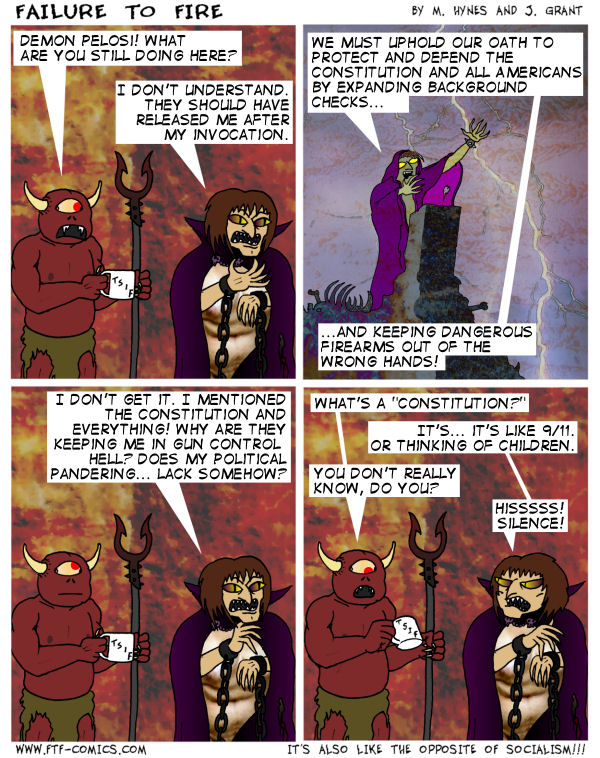
“In Congress, there can be no more fitting memorial to the lives lost in Aurora, in Newtown, and across the country than a concerted effort to enact commonsense gun safety legislation. We must uphold our oath to ‘protect and defend’ the constitution and all Americans by expanding background checks and keeping dangerous firearms out of the wrong hands.

Beyond misstating the Congressional Oath of Office that she took, the rest of the statement is just absurd.

The cartoonists at Failure To Fire nailed her on this today and they did a damn fine job of it.

A Welcome Unintended Consequence Of Colorado’s New Laws

The new Bloomberg-backed background checks law in Colorado has had an unintended and welcome side effect: it prevented a gun buyback. Together Colorado had planned a gun buyback for August 4th in the People’s Republic of Boulder. They had to call it off at the request of Boulder County Sheriff Joe Pelle.

Organizers have canceled a gun buyback at the request of Boulder County Sheriff Joe Pelle, who said Colorado’s new gun laws would make the Aug. 4 event nearly impossible to stage.

“The bottom line is what we anticipated doing would still be legal — but procedurally we can’t follow through with it at this time,” Pelle said Tuesday.

A stricter law that went into effect July 1 requires buyers to go to a licensed firearms dealer and undergo a background check. The InstaCheck systems used in the checks are not mobile, which means they couldn’t be used at the sheriff’s compound where the buyback was planned.

“It’s not a portable system,” Pelle said. “It can’t be done at the site.”

Essentially, for the event to work, Pelle said the group would have to find a licensed firearms dealer to host the event and then pay the dealer per transaction, “which becomes very unproductive,” he said.

That is just too bad for both Together Colorado and Sheriff Pelle who gave the event his full support.

It is also really too back for Boulder metalworking artist Jessica Adams who was to be given parts of the destroyed firearms to make a sculpture “creating gun violence (sic) awareness.”

HB 937 Passes Both Houses And Is Sent To Governor

It appears that the North Carolina General Assembly can get its act together when it is under time pressure. The amended HB 937 was passed by both houses of the General Assembly this evening. Earlier reports had it being on the calendar for tomorrow.

The vote was 73-41 in favor of the amendment from the Conference Committee in the House while the Senate passed it by a vote of 32-14. The roll call of the votes are not available yet.

Agreement Reached On HB 937

The Conference Committee hammering out differences between the Senate version and the House version of HB 937 has reported back to the North Carolina General Assembly with an amended bill which can be found here.

The bill has been put on the legislative calendar for an up-down vote tomorrow. I would expect it to pass.

I will have more on the changes as I read the Committee’s report.

UPDATE: The bill stays the same except for Sections 17 and 18.  The changes include:

  • Section 17.1 drops the word “license” from § 14-403.
  • Section 17.2(a) changes § 14-404 to require that a person denied a pistol purchase permit be given the reason for the denial; that the denial include specific facts as to why the applicant was denied including listing by statute number the applicable law. 
  •  Section 17.2(a) requires the sheriff to keep a list of denials, minus the personally identifying information, including the specific reason for a denial as a public record.
  • Section 17.2(a) requires the Clerk of Court to send records to the NICS System within 48 hours of being notified of any judicial finding, court order, or other factual matters that would cause a person to be denied a permit under
    § 14-404
  •  Section 17.2(a) sets the cost of a purchase permit at $5; does not allow any limit on the number or frequency of permits issued to an individual; does not allow the sheriff charge extra for the investigation, processing, or medical background checks; and requires either a permit or denial be given to the applicant within 14 days.
  • Section 17.2(a) requires the revocation of a permit for anything that happens subsequent to the permit’s issuance that would have denied a permit in the first place. Also required is that the permit holder surrender his or her permit when notified of its revocation.
  • Section 17.2(b) requires a report from the Administrative Office of the Courts regarding the implementation of the Clerk of Court NICS System notification requirement.
  • Section 17.2(c) sets the effective date for NICS System notification at July 1, 2014; for the remainder of Section 17.2(a) at October 1, 2013; and for the rest of Section 17 immediately upon becoming law.
  • Section 17.3 requires the sheriff of a county to examine the validity of all outstanding permits by January 31, 2014. If there are any that would be subject to revocation, he or she is to take steps as detailed above. A report is required from each sheriff on results of their review by March 31, 2014.
  • Section 17.4 requires sheriffs to keep a record of permits issued as well as denials. These records are non-public and confidential.
  • Section 18 just makes a minor clerical change to GS 14-315(b1)(1) which concerns a prohibition on giving or selling weapons to minors.

Natalie Foster On Language

Natalie Foster of A Girl’s Guide to Guns fame has a new commentary about about the abuse of language used by the gun prohibitionists. I’m glad to know that I’m not the only one whose hackles start to rise when they hear the words “commonsense”, “reasonable”, or the new buzzword du jour, “gun safety”. Natalie calls this condescending, manipulative language meant to confuse the voters. She is absolutely correct.

Alan Korwin of Gunlaws.com has pointed out many times that we need to change our use of language. Instead of being pro-gun, we are pro-rights. Natalie makes the point when she talks about the use of the word “gun safety” as a stand-in for gun control. If you are against the newest gun safety law aka gun control, it puts us in an uncomfortable position if we would be forced to say we are anti-gun safety laws. I think you get the point.