Dave Kopel Provides An Analysis Of 7th Circuit’s Illinois Carry Decision

In an interview with Cam Edwards of NRA News, Second Amendment scholar Dave Kopel analyzes the opinion of the 7th Circuit Court of Appeals in the Moore and Shepard cases.

He makes the point that Judge Richard Posner who wrote the decision is “the furthest thing from a libertarian” and had publicly disagreed with the Supreme Court’s reasoning in the Heller decision. However, Kopel said Posner was very smart and could read what the Supreme Court said (and meant) in that decision. If Posner had been a Supreme Court justice, his opinion might have been different. Since he wasn’t, Kopel said Posner wasn’t going to impose his own views on this case.

Accessorizing Your AR-15

Cory Trapp, Gunsite instructor and gunsmith, discusses accessorizing your AR-15 in this video from the National Shooting Sports Foundation. He discusses what add-ons you might want and what you can live without.

More importantly, he explains why some add-ons can aid your shooting while others will just get in the way. Cory makes the point that when it comes to accessorizing your AR “less is more”.

“Calm Down And Take A Valium”

Al Gore’s Current TV featured Alan Gottlieb discussing yesterday’s win in the 7th Circuit this evening. He was on The Young Turks with Cenk Uygur.

Uygur started ranting about Chicago being an “island in an ocean of guns”, the gun show loophole (sic), and how Chicagoans can just go to a gun show in another state and buy a pistol. To which Alan Gottlieb responded, “Calm down and take a Valium”. Alan then proceeded to explain how it was illegal for an out of state resident to purchase a handgun in another state and take possession of it there. As we know Federal law requires it to be shipped to an FFL in the home state of the purchaser.

Recoil Magazine Makes A Brilliant Move

After all the controversy engendered when an editor said the HK MP-7 wasn’t for civilians, Recoil Magazine seems to be getting their act together. That is, if their soon-to-be announced new editor is any indication.

I received an email this evening from Iain Harrison announcing that he was leaving Crimson Trace after two years to become the new editor of Recoil. He says of his time with Crimson Trace:

It’s been a wild couple of years as PR guy for Crimson Trace, working
with a company that has grown from being an awkward teenager and is now
hanging with the cool kids. I have been privileged to have worked with
the very best in the industry during these past, oh-so-short 24 months
and I’m extremely grateful to you all for humoring my lack of experience
in the field.  It is with a tinge of sadness therefore that I’m
announcing my resignation from CTC, but this is tempered with an
enormous amount of excitement for the next project.

Congratulations to Iain on his new position and to Recoil Magazine for making such a brilliant move.

Tavor Bullpup Coming To America

Israel Weapons Industry – IWI – announced that they have leased a 21,000 square foot facility in Harrisburg, PA and will soon start up operations there. They initially will be marketing the Tavor SAR bullpup and the Uzi Pro Pistol. Both of these will be specifically adapted for the US market.

From their release:


Ramat Hasharon, Israel, December 12, 2012 – Israel Weapon Industries (IWI) – a leader in the production of combat-proven small arms for governments, armies, and law enforcement agencies around the world – launches operations of its US subsidiary, IWI US, Inc. The company has leased a 21,000 sq. ft. facility in Harrisburg, PA, and will initially begin marketing the TAVOR® SAR bullpup rifle line in several configurations and the UZI® PRO Pistol, which will be showcased at the 2013 SHOT Show, January 15-18, in Las Vegas, NV at booth #15238.

According to Uri Amit, IWI’s CEO, “We are pleased to announce the launch of the
operations of IWI US to shooting enthusiasts in the US. We have operated for
many years in the global Defense and Law Enforcement markets, where we have
invested significant resources in developing quality, innovative weapons that
answer the needs of our customers, and our products enjoy great popularity
around the world. All of the weapons we have developed have become the
standard for the IDF as well as for the armed forces, Special Forces, and police
forces throughout the world. We have now decided to enter the civilian market in
the US and offer products that have been specially developed for the US
commercial market. Initially, we will offer several configurations of the TAVOR®
SAR and the UZI® PRO Pistol, which have undergone changes and adjustments
to suit the needs of the American consumer.”

Mr. Amit continued, “Over the years, rumors have circulated regarding the launch
of our US operations, which has created expectations in the civilian market, and
we look forward to an excellent reception of our products by US shooting
enthusiasts. We will be introducing our new weapons at the upcoming SHOT
Show – and invite you to visit our booth to take a closer look.”

About Israel Weapon Industries (IWI)

Israel Weapon Industries (IWI), located in the center of Israel, has been a world leader in small arms for the past 80 years. IWI is a member of the SK Group, which is composed of companies that develop and manufacture a wide array of military products for governmental entities, armies, and law enforcement agencies around the world. IWI’s best-known products include the TAVOR® and GALIL® ACE families of Assault Rifles, the NEGEV™ Light Machine Gun, the legendary UZI® SMG (Mini, Micro and UZI® PRO) and the JERICHO® family of pistols – which have all been considered weapons of choice by military units and top law enforcement agencies around the world. The company’s firearms are developed in close collaboration with the Israel Defense Forces (IDF). IWI and the IDF join forces in developing these weapons, whose final configurations are the product of ongoing interaction, field tests, and modifications, resulting from combat requirements and experience. All IWI weapon systems are in compliance with the most stringent military standards (MIL-STD) and ISO 9000 standards.

If the Tavor is made here in the US, then I guess they won’t have to
worry about BATFE and problems with meeting any sort of “sporting
purpose” for importation. As the Instapundit might say, heh!

UPDATE: Steve at The Firearm Blog is reporting that IWI-US has gone live with their website and has posted the MSRP for the various models of the Tavor SAR. They start at $1,999 and go up to $2,599 with the Mepro reflex sight attached.

I did find this bit interesting:

The TAVOR® is a perfect fusion of an ordnance grade steel
receiver coupled to a Mil-Spec cold hammer forged barrel and encased
into a high-impact strength polymer uni-body with exceptional
situational ergonomics. The ultra-compact form factor allows for easy
transitions in close quarter situations…or even in your favorite deer
blind.

Unfortunately, in many states, legally the .223 is considered too small for deer.

UPDATE II: I received some more info today on the Tavor and Uzi from IWI’s marketing firm. I’m posting it below and it gives some more info on both of these firearms.

The TAVOR® Family of Bullpup Rifles are versatile, innovative, and technologically advanced. They have been extensively proven on the battlefield, performing with precision and reliability, and meeting the needs of human ergonomics. The TAVOR® family was developed in close cooperation with the Israel Defense Forces (IDF), based on lessons learned from actual combat, and is in service in the IDF Infantry and Special Forces as well as in other countries throughout the world.

The body of the TAVOR® SAR, specially designed for the US market, is crafted from high strength polymer, and will be offered in black or Flat Dark Earth colors. Features include full ambidextrous controls, removable 16.5″ or 18″ barrels, Cold Hammer Forged (CHF) CrMoV chrome-lined barrels with 1:7 twist, a full-length top-mounted integral Picatinny rail and another short rail forward at a 45° angle for mounting accessories.. A stock left-hand model with 16.5″ barrel and an “IDF” model with integral MEPRO-21 reflex sight round out the product line. The TAVOR® SAR uses standard AR-15/M16 magazines, and can be easily field-stripped into sub-assemblies for routine maintenance. The standard caliber is 5.56 NATO (.223REM), with conversion kits available in 9mm Luger Parabellum and 5.45X39mm.

Developed in cooperation with the IDF, the 9mm UZI® PRO semi-automatic pistol is the newest member of the legendary UZI® family – one of the most popular weapon families in the world, with millions of units sold around the globe. Created especially for the US market, the exceptionally lightweight and compact UZI® PRO Pistol is ergonomically designed and easy to operate by right or left-handed users. It offers closed-bolt operation for maximum accuracy and safety. With many of its components made of advanced polymeric materials, the UZI PRO’s features include two Picatinny rails for various accessories, one on the top of the pistol and a second one forward under the barrel. It will be supplied with two magazines, one 20- and one 25-round.

Just Like Clockwork

It didn’t take long for the Chicago Sun-Times to call upon Illinois Attorney General Lisa Madigan to appeal the 7th Circuit Court of Appeals ruling in the joint cases of Moore v. Madigan and Shepard v. Madigan.

In their lead editorial today entitled “Madigan should appeal gun ruling”, the Sun-Times opines:

Illinois’ status as the only state that does not allow the carrying of concealed loaded guns was threatened Tuesday when a federal appeals court gave the state 180 days to change its law.

But that doesn’t mean Illinois should immediately allow anyone who feels like it to start toting a pistol.

Illinois Attorney General Lisa Madigan, who said Tuesday that she is reviewing her options, should appeal the overbroad ruling by the 7th Circuit Court of Appeals. And if the courts won’t extend the deadline while considering the appeal, the Legislature will have to craft a law that meets the court’s standards while providing as many protections as possible for citizens who don’t carry guns.

The Legislature might even be able to find a way to continue banning concealed carry while rewriting the law to satisfy the appeals court, which said the current law doesn’t rest on sufficient justification. Short of that, the Legislature could consider a narrowly crafted law, such as that in New York, which has concealed carry in theory but does not grant many permits.

Reading the full editorial, one can’t help but get the feeling that the editors of the Sun-Times are the residents of the 35th floor of the Park Tower of whom Judge Posner said had less need for concealed carry than people living in rough neighborhoods.

Frankly, I hope Ms. Madigan does pull an “Adrian Fenty” and appeal the ruling. Without the hubris of former Washington, DC Mayor Adrian Fenty, we would never have had the Heller decision confirming the Second Amendment protects an individual right. Likewise, without cases like this one being appealed, we will never get a decision from the Supreme Court on the right to carry outside the home.

Every Picture Tells A Story, Part Two (Repost)

The gun prohibitionists are already saying that blood will run in the streets when the Illinois General Assembly crafts some form of concealed carry legislation in accordance with today’s ruling by Judge Richard Posner of the 7th Circuit Court of Appeals.

“As the dissenting opinion points out, the two judges who threw out
Illinois’ law did not take account of the danger to the public from
stray bullets, and they ignored the Illinois legislature’s determination
that carrying weapons has been shown to escalate violence,” said Lee
Goodman, an organizer with the Stop Concealed Carry Coalition.

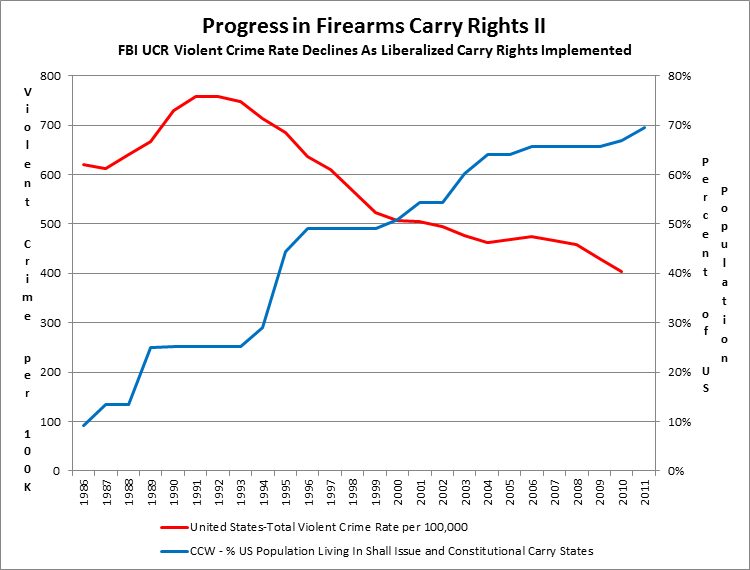
If Lee had taken the time to examine the graphic below, he would see that there is no positive correlation between less-restrictive (legal) carry (shall issue and constitutional issue) and increased violent crime. Let’s face it – Chicago already has concealed carry by thugs and criminals. The only ones prohibited from protecting themselves are honest, law-abiding citizens.

This was originally posted on Dec. 21, 2011.

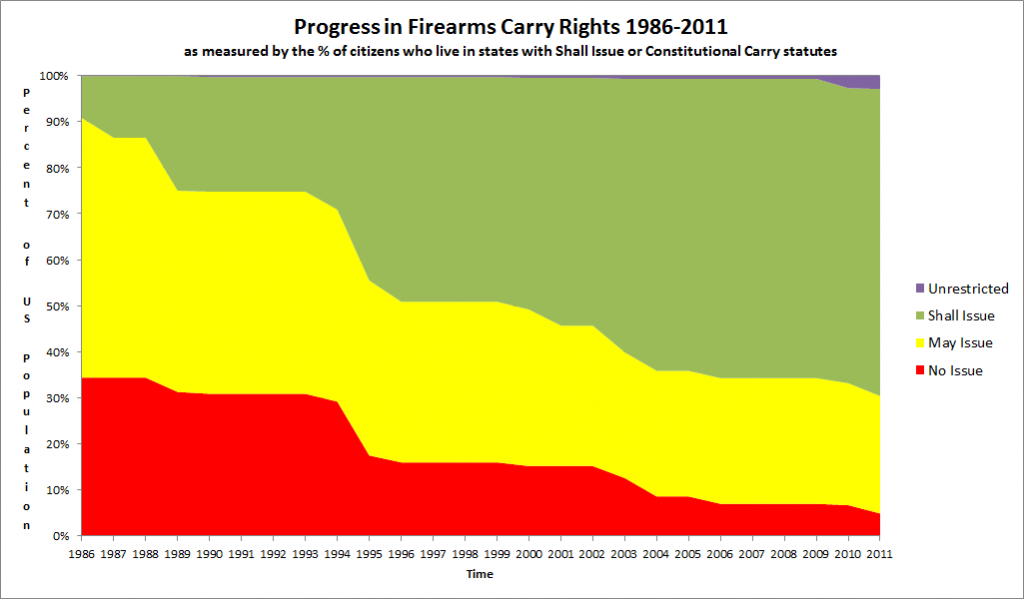
In October, I posted a graphic developed by Rob Vance that showed the progress in the growth of firearms carry rights from 1986 through 2011 as a percentage of the U.S. population. In 1986, 90% of the U.S. population lived in states that severely restricted carry rights or had none at all. Today, over two-thirds of Americans live in states with either shall-issue carry or constitutional carry. The conclusion was that shall-issue is the new norm.

Recently, the FBI released its Uniform Crime Reports statistics. Rob generated a new graph plotting these violent crime rates against the growth of less-restrictive firearm carry rights over the period of 1986 through 2011.

The data used to generate this graph is available here in Google documents. As I said in the original post, unlike the gun prohibitionists, we publish our data for the world to see. The data used comes from three sources: the FBI Uniform Crime Reports, the U.S. Census, and www.gun-nuttery.com/rtc.php which tracked the changes in carry laws over time.

Rob had the following conclusions after examining the data:

Violent crime is a complex issue, but national data is clear that there is no positive correlation between liberalized concealed carry laws and increased violent crime.

The “blood in the streets” or “Wild West” scenarios just don’t play out. To be fair, state level data is highly variable, so some caution needs to be exercised in drawing conclusions.

Rob is very explicit that there is no positive correlation between violent crime and liberalized carry laws rather than a proven negative correlation. He feels that it will take more rigorous statistical analysis before this negative correlation could be said to be proven.

The results here are reinforced by the study done by Linoge at Walls of the City which compared violent crime rates and firearm ownership. In that study, Linoge did find a relatively strong negative (-0.605) correlation between violent crime and firearm ownership.
 
While violent crime did not go down as sharply as the progress in carry rights rose, one thing that needs to be kept in mind is that while shall-issue may be the new norm that right is not extended to all locations. Bars, restaurants, government buildings, post offices, and many parks are still off-limits to concealed carry. I think this will become the next battleground for concealed carry. Interestingly enough, restrictive states like California actually have fewer restrictions on where one may carry.

As an example of the battle for fewer restricted locations, one need look no further than here in North Carolina. This session of the General Assembly changed the law concerning concealed carry in state, municipal, and county parks. It is now allowed everywhere with the exception of a local opt-out for “recreational facilities”. As might be expected, some locales are trying to push the limit on what is considered a recreation facility far beyond what was intended by the General Assembly.

Shall-issue may be the new norm but the fight will continue.

NOTE: If you click on the graphic, you can view it in its full original size.

Every Picture Tells A Story (Repost)

This was originally posted on October 6, 2011. In honor of the 7th Circuit’s ruling in Shepard v. Madigan and Moore v. Madigan, I thought it would be useful to repost it. Sometime in the next 180 days or less, the percentage of US citizens in the “red zone” will decrease. This assumes, of course, that the State of Illinois does not appeal this ruling. Now it is up to the citizens of Illinois and their elected representatives as to whether or not they move to the yellow zone or the green zone. Here’s hoping for the green zone.

I have some of the best readers in the world. One such reader is Rob Vance of California. He works in the software industry and must analyze data on a regular basis. The graphic below is as a result of his sitting down and examining U.S. Census data alongside a state’s policy on discrete or concealed carry of firearms.

The data used to generate this graphic is available here in Google Documents. Unlike the gun prohibitionists, we publish our data for the world to see. With regard to the data and methodology, Rob had this to say:

The graph maps the change in the legal status of concealed carry permits by state over time based on data found at www.gun-nuttery.com/rtc.php and the US Census Bureau (percentage of total US population by state). Classification of carry rights status was divided into four groups 1) Unrestricted 2) Shall issue 3) May issue and 4) No issue.

A couple of things about the graph and the supporting data. For population values, I used census data. 1980 -> 2010. The annual values (percent of total population by state) are rolled forward – e.g. 1980 census for years 1980- 1989, and so on. With respect to the rounding error the effect of total error is limited to a couple of tenths of a percent.

If you examine the spreadsheet with the data values you will see that a may-issue state like Hawaii is classified as a No-issue state. While you could argue that Hawaii should be listed as may-issue or conversely a state like New Jersey should also be added to the No-issue list, it doesn’t change the trends shown.

As to the conclusions that you can draw from this graph and the data, Rob had this to say:

1) In the early 1980s 90% of Americans lived in states that actively suppressed self-defense rights by severely limiting concealed carry of firearms by citizens.

2) By 2010, 2/3’s of Americans lived in states where law abiding citizens could conceal carry if they met minimal standards, and in some states (4 by 2011) needed NO state permission at all to concealed carry. A total of 41 states are now shall-issue or have unrestricted concealed carry status.

3) Few states moved from no issue to may issue. Rather when states made policy changes, they made the jump from no-issue to shall-issue all at once (again, with a couple of exceptions).

4) 30% of the citizens in the US STILL live under state governments that are hostile to the interests of their citizens in self-defense as measured by access to shall-issue (or unrestricted) concealed carry.

5) We’re down to the hard cases now – states where politicians are deeply invested in denying armed self-defense to otherwise law abiding citizens. California, Illinois and New York are where the population numbers are in terms of resistance to 2nd Amendment rights (and yes, there are a few others like New Jersey, Massachusetts, Hawaii, etc.).

If I may add a couple of other things, I’d say that shall-issue is the new norm in 2011 as opposed to no-issue or severely restricted may-issue back in 1986. The other thing I would add is that the experience with shall-issue concealed carry in the early adopting states like Florida paved the way for its adoption elsewhere. That is, people applying for concealed carry licenses are law-abiding citizens who have taken the responsibility seriously. Unlike what the Violence Policy Center would have you believe, the streets are not running with blood nor have they.

I would like to thank Rob for taking the time and making the effort to put his together. It is great research and his efforts are much appreciated.

NRA Calls It A “Victory For Self-Defense”

Just like the Second Amendment Foundation, the NRA is celebrating today’s ruling by the 7th Circuit Court of Appeals. If you will recall, the 7th Circuit combined the appeals of the SAF’s case – Moore v. Madigan – and the NRA’s case – Shepard v. Madigan – into a joint appeal. Plaintiffs’ oral arguments were presented by both Alan Gura and Charles Cooper.

The NRA’s release on the win is below:

Federal Court Strikes down Illinois’ total ban on carrying firearms for self-defense outside the home or business

Fairfax, Va. – The United States Court of Appeals for the Seventh Circuit ruled today that Illinois’ total ban on carrying firearms for self-defense outside the home or business is unconstitutional. The case involves lead plaintiff Mary Shepard, an Illinois resident and a trained gun owner, who is licensed to carry a concealed handgun in both Utah and Florida. The National Rifle Association is funding this case. The Illinois State Rifle Association is a co-plaintiff in this case.

“Today’s ruling is a victory for all law abiding citizens in Illinois and gun owners throughout the country,” said Wayne LaPierre, Executive Vice President of NRA. “The court recognized that the text and history of the Second Amendment guarantee individuals the right to carry firearms outside the home for self-defense and other lawful purposes. In light of this ruling, Mary Shepard and the people of Illinois will finally be able to exercise their Second Amendment rights.”

On September 28, 2009, while working as the treasurer of her church, Ms. Shepard and an 83-year-old co-worker were viciously attacked and beaten by a six-foot-three-inch, 245 pound man with a violent past and a criminal record. Ms. Shepard and her co-worker were lucky to survive, as each of them suffered major injuries to the head, neck and upper body. Ms. Shepard’s injuries required extensive surgeries and she continues physical therapy to this day attempting to recover from her injuries.

In today’s decision, Judge Richard Posner ruled that Illinois’ ban on carriage is unconstitutional. The Judge went on to say, “One doesn’t have to be a historian to realize that a right to keep and bear arms for personal self-defense in the eighteenth century could not rationally have been limited to the home. . . . Twenty-first century Illinois has no hostile Indians. But a Chicagoan is a good deal more likely to be attacked on a sidewalk than in his apartment on the 35th floor.”

“Today’s ruling is a major victory for law-abiding Illinoisans—and for everyone who understands that the Second Amendment protects the right both to keep arms, and to bear arms,” added Chris W. Cox, executive director of NRA’s Institute for Legislative Action. “This ruling makes clear that Illinois cannot deny law-abiding residents the right to carry a firearm for self-defense outside the home. This is a step in the right direction for all gun owners. We know it probably won’t be the end of this case, and we’re ready to keep fighting until the courts fully protect the entire Second Amendment.”

SAF On The Win Today In Chicago

The Second Amendment Foundation released this statement this afternoon concerning their win in the SAF’s case of Moore v. Madigan. As you can imagine, they are very happy.

What isn’t said is that the win in Moore/Shepard now gives them a split on carry between circuits with the 7th coming down on the side of carry while the 2nd Circuit’s ruling on Kachalsky affirmed New York’s Sullivan Law. This is very good as it will make it more likely that the Supreme Court will hear one or another of the Second Amendment carry cases working their way through the courts.

From the SAF’s release:

SAF WINS HUGE VICTORY FOR CARRY IN ILLINOIS

BELLEVUE, WA – The Second Amendment Foundation has won a huge victory for the right to bear arms outside the home, with a ruling in the Seventh Circuit Court of Appeals that declares the right to self-defense is “broader than the right to have a gun in one’s home.”

The case of Moore v. Madigan, with Judge Richards Posner writing for the majority, gives the Illinois legislature 180 days to “craft a new gun law that will impose reasonable limitations, consistent with the public safety and the Second Amendmenton the carrying of guns in public.”

“We are very happy with Judge Posner’s majority opinion,” said SAF founder and Executive Vice President Alan M. Gottlieb. “This is a victory for Illinois citizens who have been long denied a right recognized in the other 49 states; to have the means necessary for self-defense outside the home.

“In the broader sense,” he added, “this ruling affirms that the right to keep and bear arms, itself, extends beyond the boundary of one’s front door. This is a huge victory for the Second Amendment.”

“The Second Amendment,” Judge Posner writes, “states in its entirety that a well regulated Militia, being necessary to the security of a free State, the right of the people to keep and bear Arms, shall not be infringed.’ The right to bear’ as distinct from the right to keep’ arms is unlikely to refer to the home. To speak of bearing’ arms within one’s home would at all times have been an awkward usage. A right to bear arms thus implies a right to carry a loaded gun outside the home.”

Later, Judge Posner adds, “To confine the right to be armed to the home is to divorce the Second Amendment from the right of self-defense described in Heller and McDonald.”

“That the court will give Illinois lawmakers six months to craft a law allowing carry outside the home recognizes that the right to bear arms means what it says,” Gottlieb concluded. “The ball is now in the Legislature’s court, and we eagerly wait to see how well they can live up to their responsibility.”