 by
by 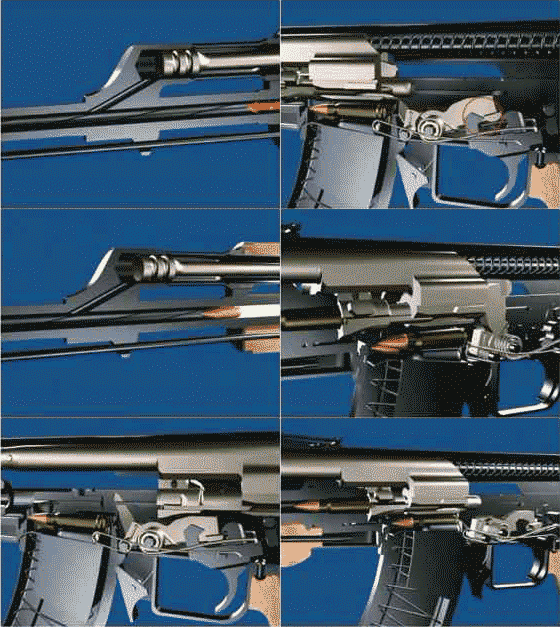
I love this!
I watch it over and over as if I don’t have other things to do to get ready for Christmas.
This is from Miguel at Gun Free Zone.

I love this!
I watch it over and over as if I don’t have other things to do to get ready for Christmas.
This is from Miguel at Gun Free Zone.
According to a post from the NFA Owners Association, it seems that Senate Majority Leader Harry Reid has not scheduled any hearings or votes on the nomination of Andrew Traver to head ATF.
“Pinky” Reid is showing his true colors again.
He is stealthily, but very clearly, supporting anti-gun zealot Andrew F. Travers, to become the new head of BATFE. He has to do this by stealth in order to maintain the myth that he is a strong supporter of our RKBA.Reid has NOT made any real effort to ensure the Traver nomination is voted on before congress adjourns.
This is typical of him.
He will let Traver become a recess appointment, then continue to claim that he “really does” support our RKBA. If anyone complains he will deny all responsibility, probably blaming the republicans for time running out.
Readers here might remember that one of the claims for allowing Reid to remain in office was that he is SENATE MAJORITY LEADER, and a (claimed) supporter of our RKBA. IF he TRULY wanted Traver’s nomination to be scheduled and voted on it would be.
I checked with his DC and local office, asking when a hearing would be held.
They could not give me a direct answer. The D.C. office insisted they did not know, and transferred me to a busy signal. The Carson office promised to send me a written response, which I expect to get several days after the question is moot.We can let him slide on this, or we can demand that he actually make more than a token effort to REPRESENT US on this!
Contact info:
Senator Harry Reid (D) NV.
Web site: http://reid.senate.gov
Mail: United States Senate
Washington, DC 20510-2803
Ph. (202) 224-3542, Fax (202) 224-7327Carson City – Ph. (775) 882-7343
Reno – Ph. (775) 686-5750
Las Vegas Ph. (702) 388-5020
Rural Mobile – Ph. (775) 772-3905
Using senate rule 14 Reid could easily bring the Travers nomination to a vote before the “Lame Duck” session’s end.
That he is NOT doing so confirms for me that he intends to see ATF headed by an anti-RKBA zealot via “Recess Appointment”, and deny all responsibility for it.
I checked status on this before posting, as of today there is still no hearing scheduled for the Travers appointment.
While this does make some sense and would make it easier for Traver to be a recess appointment, I have to say I doubt that not scheduling a vote on Traver is akin to pushing Traver. Reid has plenty of other things on his agenda before the end of this session that are of greater importance to both Reid and Obama than Andrew Traver. Indeed, Reid has threatened to not recess the Senate in order to get it all in before the new Congress forms in January.
Full hearings in the Judiciary Committee take time for any nomination. Checking the committee’s website, no hearings of any sort have been scheduled for the month of December. They also have a number of judicial nominees that have had their hearings waiting for confirmation.
The last hearings held by the full committee were on November 17th which was the same day that Traver’s nomination was sent to the Senate. The hearings on the 17th were for judicial nominations from May.
Frankly, I hope Harry Reid carries through with his stupid obstinate refusal not to recess because it prevents any recess appointments. Let’s face it, castrating the U.S. military’s nuclear capability is more important to Obama and Reid than Andy Traver.
H/T SayUncle
Then the Brady Campaign to Prevent Gun Ownership should feel very blessed. Seems they don’t have a lot of it and are begging for more.
A post from The Madman Raves discusses their fundraising email about the budget shortfall.
I guess in these hard economic times people are less likely to continue donating to an organization that is becoming increasingly irrelevant. What a shame. Not.
From the NRA Grassroots Alert:
BATFE Requests “Emergency”
Authority To Track Semi-Automatic Rifle SalesFriday, December 17, 2010
The Bureau of Alcohol, Tobacco, Firearms and Explosives has proposed that it be given emergency authority for six months, beginning January 5, to require about 8,500 firearms dealers along the border with Mexico “to alert authorities when they sell within five consecutive business days two or more semiautomatic rifles greater than .22 caliber with detachable magazines.” A Washington Post story reporting on the BATFE proposal described that definition as being applicable to “so-called assault weapons,” but it would also apply to many rifles that have never been labeled with that term.
The reporting requirement will apparently be imposed under the “authority” the BATFE has used in the past to demand reporting of other types of transactions from certain limited groups of dealers over the past 10 years, but the new proposal is far broader than any previous use of this authority. Of course, there’s no law today that prevents dealers from reporting suspicious transactions (or attempted transactions) to the BATFE, and dealers often do so. The BATFE is also free to inspect dealers’ sales records—either for annual compliance inspections or during a criminal investigation.
NRA-ILA’s chief lobbyist, Chris Cox, denounced the attempt to establish a registry of Americans who purchase semi-automatic rifles that gun control supporters ultimately want to see banned. “This administration does not have the guts to build a wall, but they do have the audacity to blame and register gun owners for Mexico’s problems,” Cox told the Post. “NRA supports legitimate efforts to stop criminal activity, but we will not stand idle while our Second Amendment is sacrificed for politics.”
The Post says “The plan by the Bureau of Alcohol, Tobacco, Firearms and Explosives revives a proposal that has languished at the Justice Department and in the Obama administration for several months,” and that the gist of the plan was proposed by Mayors Against Illegal Guns (MAIG) last year. It its August 2009 Blueprint for Federal Action on Guns, MAIG indeed proposed that “ATF should identify the long guns most linked to crime and require dealers to report multiple sales of such guns.”
The idea must have appealed to the BATFE, because in June of this year Congress’ Government Accountability Office released a report noting that BATFE officials had claimed that U.S. efforts to stop the smuggling of firearms to Mexico are hindered by “a lack of required background checks for private firearms sales, and limitations on reporting requirements for multiple sales.”
Curiously, in September, a draft of the Department of Justice’s Inspector General’s Office’s unfavorable review of BATFE’s Project Gunrunner, established to combat the trafficking of firearms to Mexico, didn’t mention multiple sales at all. But the final version of the review, released in November, mentions “multiple sales” 43 times and says “the lack of a reporting requirement for multiple sales of long guns – which have become the cartels’ weapons of choice – hinders ATF’s ability to disrupt the flow of illegal weapons into Mexico.”
Whether BATFE intends its plan as another expansion of its oft-criticized firearm sales record tracing empire, or to lay the groundwork for legislation or regulations restricting “assault weapon” sales, or to fatten the files the agency keeps at its National Tracing Center in West Virginia remains to be seen. And the legality of requiring sales reports on any long guns is also in doubt. When the Congress specifically imposed multiple sales reporting on handguns only, it implicitly stated its intention that the same requirement not apply to sales of long guns.
However, it is crystal clear that some in the Obama Administration agree with those who believe the answer to crime is always more gun control. In September, MAIG blamed crime in states that have “strong” gun laws, on states that don’t have the same laws. And ever since President Obama took office, gun control supporters have been blaming Mexico’s crime problem on America’s gun laws.
The fact that Mexico’s multi-billion dollar drug cartels have machine guns, rocket launchers, grenades, and other potent weaponry you cannot buy in the United States is, to gun control supporters, irrelevant. The fact that most of the cartels’ guns have never been on this side of the U.S. border is, as far as they are concerned, a trifling inconvenience. The fact that the cartels will never have enough “assault weapons” or any other guns from the U.S. to hand out to all the Mexican policemen, soldiers and politicians on their payrolls, is, in their view, an unimportant detail. And the fact that the murder rate in the United States is at a 45-year low, while crime in Mexico is through the roof (the murder rate in Juarez is 115 times higher than in El Paso) is, they would certainly say, a contradiction best ignored.
To read the BATFE’s Federal Register notice about the plan, and for information on how to send your comments, click here (http://edocket.access.gpo.gov/2010/pdf/2010-31761.pdf). Comments about the proposal will be accepted for two months; if you choose to comment, please state your firm but polite opposition to the plan.
Needless to say, the NRA will not only comment, but take whatever other action is appropriate to block this sweeping expansion of federal recordkeeping on gun owners. Stay tuned.

H/T Cam Edwards
Last week, Department of Justice attorneys representing the U.S. Postal Service filed a Motion to Dismiss the suit brought contesting the ban on firearms on Postal Service property. This suit was brought by the Mountain States Legal Foundation on behalf of Debbie and Tab Bonidy as well as the National Association for Gun Rights.
The Bonidys live outside of Avon, Colorado in an area which does not receive home mail service. As a result, they have to pick up their mail at the Post Office in Avon where they are provided a free mail box. The Bonidys, both of whom have Colorado concealed carry licenses, want to be able to carry a handgun for self-protection on the way to, while, and upon returning from picking up their mail. Current postal regulations prohibit possession of a firearm on USPS property including the parking lots.
The Motion to Dismiss the plaintiffs’ complaint seeks to have it dismissed pursuant to Federal Rule of Civil Procedure 12(b)(6). The Postal Service argues that even if all the facts are true as presented, the Bonidys have failed to state a viable claim. They argue that the Bonidy’s Second Amendment claim is precluded by existing precedents of the U.S. Supreme Court and the Tenth Circuit Court of Appeals. They summarize their argument as follows:
First, the regulation does not even implicate the Second Amendment because that Amendment does not extend so far as to protect the carrying of firearms on postal property. Second, even assuming that the USPS regulation implicates conduct protected by the Second Amendment, the regulation would pass constitutional muster. If the Court reaches the issue, it should follow the vast majority of courts and analyze the USPS regulation under intermediate scrutiny. But the USPS regulation passes muster under any level of constitutional scrutiny, including strict scrutiny. Accordingly, the Court should uphold the USPS regulation and dismiss this lawsuit.
The attorneys for the Postal Service have divided their argument into three parts. First, they argue that the Heller decision made the Second Amendment a limited right. Second, they argue that Postal Service property including parking lots fall into the “sensitive places” exclusion of Heller. Third, they argue that even if the District Court does get to the point of conducting an independent analysis, they will find there is no Second Amendment right to have a handgun on Postal Service property and that intermediate scrutiny is the proper level of scrutiny.
The first of their arguments is that the Second Amendment is a limited right. They start by examining the Heller decision. They note that in Heller, “the Court repeatedly emphasized that the District of Columbia handgun ban extended ‘to the home, where the need for defense of self, family, and property is most acute.'” This emphasis on the home is to point out that the Second Amendment protection outside the home is more limited. They then go through some of the exceptions noted in Heller such as the mentally ill, felons, and laws forbidding the carrying of firearms in “sensitive” places. They then note that the Supreme Court limited the types of weapons protected. However, here they misstate Heller by saying that the Second Amendment protection was limited to “‘those in common use’ at the time of the Amendment’s passage” which implies that we are limited to flintlock pistols, Kentucky rifles, Brown Bess muskets, and fowling pieces.
As part of their argument that the Second Amendment is a limited right, they examine how lower courts have treated the Second Amendment and what level of scrutiny they applied post-Heller. In general, the cases they cite in defense of their position used intermediate scrutiny or some level approximating it if the courts got to the point of applying any level of scrutiny. This level of scrutiny generally requires the challenged law or regulation be substantially related to an important governmental objective.
However, many courts avoided trying to determine any level of scrutiny by comparing the law being challenged on Second Amendment grounds to the list of “longstanding prohibitions” provided in Heller. As an aside, I get the feeling that the Justice Department lawyers are trying to “guide” the District Court to take this approach.
The second of the arguments presented is that the USPS property is a sensitive place and thus the USPS regulations forbidding firearms do not violate the Second Amendment. After a discussion of how the Tenth Circuit and other Courts of Appeal have handled the Second Amendment and felons in possession, they note that courts have extended the logic of Heller “to conclude that prohibitions of firearms beyond those specifically enumerated in Heller do not violate the Second Amendment.” Included in this extension are misdemeanor domestic violence convictions, possession by drug users, and prohibitions against firearm possession by illegal aliens.
If categories of restrictions beyond those enumerated in Heller do not violate the Second Amendment, as the Tenth Circuit has held, then the constitutionality of the USPS regulation, a quintessential “law[] forbidding the carrying of firearms in sensitive places such as schools and government buildings,” Heller, 128 S. Ct. at 2817, follows a fortiori.
They specifically note that courts have interpreted sensitive places broadly. In a Fifth Circuit case, U.S. v Dorosan, a Postal Service employee’s conviction for having a handgun in his car on a USPS parking lot was upheld since they found the Postal Service “used the parking lot as a place of regular government business.” Other places that the Federal courts have found to be sensitive places include park facilities, fairgrounds, aircraft, proximity to a school zone, and National Park lands. On this last location, National Park lands, they devote a full page to U.S. v Masciandaro. This was a 2009 case in Virginia where the court found that though it wasn’t specifically mentioned in Heller it would “fall within any sensible definition of a ‘sensitive place.'” Indeed this court found that roads and parking lots are even more sensitive because they are “frequented by large numbers of strangers, including children.” The Justice Department attorneys fail, however, to point out that later Congressional action specifically allowed firearms in National Parks as of February 2010.
The third and final argument raised on behalf of the Postal Service is that if this court does undertake an independent analysis it will find that the USPS regulation doesn’t violate the plaintiffs’ Second Amendment rights. Moreover, they argue that the appropriate standard to use is intermediate scrutiny. Their argument is that the USPS regulation is one of the “presumptively lawful regulatory measures” identified in Heller. As such, they say the Bonidy’s claim should be denied as a matter of law.
As Heller expressly approved the comparison of the Second Amendment to the First, 128 S. Ct. at 2799, 2821, this doctrine reinforces the notion that the “presumptively lawful regulatory measures” enumerated in Heller – such as restrictions on carrying firearms in “sensitive places” – are outside the reach of the Second Amendment altogether.
The Justice Department attorneys argue that this court should follow the majority of other courts and apply intermediate scrutiny. They argue that the USPS regulation banning firearms on their property is similar to a “time, manner, place” restriction that would bear intermediate scrutiny in the First Amendment context. The restrictions, they argue, are minor and consistent with the government acting in a proprietary capacity. The example they use for comparison is the USPS restrictions on the solicitation of “alms and contributions on postal premises” by charities.
The conclude their final argument in favor of dismissal by saying that the gun ban on USPS property would pass constitutional muster under any level of scrutiny, even strict scrutiny. They assert that the ban is in the interest of “promoting order and public safety and preventing criminal violence” on Postal Service property which courts have found to be legitimate and compelling. Moreover, the regulations are “narrowly tailored and substantially related to furthering public safety.” They end by quoting an aside from the Dorosan case where the Fifth Circuit Court of Appeals suggested Mr. Dorosan could have just parked elsewhere if he wanted to have a gun in the car and to abide by the regulation.
I do not know how this District Court will look upon this Motion to Dismiss. Nonetheless, this Motion to Dismiss is important outside this immediate case because it gives a good look at the mindset of Justice Department attorneys regarding the Second Amendment within the Obama Administration. Other post-McDonald challenges on Second Amendment grounds have been against states and municipalities and not the Federal government. In this case we see a Federal entity, albeit a semi-autonomous one, which has regulations prohibiting firearms on their property. The argument made by the Justice Department is, in essence, we are the government and we say we have a good reason for the regulation. Therefore, it doesn’t impact your precious little Second Amendment so sit down, shut up, and park elsewhere.
From the Brady Campaign:
Brady Center Urges Court to Dismiss Lawsuit Seeking Right to Carry Guns During Riots and States of Emergency
Dec 16, 2010
Washington, D.C. — The Brady Center to Prevent Gun Violence today filed a brief in federal court in North Carolina urging the court to dismiss a lawsuit seeking a right to take up arms in streets and other public spaces during riots or other emergencies. The lawsuit challenges a longstanding North Carolina law that allows gun carrying on a person’s property but temporarily bars public gun carrying in the vicinity of a riot and during states of emergency.
“The Second Amendment does not grant a right of vigilantes to take up arms on our streets during a riot or state of emergency,” said Paul Helmke, President of the Brady Center to Prevent Gun Violence. “Police and emergency responders seeking to quell a riot or deliver aid during an emergency should not be forced to contend with legally-authorized armed individuals and groups roaming alleys and public streets.”
The Brady Center’s brief argues that there is no right of armed vigilantes to take to the streets during riots or congregate in the vicinity of emergency responders trying to secure a downtown during riots, looting, or terrorist attacks. The prospect of police and emergency responders being powerless to stop bands of armed citizens from taking to the streets during emergencies, looting, or rioting poses a serious threat to the government’s ability to maintain public order and deliver emergency services. If the lawsuit were successful, law enforcement would be unable to detect whether roaming armed individuals or gangs were would-be looters, terrorists, or vigilantes, thus jeopardizing their safety and their ability to respond to states of emergency.
The U.S. Supreme Court recently held that the Second Amendment grants a right to possess a gun in the home for self-defense, but emphasized that this right “is not unlimited” and is subject to “reasonable firearms regulations.” The Supreme Court has held that bans on carrying concealed weapons do not violate the Second Amendment and courts have given the government broad authority to restore order during riots and emergencies.
The lawsuit, Bateman v. Purdue, was filed by the Second Amendment Foundation in the United States District Court for the Eastern District of North Carolina. The Brady Center’s brief was joined by North Carolina Million Mom March Chapters of the Brady Campaign to Prevent Gun Violence and the Religious Coalition For a Nonviolent Durham. The brief was filed by attorneys with the Brady Center and the firm Hogan Lovells US LLP, along with Drew Erteschik of the Raleigh, N.C. firm Poyner Spruill LLP.
To paraphrase Lynyrd Skynyrd –
Well, I heard Ms. Brady sing about her
Well, I heard ole Sarah put her down
Well, I hope Sarah Brady will remember
A Carolina man don’t need her around anyhow
UPDATE: David Codrea has some good commentary on this nonsensical press release from the Brady Bunch in his National Gun Rights Examiner column.
In a story in the Washington Post that I linked to yesterday about the BATFE’s proposal to require reporting of multiple purchases of certain rifles was a little tidbit about who pushed the nomination of Andrew Traver in the Obama Whitehouse. Turns out it was Rahm Emanuel according to Ben LaBolt who is a spokesman for Emanuel’s mayoral campaign.
LaBolt said that Emanuel recommended Andy Traver of Chicago to be nominated by Obama to be director of the ATF and was the “point man” in the Clinton administration when Congress passed an assault weapons ban and required background checks for gun sales. Clinton later blamed those bills for the GOP takeover of Congress in 1995.
The plot thickens.
Not only did Alan Gura have to fight the District of Columbia over the Second Amendment, now he is having to fight them in an effort to get paid for his efforts in the Heller case. The Legal Times Blog is reporting that the District of Columbia is balking over the bill submitted to the District Court by Gura. Basing his bill for fees on the prevailing market rates for complex Federal litigation, he submitted a request for $3.13 million to Judge Emmet Sullivan. This was for over 3,000 hours of billable time for six attorneys including himself.
The District has countered that they should only have to pay $722,000.
Samuel Kaplan of the District’s Office of the Attorney General argued the plaintiffs’ team had failed to prove why they should receive compensation on par with major law firms in the District. Kaplan called the gun litigation complicated but not complex, a term he reserved for class actions.
Kaplan said Gura’s team did not build the case from scratch, relying instead on what he called decades of scholarly literature on the Second Amendment.
It takes a lot of gall to say the premier case establishing the Second Amendment as an individual right is merely complicated but not complex which is a designation that the District’s attorneys reserve for the cases brought by the bottom-dwelling plaintiff’s attorneys for stuff like cigarette smoking and exposure to asbestos.
Judge Sullivan, according to this account, questioned whether he should take the District’s finances into account when considering Gura’s bill and how much he should be paid from the taxpayer’s money. Gura countered,
telling Sullivan he (Gura) should not be (in) a position that requires him to assess the city’s budget priorities. Sullivan should base his fee ruling on an objective analysis of market rates and performance, Gura said.
My humble suggestion to Judge Sullivan is that if he doesn’t want to use taxpayer money to pay Mr. Gura he should take it out of the assets and retirements of the so-called public officials who passed the handgun ban in the first place as well as those like former Mayor Adrian Fenty who kept enforcing the unconstitutional ban.
The bottom line is that it is well past time for the District of Columbia to stop being cheap bastards. You lost and we won. Now pay up.
UPDATE: After Mark C. made the comment below, I looked up Alan Gura’s motion for fees. You can find it here. It is brought under 42 USC 1988 as he surmised. If you want to know about the history of the Heller case, it is worth reading the few first pages.
And how to prepare for the Zombie Apocalypse among other things as answered on the gun forums.