ISRA On Cook County’s Brief In Wilson v. Cook County

Wilson v. Cook County is the State of Illinois case challenging Cook County’s Blair Holt Assault Weapons Ban. It was remanded back to the the First District Appellate Court for reconsideration based upon the McDonald decision.

Here is the Illinois State Rifle Association’s take on Cook County’s brief which they released this morning.

The Cook County State’s Attorney’s Appellate Court defense of the county gun ban (Wilson, et. al. v. Cook County, et. al.) got off to a bad start when briefs filed by the county before the First District Appellate Court were found to contain factual errors. More specifically, these factual errors included the misquoting of U.S. Supreme Court decisions in the DC v. Heller and McDonald v. Chicago cases. (The ISRA was a Plaintiff in McDonald). When these errors were brought to light by the plaintiffs, the county hastily filed a motion to withdraw the erroneous briefs in favor of amended versions. Presently, the plaintiffs in the case have moved to strike the amended briefs as the amendments do not remedy the ramifications of the misquotes contained in the original set of briefs. In fact the County may have used their own “errors” to further violate the Court’s rules and to additional arguments and bolster existing arguments in their amended brief.

“We find it interesting that the Cook County State’s Attorney’s office would blame ‘electronic errors’ for the tainting of its briefs with misquotes,” commented ISRA spokesman, Richard Pearson. “This situation is made all the more curious given that the misquotes would fundamentally alter the intent of two landmark Supreme Court decisions – D.C. v. Heller and McDonald v. Chicago. In the county’s briefs, the two high court decisions are erroneously quoted as addressing ‘common handguns’ whereas the decisions, as written, do not contain the phrase ‘common handguns.’ There is a clear difference when one addresses handguns versus ‘common’ handguns in that the latter would drastically reduce the types of firearms whose ownership is protected under the Second Amendment.”

“If I were a cynic,” continued Pearson, “I’d suggest that these ‘electronic errors’ were just poorly executed attempts by the Cook County State’s Attorney’s office to re-write the Heller and McDonald decisions more to Mayor Daley’s liking.”

The ISRA is the state’s leading advocate of safe, lawful and responsible firearms ownership. For more than a century, the ISRA has represented the interests of millions of law-abiding Illinois firearm owners.

How the heck can an electronic filing system be responsible for misquoting Supreme Court decision? Does the Cook County State’s Attorneys Office have some sort of computer-generated, artificial intelligence system with a random quote generator that writes its briefs? I sincerely doubt that a computer is at fault here. I guess this is just another of the gifts from Cook County and the City of Chicago like President Obama, Mayor Daley, and Andrew Traver.

Peruta Case Appealed To Ninth Circuit Court Of Appeals

On Tuesday, the attorneys for Edward Peruta, the California Rifle and Pistol Association, and the other plaintiffs in the case suing the County of San Diego and Sheriff William Gore over the “good cause” requirement filed an appeal of the case to the Ninth Circuit Court of Appeals.

NOTICE IS HEREBY GIVEN that Edward Peruta, Michelle Laxson, James Dodd, Leslie Buncher, Mark Cleary, and California Rifle and Pistol Association Foundation, Plaintiffs in the abovenamed case, hereby appeal to the United States Court of Appeals for the Ninth Circuit from the final judgment of the district court, entered in this case on December 10, 2010 (attached hereto as Exhibit “A”); the district court’s order denying Plaintiffs’ Motion for Partial Summary Judgment and granting Defendant’s Motion for Summary Judgment, also entered on December 10, 2010 (attached hereto as Exhibit “B”), and all interlocutory orders that gave rise to the district court’s judgment. Date: December 14, 2010

Unfortunately, nothing about the appeal is showing up yet in the Pacer System for the Ninth Circuit. The above is from the District Court.

As many have commented elsewhere, the Ninth Circuit is one of those weird circuits where you can get a great three judge panel or a horrible three judge panel. Given the very size of the circuit, the nation’s largest, you could have a judge from Alaska, Montana, and Arizona on the three judge panel or you could get two from San Francisco and one from Hawaii. Moreover, with 47 judges on the Appeals Court whose appointment ranges from JFK to George W. Bush, you have a wide variety of judges.

It will be interesting to see what happens with this case. Even a loss here if coupled with a win in another circuits would not be all bad. There are a number of cases contesting carry regulations in other circuits such as Kachalsky in the 2nd, Woollard in the 4th, and D’Cruz in the 5th. Diversity of opinions between the circuits would make it more likely that the Supreme Court would grant certiorari to at least one of the carry cases.

Washington Post In Tears Over NRA’s Influence

The Washington Post ran a story today that was intended to be a hit piece on the NRA and its influence on Congress. It is part of their The Hidden Life of Guns series.

In the story they decried the amount of money the NRA spent on Congressional races of which 80% were won by NRA endorsed candidates. However, if you look at the graphic presented for House races, the striking thing is that for the majority of endorsed candidates the NRA spent nothing. As in nada, zilch, zero.

While not true for the Senate, in the House races even when the NRA endorsed candidate lost, their opponent was usually as good on gun rights as the endorsed candidate. I wonder how the Post would like to play that little tidbit.

There are a number of good blog posts on this article in the Post. Instapundit linked to the story with the snarky intro – WHEN IT’S BAD THAT CIVIL RIGHTS GROUPS have influence. Bob Owens at Confederate Yankee applies a proper fisking to the story as well.

Finally, in the not connecting the dots category comes this from Don Davis of Don’s Guns and Galleries in Indianapolis who only yesterday they pilloried for being number three on the list of crime guns traced.

Don Davis, 77, has run Don’s Guns and Galleries in Indianapolis for 37 years and says he is one of the highest-volume dealers in the region. A big supporter of the Second Amendment right to bear arms, Davis resigned from the NRA many years ago. “They used to be an organization for the hunter and the fishermen,” he said recently. “Then they got into politics. They’re so political, that’s what they do with their money. Today if you say anything about a gun, they use their money to run against you.”

If it weren’t for the NRA being political, Mr. Davis and his gun shop would have been forced out of business long ago by the gun control forces.

UPDATE:  Sebastian at Snow Flakes in Hell does a good job dissecting the Washington Post article. Also both he and Thirdpower over at Days of Our Trailers caught the bit about Ray Schoenke being paid by the Obama campaign to shill for them to gun owners. I missed that part.

FNH SCAR Mk20 SSR Approved For Full-Rate Production

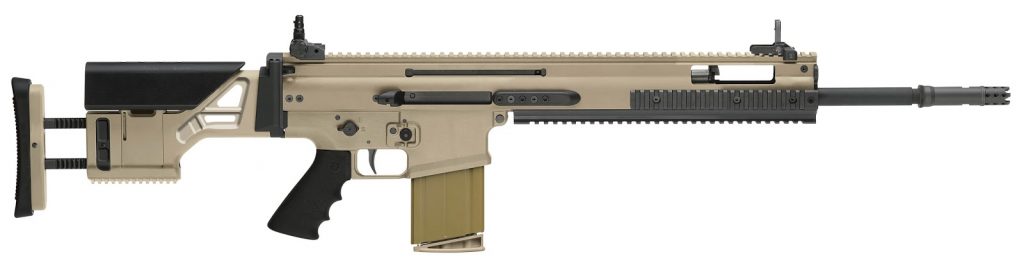
In a press release sent out today from FNH-USA, it was announced that US Special Operations Command had approved the FNH SCAR Mk 20 MOD 0 Sniper Support Rifle (SSR) for full-rate production. The Mk 20 is expected to start being fielded in mid-May 2011.

According to FNH, the Mk 20 was originally meant to be the sniper variant of the SCAR-H which is now designated the Mk 17. However, after the Mk 17 reached the “status of Operationally Effective/Operationally Suitable and Sustainable”, the Special Operations sniper community worked to refine the sniper variant to better suit the needs of long range, precision shooting. After these refinements and revisions, it was designated the Mk 20.

FNH-USA describes the Mk 20 as follows:

The MK 20 features an extended receiver which provides the additional rail space required for mounting in-line night vision and thermal devices with standard/sniper day optics, a non-folding precision stock with an adjustable cheek piece and length of pull that provides adjustability and a more rigid firing position for making long range target engagements, a beefed up barrel extension and barrel profile to reduce whip and improve accuracy, and an enhanced modular trigger that can be configured for single-stage or two-stage operation, requires no adjustments, and is ruggedized for field use. As a part of the SCAR Family of Weapons, the MK 20 shares a high percentage of parts commonality (over 60%) with the MK 17, maintains the enhanced ergonomics and improves accuracy.

The barrel of the Mk 20 SSR is free-floated, chrome-lined, and cold hammer-forged. It has an estimated service life of more than 15,000 rounds.

Back during the summer there was some confusion and controversy on whether the full SCAR line had been approved for Full-Rate Production. Initially, the impression was given by FNH-USA that the SCAR-16 (or SCAR-L) had been approved but this was in error.  Only the SCAR Mk 17 (formerly SCAR-H) and the Mk 13 grenade launcher were approved at that time. With the addition of the Mk 20 SSR, this makes three members of the SCAR family approved for full-rate production and fielding to the Special Operations community.

Light Blogging Due to Network Outage

There will be light blogging for today and tomorrow. Earthlink’s DSL is down in our region due to some network problems.

My theory is that the cold weather caused it. It was 5 deg. when I got in my car this morning at 8am. And supposedly North Carolina is the “Sunny South”. As the Instapundit would say, heh!

I’m writing this at the local Public Library. I’m sure they would be horrified to know that guns are being discussed within the confines of the library. Or maybe not – this is western North Carolina and it isn’t Asheville.

UPDATE: Earthlink said DSL would be up by 1:30pm tomorrow. It was up at about 6pm. I have to give them credit for doing a good job.

I Lost A Bet And I’m Happy About It

The Complementary Spouse and I had a bet on whether I would have 100,000 visits to this blog before the end of 2010. I think the total was in the 60,000 range when we made the bet. Obviously, she had more faith in me than I did. The 100,000th visitor was yesterday evening and was from the state of Ohio.

Our bet was for $1 just like in the Dan Ackroyd – Eddie Murphy movie Trading Places.

As I said, I lost the bet and I’m happy about it. Thanks to all who have visited and continue to visit this blog.

Also, thanks are due to other bloggers like Sebastian, SayUncle, Instapundit, Dave Hardy, and David Codrea who have linked to my posts here. Without them and their links to this blog, I’d still be puttering along with a few hits a day.

Finally, thanks to the Complementary Spouse aka The Blog Widow for her faith in me and this blog.

Judge Rules For San Diego In Concealed Carry Challenge

Judge Irma Gonzalez ruled for San Diego on Friday in Peruta v. County of San Diego. She denied the plaintiff’s motion for a partial summary judgment and granted the defense’s motion for a summary judgment. The case was a challenge to to how San Diego Sheriff William Gore chose to define the good cause requirement of the California concealed carry permit. He required that an applicant show more than a generalized fear for one’s personal safety as a reason. Supporting documentation was also required by the sheriff.

Judge Gonzalez states that the key question in the case is whether the right to possess a handgun in one’s home for self-defense extends to either concealed or open carry of a loaded handgun. In her opinion, she starts by discussing the scope of the right to keep and bear arms. She noted that the Heller decision applied a place and manner analysis to D.C.’s prohibition on handguns. As we know, the Supreme Court found that the right of citizens to have a functional firearm including handguns in the home for self-defense was fundamental under the Second Amendment. However, outside the home they noted the Second Amendment right was not unlimited.

Judge Gonzalez then examines the plaintiffs’ contentions in the context of California law. Peruta maintained the under California law, the single outlet for a self-defense with a handgun was Cal. Penal Code Section 12050 with allows sheriffs to grant concealed carry licenses. After examining the California law governing open carry, both loaded and unloaded, she finds many exceptions that would permit self-defense with a handgun. Therefore, she refuses to accept Peruta’s contention that Cal. Penal Code Section 12050 is the sole outlet for self-defense with a handgun outside the home and that Cal Penal Code Section 12031 places an unlawful burden on the right to carry for self-defense.

The opinion looks at the 19th century cases dealing with concealed carry just like the Supreme Court did in Heller.

Because Defendant’s policy for issuing concealed carry licenses under section 12050 would pass constitutional muster even if it burdens protected conduct, the Court does not need to decide whether the Second Amendment encompasses Plaintiffs’ asserted right to carry a loaded handgun in public.

Judge Gonzalez then examines the appropriate level of scrutiny. While the plaintiffs argue that strict scrutiny is appropriate, she isn’t persuaded and notes that “fundamental constitutional rights are not invariably subject to strict scrutiny.” Moreover, she says, intermediate scrutiny is the norm of most courts as seen in the post-McDonald litigation. Such scrutiny allows government to “paint with a broader brush” and conduct is allowed so long as it is significant, substantial, or important.

In this case, Defendant has an important and substantial interest in public safety and in reducing the rate of gun use in crime. In particular, the government has an important interest in reducing the number of concealed weapons in public in order to reduce the risks to other members of the public who use the streets and go to public accommodations. See Zimring Decl. The government also has an important interest in reducing the number of concealed handguns in public because of their disproportionate involvement in life-threatening crimes of violence, particularly in streets and other public places. Id. Defendant’s policy relates reasonably to those interests. Requiring documentation enables Defendant to effectively differentiate between individuals who have a bona fide need to carry a concealed handgun for self-defense and individuals who do not.

The Court acknowledges Plaintiffs’ argument that many violent gun crimes, even a majority, are committed by people who cannot legally have guns, and the ongoing dispute over the effectiveness of concealed weapons laws. See Moody Decl. But under intermediate scrutiny, Defendant’s policy need not be perfect, only reasonably related to a “significant,” “substantial,” or “important” governmental interest. Marzzarrella, 614 F.3d at 98. Defendant’s policy satisfies that standard. Accordingly, the Court DENIES Plaintiffs’ motion for summary judgment and GRANTS Defendant’s motion for summary judgment on Plaintiffs’ right to bear arms claim.

Compared to her discussion of the right to bear arms and the proper level of scrutiny, Judge Gonzalez disposes the remaining claims dealing with Equal Protection, the right to travel, and Due process rather quickly and in the San Diego’s favor. With regard to Due Process, she writes:

Pursuant to Erdelyi, the Court concludes that because Plaintiffs do not have “property or liberty interest in a concealed weapons license, the Due Process Clause did not require [Defendant]to provide [them] with due process before denying [their] initial [license] application[s].” Id. In any event, there is nothing to suggest that Defendant’s licensing procedures deprive Plaintiffs of the opportunity to be heard at a meaningful time in a meaningful manner. See Mathews v. Eldridge, 424 U.S. 319, 333 (1976). The Court GRANTS Defendant’s motion for summary judgment on Plaintiffs’ due process claim.

While a loss at the District Court level, undoubtedly this case will be appealed to the Ninth Circuit Court of Appeals. I know a lot of California gun owners are very disappointed in this decision as well they should be.

There are a number of discussion threads regarding this decision on the CalGuns Forum. One of the more important ones is by Gray Peterson who is the lead plaintiff in the Colorado case Peterson v. LaCabe. The thread deals with what should come next in light of this decision. One of the longer threads has been following the case since oral arguments were made. The decision is announced on page 10 of the thread.

Justice Breyer: “Get On A Subway And Go To Maryland”

Justice Stephen Breyer was on Fox News Sunday with Chris Wallace. They discussed the history and intent of the Second Amendment (and Breyer’s interpretation of it).

The money quote was when he said to Chris Wallace, “Are you a sportsman? Do you like to shoot pistols at targets? Well then get on the subway and go to Maryland. There is no problem!” This was in reference to Wallace noting that there is still an effective ban on handguns in the District of Columbia.

I just love how cavalier Justice Breyer appears in his discussion of the Second Amendment. There is no problem except that it is a fundamental right enshrined in the Bill of Rights. To have a sitting Associate Justice of the Supreme Court utterly dismissing my rights as an American just galls me to no end.

Lest we forget, Justice Breyer was Bill Clinton’s gift to American jurisprudence. While we don’t have to worry about any more Clinton appointments, we still must worry about Obama and any future appointments by him.

H/T Gateway Pundit

Update: Fox has posted a story on this interview. You can read it here. It will still make you mad. Cam Edwards says he intends to rebut it point by point on his show tomorrow.

Update II: Fox has posted the full interview. I have embedded it if you want to view it.