
 by
by Aaron at the Guns and Ammo Blog has his monthly listing of contests offering free guns and accessories up. Free is good! You can link to it here.
Concealed Carry and Public Restrooms
This is a good video on some of the things to consider while carrying concealed and using a public restroom. It is full of good tips. I really like the suggestions to use the “family” bathroom in a restaurant or store as you will the only one in there and the door can be locked. The video is 18 minutes long but worth it. You can always fast forward if you want or need to.
H/T Cowboy Blob
For North Carolina Voters
Grass Roots North Carolina and its GRNC Political Victory Fund have published their 2010 Remember in November Voters Guide. One of the key things to point out about this guide is that it does not endorse any candidate. Rather it surveys candidates and analyzes their voting records to see how they stand on gun rights.
As Paul Valone notes in his Charlotte Gun Rights Examiner column:
GRNC’s “Remember in November” candidate evaluation system factors survey scores, gun-related voting records, bill sponsorship and other measures into a spreadsheet which estimates the percentage of the time a given candidate can be expected to concur with a control group of GRNC’s Life and Benefactor members.
A candidate who agrees at least 90% of the time gets four stars (****), 80% gets three stars (***), 70% gets two stars (**), 60% gets one star (*), and an estimated agreement of less than 60% gets zero stars (0).
This system does not give an automatic advantage to incumbents like the NRA’s ranking system. They don’t make any deals with candidates for better ratings nor will they give a candidate a better rating in exchange for a donation.
The following is a key to reading their ratings from the GRNC website:
PAR/DIS: Candidate’s party and district. “D”=Democrat, “L”=Libertarian, “R”=Republican. Number is district number.
SURVEY: The percentages listed depict agreement between a given candidate and our control group (e.g. an “80” under the “Survey” section means 80% of the candidate’s answers agreed with the Conservative Gun Owners). “NR”means the candidate failed to return the survey.
VOTE: Votes are more accurate than surveys and should be given more attention in determining candidate stance. Where available, this column indicates how often candidates’ votes agree with the control group of gun owners (e.g. a “90” under “Voting Record” indicates candidate’s voting record agrees 90% of the time with what was desired by control group).
OTHER: Derived from evaluations by other gun groups, bill sponsorship, etc.
EVAL: The evaluation is not a rating. It estimates percentage of time candidate is expected to agree with the Conservative Gun Owners.
Challenge to Ban on Firearms on Postal Service Property
Attorney Jim Manley and the Mountain States Legal Foundation are taking on the US Postal Service’s ban on any firearm on USPS property. The challenge is on behalf of Debbie and Tab Bonidy of Avon, Colorado and the National Association for Gun Rights. A lawsuit, Bonidy et al v. USPS et al, was filed Monday in U.S. District Court for the District of Colorado.
The Bonidys live in a rural area of Colorado that doesn’t have home mail delivery. Because of that, the local post office in Avon, Colorado provides the residents of the area with a post office box at no charge. While they both have Colorado concealed carry permits and regularly carry, the Bonidys cannot carry concealed or openly when picking up their mail. They even can’t leave their firearms locked in their car as this would violate 39 C.F.R. § 232.1(l). This regulation reads:
(l) Weapons and explosives. No person while on postal property may carry firearms, other dangerous or deadly weapons, or explosives, either openly or concealed, or store the same on postal property, except for official purposes.
Violation of this regulation could subject them to a fine or imprisonment or both. Rather than risk this, they, through their attorney, requested that the USPS amend or repeal this provision as it was broader than other firearms restrictions on Federal property and because it went beyond what was allowed under the Heller decision.
In response to their letter, Mary Anne Gibbons, General Counsel for the USPS, informed the Bonidys that the USPS believed that it was on firm legal ground and that bringing firearms on Postal Service grounds would indeed violate 39 C.F.R. § 232.1(l). She said the Postal Service would be seeking the advice of the Justice Department on the issues raised on behalf of the Bonidys.
The lawsuit is seeking a permanent injunction against the enforcement of the Postal Service regulations on the grounds that:
By prohibiting Plaintiffs from possessing a functional firearm on real property under the charge and control of the USPS, Defendants currently maintain and actively enforce a set of laws, customs, practices, and policies that deprive Plaintiffs of the right to keep and bear arms, in violation of the Second Amendment.
In addition to the injunction, the plaintiffs are seeking costs, attorney fees, and any further relief that the Court may award.
In a parenthetical note, this is the first time that I am aware that the National Association for Gun Rights has been a party to any post-McDonald litigation. Due to their sensationalist “alerts” on Rep. Bobby Rush’s HR 45 as a means of fund-raising, they have not been taken too seriously in the past. If this lawsuit marks a change in their direction, so much the better.
Open Carry Lawsuit in Wisconsin
On Saturday, September 18th, five members of Wisconsin Carry met and ate at a Culver’s (mid-west burger chain) in Madison, Wisconsin. According to the story in the Wisconsin State Journal:
Eight officers came to the restaurant and demanded identification from the five men, Gold said, adding that when two of them refused, they were handcuffed, disarmed and searched for identification, then given municipal citations for obstruction and released. Wisconsin Carry won a $10,000 settlement for a Racine man in a similar situation.
Two days later, the charges for obstruction were dropped against the two members who refused to provide identification. The Madison Police Department then filed disorderly conduct charges against all five of the Wisconsin Carry members. According to the press release from the MPD:
The complainant’s statement clearly reveals that she recognized the potential for violence from these armed men, and it was this fear that motivated her call to police. On the basis of this fact, the MPD will be rescinding the 2 obstructing citations. They were issued in error. Instead, citations for City Ordinance DC will be given to those who engaged in the behavior that led to the need for police to be called.
The DC statute does not require an actual disturbance take place, only that conduct in question is of a type that tends to cause or provoke a disturbance.
However, there is some dispute as to whether the “complainant” felt threatened or in fear. Wisconsin Carry summarizes the 9-1-1 call as follows:
At or about the time that the WCI members finished their meal and left the restaurant, a woman in her car observed them openly carrying handguns and called 911 to report it to the City of Madison Police Department. The 911 caller informed the dispatcher that she didn’t know if it was an emergency, the men were doing nothing wrong and appeared totally relaxed, weren’t threatening anyone and the restaurant was full of people but they each had sidearms and she didn’t know if that was legal.
Upon being informed by the 911 dispatcher that open-carry is legal the woman stated “then there is no problem and its not an emergency”. The dispatcher then suggests that if the woman is concerned or disturbed then it becomes a problem and the woman says “no they weren’t threatening anybody or acting threatening”. When the dispatcher informs the caller they are sending officers she says “well I feel bad then because they weren’t doing anything wrong”.
The full 9-1-1 call can be heard here.
It is important to note that while Wisconsin is one of the two states that still doesn’t allow concealed carry, open carry is legal. In April 2009, Wisconsin Attorney General J. B. Van Hollen issued an advisory memorandum regarding open carry. The memo’s summary states:
Under Article I, § 25 of the Wisconsin Constitution, a person has the right to openly carry a firearm for any of the purposes enumerated in that Section, subject to reasonable regulation as discussed herein. The Wisconsin Department of Justice (the Department) believes that the mere open carrying of a firearm by a person, absent additional facts and circumstances, should not result in a disorderly conduct charge from a prosecutor.
If the behavior reported in the 9-1-1 call is accurate, then it appears that the actions of the Madison Police Department go beyond what the Attorney General’s advice suggests. The memo specifically states that under a Terry or investigative stop, while officers can ask questions, the person is under no obligation to answer them or to be compelled to identify him or herself.
In response to these charges of disorderly conduct and the subsequent policy proclamations in the City’s press release, Wisconsin Carry and four of the individuals involved filed a lawsuit against the City of Madison and Madison Police Chief Noble Wray in U.S. District Court for the Western District of Wisconsin on this past Wednesday (Sept. 29th). They are represented by the Troupis Law Firm of Middleton, WI and John Monroe of Roswell, GA. Monroe is the VP of GeorgiaCarry.Org and is currently handling a CalGuns Foundation sponsored case, Peterson v. LaCabe, in Denver, Colorado.
The lawsuit, Wisconsin Carry, Inc. v. City of Madison et al, alleges three causes of action in their request for a permanent injunction against Madison and Chief Wray. First, the suit alleges that the City of Madison and Chief Wray are violating the Second and Fourteenth Amendment rights of the plaintiffs by their demands for ID or face arrest solely because they were openly carrying a firearm. The suit goes on to say that the new policies announced by the Madison Police Department in their press release (see above link) are “designed and intended to chill and prevent WCI’s members free exercise of their Constitutional right to keep and bear arms.”
The second cause of action alleges that Madison and Chief Wray are subjecting “WCI members and other persons to invidious discrimination, and constitutes a violation of their right to Equal Protection secured by the Due Process Clause of the Fifth Amendment to the United States Constitution.” The plaintiffs allege the new policy and procedures outline on September 22nd in the press release constitute harrassment, establishes a policy of unreasonable search and seizures, and is hostile to the right to keep and bear arms.
The third and final cause of action states that by maintaining and enforcing the laws, policies, and procedures set forth in response to the open carry movement, Madison and Chief Wray are violating the Second and Fourteenth Amendment rights of Wisconsin Carry members and the other named plaintiffs. Wisconsin Carry and the other plaintiffs:
are deprived of equal protection by virtue of the fact that the Defendants are enforcing criminal laws against the Plaintiff’s members based solely on the exercise of their constitutional right to keep and bear arms, and specifically, on their choice to openly carry a firearm as allowed by law.
Specifically, the suit asks the court to provide a permanent injunction that mandates:
the City of Madison and its Police Department to rescind and retract the orders and recommendations contained in its press release issued on September 22, 2010, and requiring these Defendants to take immediate corrective action to instruct its police officers and the general public that these orders and recommendations violate the Constitutional rights of these Plaintiffs and others, and are therefore not to be followed.
The suit also asks for attorney fees and costs as well as damages in an amount to be determined at trial.
The City of Racine, Wisconsin had a similar incident in 2009 and was sued by Wisconsin Carry in U. S. District Court for the Eastern District of Wisconsin. In March of this year, a judgment was entered in favor of Wisconsin Carry. The City of Racine and two of their officers had to pay $10,000 as a result. Given that, I wouldn’t be surprised to see a negotiated settlement in this case along with a recision of the new Madison PD policies and procedures.
The Horror!
I’m stuck in a cafeteria where they have CNN’s Headline News blaring. For the last two hours, the news anchors have been “reporting” on the move in some states to allow firearms in bars and restaurants that serve alcohol. They are shocked (shocked!) that anyone would consider this. From their report, you are left thinking that liquored-up, testoterone laden guys will be shooting it out in bars like in the old Wild West movie.
Of course, most of the time they have failed to give the listeners the whole story. That is, while you may be allowed in the bar or restaurant with a handgun, you still are forbidden from drinking in most of these states.
They are asking for listeners to call in and give their thoughts on this. I wonder if any voice of reason can get past the call screener.
I presume that this story in the New York Times is what prompted HLN to go sensational with this.
Since I work during the day, I had forgotten what a vast wasteland daytime TV has become.
Impact of Cost and Time on Number of CCW Permits
The Texas Tribune just published an article examining concealed carry permits rates in various Texas cities. The major finding was that people living in the wealthier neighborhoods were more likely to have a CCW permit than those living in poorer neighborhoods.
Jonathon Hartsfield and Adam Kelly live on opposite sides of San Antonio. They both own guns, they’ve never been in serious trouble with the law and they’d both like to have a concealed handgun license — just to be safe.
But like many of his neighbors on the city’s low-income South Side, Hartsfield hasn’t applied for a gun permit, which costs $140 for the license fee and roughly $100 or more for the 10-hour instruction class. “I’d like one,” says Hartsfield, 22, who works at a shooting range on Pleasanton Road called A Place to Shoot. “It’s the cost and time to get it.”
Kelly, 36, lives on the city’s North Side — one of the most popular areas for concealed handgun licenses. Two weeks ago, he attended the mandatory class to obtain his permit. “It’s the right thing to do if you’re going to have a gun,” Kelly says.
This correlates very strongly with the research of Professor John Lott. At the recent Gun Rights Policy Conference, Lott noted that there was a 40% difference in CCW permits between states that require 9 hours of training and those that require only 8 hours of training. A 9 hour requirement suggests that the class must be taken over two days instead of just one.
As the article notes, the state of Texas requires 10 hours of training and a $140 application fee. Costs for taking the class average around $100. That requirement was set in 1995 when the law was first passed.
More Beginner Tips from Il Ling New – Stance and Body Position
Another video from Ruger Firearms featuring Il Ling New of the Gunsite Academy. In this video she discusses the proper stance and body position for a shooter.
GRPC – Day 3
The third day of the Gun Rights Policy Conference was only a half day. Peggy Tartaro, editor of Women & Guns, served as the moderator for this day. The day began with a session on knife rights.
Doug Ritter – founder and chairman of KnifeRights.org – They have trademarked the slogan “Knife Rights – The Second Front in the Defense of the Second Amendment”. Doug noted that the challenges faced with regard to knife rights are that the same groups against gun right are against knife rights, the anti’s are looking at knives as an easy target, and finally, they see attacks on knives as a backdoor to more gun control. The biggest challenge right now is the declared war on pocket knives by NY DA Cyrus Vance, Jr. who is attempting to shake down retailers in the same way that Tony Soprano might. A lawsuit is being readied against New York on this. The legal team will include Alan Gura and NJ gun rights attorney Evan Nappen among others.
Les de Asis – found and president, Benchmade Knives – noted that the Federal Switchblade Act was enacted in 1958. At that time, knife makers were not united and rolled over in the face of opposition. The difference now is that knife makers are united. Many companies have donated over $30,000 each to finance the pending litigation in New York City.
Todd Rathner – NRA Director and director of legislative affairs for KnifeRights – Said that we need to build support for knife rights at the state and local level. Pointed to their success in Arizona and New Hampshire. Said we have to be pro-active. Remember that knives are everyday tools.
The next session was entitled “Countering the Establishment Media Bias”. The session was moderated by Tom Gresham of GunTalk Radio.
Tom Gresham – Said that there was and was not media bias. Part of it comes from ignorance. Noted they usually don’t know they are wrong and we must work to educate and correct them. Rather than getting in their face about it, be smart and give a reasoned argument. Remember ignorant is not the same as stupid and the media isn’t stupid.
Declan McCullagh – CBS News – There is media bias. Political editors tend to be left of center. Some try to compensate for this, some don’t. The biggest bias is invisible bias – the story that isn’t written.
Malia Zimmerman – editor of the Hawaii Reporter – Discussed how to reach out to the media. Make an expert list and give out to the media. When dealing with TV reporters, make sure to talk to the cameraman as they tend to be more conservative and often ex-military.
Don Irvine – president of Accuracy in Media – To combat media bias, we need to be experts in using social media such as Facebook and Twitter. It allows us to get our message out even if the media won’t do it.
The third session of the day featured a discussion on campus safety and the battle for concealed carry on campus.
David Burnett, president of Students for Concealed Carry on Campus – The Virginia Tech shootings were a mini-9/11 for colleges. Discussed the empty holster protests which are a token of being disarmed. It has now spread to 130 campuses and has gotten a lot of publicity. Noted that students are being taught that being disarmed will keep them safe.
Jim Manley – staff attorney for Mountain States Legal Foundation – Discussed their lawsuit against the University of Colorado. Under the Colorado Concealed Carry Act, universities are areas where concealed carry is permitted. Won their case in the Colorado Ct. of Appeals but the university appealed to the CO Supreme Court. The Ct. of Appeals rejected rational basis – a lesser standard – as the standard of review.
Rick Walker – Western Regional Director, SCCC – Noted the importance to get to students now as they are the next generation of leaders. Help students to get involved; teach them they have a role.
The Battle for Places to Shoot was the next session. The various challenges to gun ranges on both public and private land was discussed.
Dave Workman – senior editor for Gun Week – Discussed the threats to shooting and hunting on public lands especially US Forest Service land. USFS has, in some areas, tried to use a non-existent law/court ruling to shut down shooting areas. Noted that the introduction of wolves along with endangered species will be used as a means to impact shooting on public lands because the noise might “bother” them. Pointed out HR 5523 which would prohibit the closure of public shooting on public lands. Need to see if your Congressman is a sponsor.
Guy Smith – founder of GunFacts.info – Suggested we get involved with the local shooting ranges so that they will survive. Need to keep track of local government meeting agendas as they are where the threat will come from. Pre-emption laws are our number one tool to keep ranges open.
Jim Bass – president of the Sacramento Valley Shooting Center – Ranges can’t avoid being on the radar of anti-gun groups and politicians. Ranges must absolutely make sure that they are in compliance with all environmental and lead abatement laws. Should have lead reclamation policies in place along with safety equipment.
The final presentation session of the day was a discussion of the gun rights battles of the future and how to prepare for them.
Joe Waldron – legislative affairs director of CCRKBA – Since the budget has not been passed by Congress yet, the funding acts for department such as Justice and Homeland Security will be targets for add-ons for gun control. Logic and facts are needed to pass pro-gun bills; only emotion is needed to pass gun control laws. The lame duck session could be very dangerous for gun rights if the Democrats lose.
Sean McClanahan – president of the Iowa Firearms Coalition – Said we need to encircle or hem in the anti-gunners. In the pursuit of gun rights, we should ignore party politics for the most part. Noted that “shall issue” concealed carry passed in Iowa due to a Democrat.
Alan Gottlieb – Joined the last session towards the end. Said we can never give up because if we do, we lose. We need to keep the anti-gunners on the defensive. Their advantage is that they have a common target – guns. We must present a united front and not air our dirty laundry in public.
The conference ended with the report of the resolutions committee and closing remarks from Alan Gottlieb and Joe Tartaro.
$500 Annual Fee for Concealed Carry?
NJ State Senator Jeff Van Drew (D-Cape May) has proposed a bill “to make it easier for New Jersey residents to carry handguns, and he thinks the state can make some money in the process.” Currently, you must show “justifiable need” to get a concealed carry permit in New Jersey.
According to the details of his bill, an applicant would have to pass a criminal background check including fingerprinting, take a NJ Police Training Commission approved course in the safe use, storage, and maintenance of a firearm, take a marksmanship qualification test, take another State Police Superintendent approved class on the lawful use of force and justifiable use of a firearm, and then pay an annual fee of $500 for the privilege of carrying concealed.
For this deviation from the party line, Van Drew has been accused by Bryan Miller, the Executive Director of NJ Ceasefire of “kowtowing to the pro-gun forces of darkness who want to turn this country into an armed society”. I love that phrase – pro-gun forces of darkness. I can just see the T-shirts now.
According to the article at NJ.com, this bill has only a long-shot for passage.
I’m not sure what galls me more – the $500 annual fee so a bankrupt state can meet its pension obligations or that the proponent of a concealed carry bill with incredibly onerous requirements and fees can be thought to be “kowtowing to the pro-gun forces of darkness.”
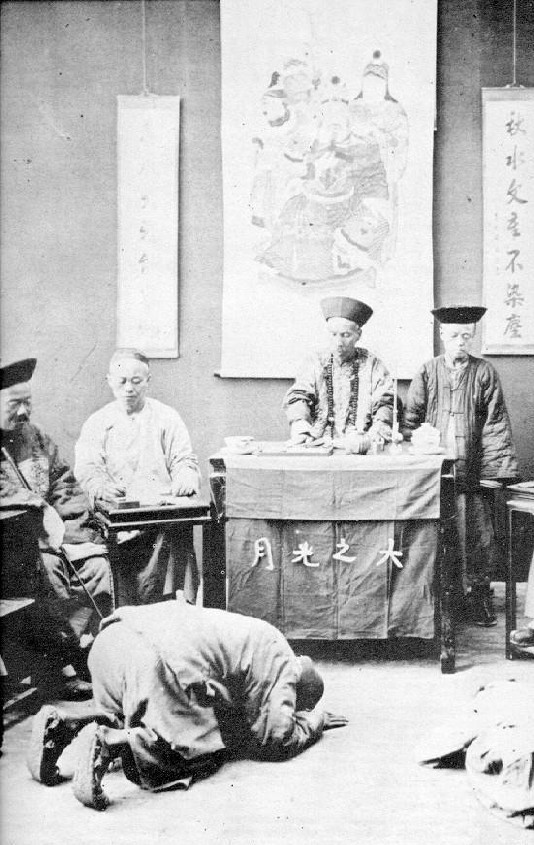 |
| A proper Kowtow |