GRPC – Day 2 – Part 2

More from Day 2 of the Gun Rights Policy Conference.

Sheldon Clare – President of National Firearms Association (of Canada) – Discussed the close vote on removing long arms (shotguns and rifles) from the Canadian Gun Registry. Noted that if it had been a truly “free” vote, it would have passed instead of losing 153-151. Rarely do party members stray from the party line on votes in the Canadian Parliament or they know they will pay the consequences from their party leadership.

Bill McGrath – legal counsel, Safari Club International – He said the biggest issue for gun owners and hunters is unelected bodies making rules, laws, and regulations. McGrath pointed to the European Commission as a prime example of this. The bureaucrats in Brussels make many rules that will eventually effect us. For example, the EU recently passed a regulation banning ammo in checked baggage. Most European countries have been allowed to opt out. However, if this regulation is adopted by the International Air Transport Association, it could impact us in the US. He pointed out the current 5 kilo limit on ammo in checked baggage is a result of the IATA.

Bob Barr – former Congressman from Georgia – Barr was the lunch speaker and spoke about the role of the United Nations on gun control. He specifically talked about the Arms Trade Treaty which the Obama Administration backs.

Tom Gresham – host of GunTalk radio and a director of SAF – Started by apologizing for dissing Californians. He noted the role of CalGuns and CRPA in changing policy in California. Some actions are to gain time and distance. For example, the sunset provision of the so-called Assault Weapons Ban bought us time to change Congress. When the Democrats agreed to that provision in 1994, they never thought they’d be out of power in 2004.

Alan Gura – attorney in the Heller and McDonald cases – noted that the SCOTUS have used substantive due process as a way to make up for screwing up on the Privileges or Immunities Clause under the Slaughterhouse cases. Had always planned to argue both substantive due process and the P or I clause in the McDonald case. You could tell he was still perturbed with the role the NRA played in taking some of his oral time in that case.

Gura later discussed the Ezell case in Chicago which is challenging the Chicago ban on gun ranges. He said when they looked at the new Chicago Gun Law, they looked for three things: low hanging fruit, annoying, and unconstitutional. The gun range ban was all three.

Donald Kilmer – attorney for Nordyke in the Nordyke v. King – Kilmer is one of the leading California gun rights attorneys. He said originally that the Nordyke case was a Pyrrhic victory as it declared the Second Amendment applied to the states but it didn’t allow the Nordykes to put on their gun show in Alameda County. Now, since the case is being re-argued in the 9th Circuit, there is a chance to get the gun shows restored on the Alameda County Fairgrounds. However, it goes beyond that since many other California counties adopted Alameda County’s ordinance, they would be overturned if Nordyke wins.

Gene Hoffman – CalGuns Foundation – Californians lost their gun rights incrementally and will win them back incrementally. Echoing what Alan Gura has said in the past, it is essential to pick the right fight with the right plaintiff. Discussed Sykes v. McGinnis which is challenging discretion in CCW permit cases. Noted that not being banned from owning a firearm and wanting to have a means of self-defense should be reason enough to get a CCW permit.

Massad Ayoob – Noted that Florida became a shall issue state in 1987. He pointed out that a lot of the grass roots groups have grown up post 1960s and post CCW legislation.

Bill Caffrey – Handgun Club of America – “Even idiots have rights” – Speaking of the AZ constitutional carry noted that no fees, no training, and no licenses may mean we have accidents or damn fools with guns. We need to encourage legislators to make it easier and cheaper to get training. By this he meant more range availability.

Alan Korwin – publisher and owner of Bloomfield Press – Noted that we should not be pro-gun but pro-rights and pro-freedom. This makes the opposition anti-rights and anti-freedom.

Gary Marbut – Montana Shooting Sports Association – The Federal government has expanded the Commerce Clause from colonial times. Discussed their case backing the Montana Firearms Freedom Act.

Nick Dranias – Goldwater Institute – Said we should look at the First and Second Amendment the same. You don’t license printing presses so you should do the same with arms.

Michael Boldin – Tenth Amendment Center – Noted that if enough states tell the Feds to lump it, the Feds back off.

Paxton Quigley – author, Armed and Female – said she had been anti-gun earlier in life. Then a good friend was raped and Quigley realized that if she had been armed, she would have been able to protect herself. Noted that the number of women who are firearms owners is growing. She discussed being interviewed for a feature in Marie Claire magazine.

Nikki Stollard – Pink Pistols – She was unexpectedly absolutely hilarious. She noted that Deana Sykes, the lead plaintiff in Sykes v. McGinnis, is the Sacramento head of Pink Pistols. The one thing the California press would hate to be seen as is homophobic. So, if the press attacks Sykes, then it is homophobic.

Dr. Timothy Wheeler – Doctors for Responsible Gun Ownership – said the scientific endeavor against gun rights (such as using the CDC) was as bad as the prejudice against guns in academia.

David Theroux – President, The Independent Institute – discussed the problems that they had with the Stanford University Press in publishing Stephen Halbrook’s book, The Founder’s Second Amendment. Ended up publishing it themselves as Stanford put up all sorts of roadblocks to stop its publication.

Unfortunately, I missed the last session of the day as the time change caught up with me.
Open Carry Win in California

UOC or unloaded open carry may seem like an alien concept to those of us who live outside of California. We understand concealed carry and we understand open carry. But unloaded open carry? However, in California, due to a quirk in the law, it is legal to carry an unloaded firearm openly and to have a loaded magazine or speed-loader elsewhere on your body.

To answer the question of why one would even bother all you have to do is look at the California Department of Justice concealed carry permit statistics. While in some of the more rural counties concealed carry permits are issued regularly, in the largest urban counties you can forget about it unless you are rich or famous or both. In San Diego County for the year 2007, there were only 1,479 permits issued out of a population of 2.8 million. That is about a .05% rate. Los Angeles County is even bigger in population (approximately 10.3 million) and even stingier with their permits (1,237). However, the dubious prize winner is San Francisco with just 6 permits issued in 2007.

To protest this disparity in granting concealed carry permits, there is a burgeoning Unloaded Open Carry movement in California. Activists will carry their firearms openly and unloaded in public. One such activist is Samuel Wolanyk of San Diego. In urban areas this can cause a bit of a stir. Here is how Gene Hoffman of the CalGuns Foundation describes Mr. Wolanyk’s encounter with police in San Diego:

Nearly two years ago, “open carry” activist Wolanyk wound up looking down the barrels of two police handguns when San Diego Police officers Jody Kinsley and Troy White responded to a call of a man wearing a kilt, with a holstered gun, in San Diego’s Mission Beach area. The officers immediately exited their vehicles on arrival at the location, drew their firearms, and ordered Mr. Wolanyk to the ground.

The officers quickly determined the firearm was unloaded, had no magazine in it, with no round in the chamber, and was thus in full compliance with California law. The firearm was unloaded even though Mr. Wolanyk did separately possess loaded magazines carried in an additional pouch attached to his belt (a completely lawful activity).

Until that day, these officers had never heard of the burgeoning Unloaded Open Carry movement, in which persons entitled to possess firearms exercise their right to lawfully carry unloaded, holstered handguns (though some onerous geographic limitations do apply). One other key legal restriction on open carry in California law also exists: people must give up their Fourth Amendment rights and submit to law enforcement examination of the firearm to determine if it’s loaded. In Wolanyk’s case, however, the officers weren’t performing a loaded firearm examination; in the officers’ minds, they were responding to a “man with a gun” call and acting accordingly.

After San Diego Police Sergeant David Kries arrived at the scene, Mr. Wolanyk had hoped the officers’ errors would be competently rectified and he would then be free to go. But Sgt. Kries showed he too didn’t understand California’s complex gun laws, and arrested Mr. Wolanyk for carrying a “loaded” firearm – in direct conflict with both prior case law (People v. Clark) and common sense, which requires ammunition to be in a position from which it can be fired in order for a firearm to be considered loaded. Mr. Wolanyk was taken to San Diego Police headquarters, where it was determined that he violated no law. Two hours later, Wolanyk was back at Mission Beach with Officer Kinsley handing him back his firearm and ammunition. Neither an apology nor an explanation of why the Department hadn’t properly trained their officers was provided.

This incident led to a CalGuns Foundation funded and supported lawsuit against the City of San Diego. One goal of Wolanyk v. San Diego was to ensure that the police officers of the San Diego Police Department were properly trained regarding UOC. The other, as one might well expect, was to clear Mr. Wolanyk’s name.

On Wednesday, September 29th, the City of San Diego settled the lawsuit rather than to go to trial with it. Mr. Wolanyk received $35,000 for his improper arrest and the SDPD granted his petition for a Finding of Factual Innocence which acknowledges that they had no reasonable cause for his arrest. Along with the settlement, the SDPD will enhance their training of their police officers to prevent such improper arrests in the future. This is definitely a win for civil and gun rights in California.

Now that the lawsuit has been settled, Mr. Wolanyk has posted the details of the incident on the CalGuns forum here. If the details are accurate, and I presume that they are, it is obvious that he knew the law on unloaded open carry more than the officers and police sergeant in question.

I am not an enthusiastic proponent of open carry as I think carrying concealed helps preserve your “gray man” status and preserves your element of surprise when dealing with the criminal element. That said, I do realize that open carry works to legitimize the carrying of firearms and desensitize the general public to the sight of a gun. As some have observed, it is akin to the gay rights movement in some of their protests. You may not always agree with them but you have to admit that they have been very effective in securing gay rights. In time, I hope the same will be said for the open carry activists.

Impressions of California – Bay Area and Central Coast

We are finishing up our trip to California’s Bay Area and Central Coast today. We are in the SFO terminal waiting for our flight back to North Carolina.

My first impression of San Francisco is that it is crowded. Even in the more residential areas, people live, to use a Southern expression, cheek by jowl. However, once you get out of the city, there is a lot of open space.

Driving along the Pacific coast, one can see why surfing is so big on the West Coast. It’s the waves. You just don’t see waves like this at East Coast beaches. The scenery is outstanding and the beaches are everywhere. And in many areas, there is little to no inhabitation.

Another quick impression – and that is all it is – of this part of California is that the high-tech cities and suburbs are heavily Anglo and Asian while the more agricultural or industrial areas are heavily Latino or Hispanic. I haven’t checked any data on this but when comparing the Silicon Valley suburbs to Salinas, this seems very evident.

If I were a wine drinker, I’d be in heaven. We found very good wine available directly from the winery as low as $60 per case. And little vineyards are everywhere both north and south of San Francisco.

Another impression is how vital agriculture is to the California economy. Whether along the coast between Half Moon Bay and Santa Cruz or inland in the Salinas Valley, agriculture is king. Along the coast we saw tons of Brussels sprouts and artichokes being grown while inland we saw the grapes, lettuce, etc.

Gang violence is a problem in some areas. While we were in Salinas, there was a 17 year old who was gunned down while walking with a friend. The friend ran away and the kid died. It was suspected to be gang related.

Finally, this place is mountainous! Whether inland or driving along the coast, the hills were everywhere. However, unlike my native Smokies, these hills are sparse and brown. I can see why wildfires are a major problem – one spark and you can have a grass fire. Moreover, with so many houses built on steep slopes, firefighters have a hard time just getting to the site.

It was a fun trip. The GRPC conference was great. We ate well, we tasted some nice wines, and we met some nice people. That said, it’ll be nice to get home even if we just had 3-4 inches of rain from a tropical storm. Regular blogging should resume tomorrow and into the weekend. There is a lot to write about and just not enough time!

SF Chronicle’s Non-Endorsement

This past Sunday the San Francisco Chronicle decided not to endorse either Barbara Boxer or Carly Fiorina. Given that newspaper’s reliably liberal leanings, that was quite a surprise. And from subsequent letters to the editor, it has angered their liberal readers.

The reason given for not endorsing Boxer is that she:

has failed to distinguish herself during her 18 years in office. There is no reason to believe that another six-year term would bring anything but more of the same uninspired representation.

Her voting record isn’t a problem for them as she is a reliable liberal and they agree with her voting record.

The Chronicle thinks Fiorina would be much more effective and work well in the Senate. However, they don’t like her positions on the issues. One of the one’s that they don’t like is gun control. They say:

her unwillingness to support even the most commonsense gun-control measures to keep assault weapons off the street or to deny guns to suspected terrorists on the federal “no fly list.”

Repealing ObamaCare and no immigration reform until the border is secure also make their list. In other words, Carly Fiorina represents mainstream positions on the issues according to most Americans but not the San Francisco Chronicle editorial board. One could only hope more Californians decide that Boxer is a hack and needs to be replaced than not.

Gun Permits: OK for Trump But Not For You

I’m sure that People magazine didn’t mean to make the case about the inequities in New York’s “may issue” concealed carry laws – but they did.

Among the big names licensed to pack heat: Marc Anthony, Robert De Niro, Donald Trump, and his son, Donald Jr., Mets third baseman David Wright, and Martha Stewart’s daughter, radio host Alexis Stewart.

Anthony, 42, has a special permit that allows him to carry a loaded weapon in the city, and has a similar permit for Nassau County, where he and Jennifer Lopez have a $2 million home in Brookville.

The article says that celebrities are feeling “vulnerable” due to the ease with which personal information can be found on-line. Excuse me if I don’t feel that sympathetic to these poor celebrities. The ordinary New Yorker doesn’t employ a publicist to push stories about them in the media and on the Internet. If they are feeling “vulnerable” then celebrities should look at their own behavior.

As to the average New Yorker, they can just forget it. So what if they are vulnerable to thugs, rapists, and murderers, they aren’t celebrities so they can just suck it up and deal with their fears.

GRPC – Day 2 – Part 1

Day 2 of the Gun Rights Policy Conference is the big day of the conference. Below are some of my brief impressions of the speakers and what they had to say.

Alan Gottlieb said the gun rights movement should emulate the civil rights movement if we want to achieve success. That is, it should be bottom up with the grass roots guiding the movement instead of top-down like the gun control groups.

Joe Tartaro, President of SAF, said that our goal is the preservation of our rights. He compared our opponents to characters in the classic movie The Wizard of Oz. As we go down the Yellow Brick Road, we first come to the Wicked Witch of the West. No surprise here – it’s Nancy Pelosi. Then there are the Flying Monkies – Eric Holder, Chuck Schumer, Hillary, and Lautenberg. Finally, there are the Munchkins – Michael Bloomberg, Mayors Against Illegal Guns, and his “munchkin mayors”.

Alan Gottlieb came back and said that judges are key in the next few years. He said that if the anti’s lose in the legislature, they will seek to impose gun control by using regulations out of the Executive Branch. The judiciary will be the only way to stop them. He noted that we can expect all new judicial appointments to be anti-gun. It will be a litmus test like being pro or anti abortion.

Larry Pratt – “DISCLOSE Act is like a gag. A gag in the throat is not the way to promote freedom under the Bill of Rights – not just gun rights.”

Jeff Knox of the Firearms Coalition – “Our single issue is liberty”. He made a point that we need to lose the word ALLOW. We should not say that we are allowed to exercise our gun rights. They are our rights to begin with.

State Senator Sam Sloam of Hawaii – “Hawaii is to the left of San Francisco and to the right of PyongYang, North Korea”.

Tom Pedersen – lobbyist for the California Rifle and Pistol Association – Litigation has changed the willingness of politicians to push anti-gun bills.

Richard Pearson – Exec. Dir. of Illinois State Rifle Association – “The Chicago tar pit is bigger and stickier than the LeBrea tar pit in California!”

Jim Wallace – Gun Owners Action League (of Massachusetts) – Stopped saying gun rights and started saying civil rights about 5 years ago. Has renamed the proposed one gun a month bill in MA the Lawful Citizen’s Imprisonment and Profiling Act.

Eugene Volokh of the Volokh Conspiracy said that constitutional rights are not as well protected by the courts as you would expect.

I’ll stop with that and do another report later on more from Day 2.

There’s An App for That

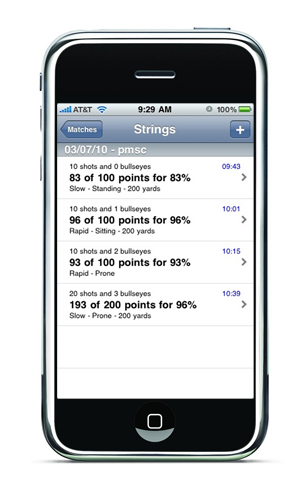
The Civilian Marksmanship Program has recently released an app for use with the iPhone and iPad. The app is for keeping score at CMP sponsored shooting events. In their words:

CMP is the official app for keeping score at Civilian Marksmanship Program sponsored shooting events. It features an easy to use interface that allows for quick recording of your score after each string. The CMP app calculates your shooting percentages automatically to let you know how you are doing throughout the event. You can also enter notes and record conditions so that you have a permanent record of details of each event. This application is sponsored and endorsed by the Civilian Marksmanship Program and a portion of the proceeds from the sale of this software are donated to the CMP.

 They have a link to the app store on their page linked above. All I can say – is there anything that doesn’t have an iPhone app anymore?

Great Project in Arizona

As you should know by now, Arizona has constitutional carry. You can carry a handgun openly or discretely without a license. There is no training requirement, no license, and no fee or tax that has to be paid. Some who put on the formerly required concealed carry permit class were upset at this and tried to rally opposition to it. They based their opposition to it on the need for training.

We all need training. That should be a given. The Arizona Citizens Defense League has stepped in with a great project to provide this training. They call it TrainMeAz.com.

Interested parties from around the state joined forces to promote gun-safety training, the shooting sports, self-defense awareness and exercise of the fundamental constitutional right of the people, to keep and bear arms for all lawful purposes. The goal is to advance marksmanship, safe gun handling, and a deep appreciation of the valuable role firearms play in a peaceful society, on a statewide scale.

 They maintain a list of all the gun trainers and training classes in Arizona, a list of ranges and other places to shoot, gun shows, and information for people traveling to Arizona.

To publicize their efforts they have, in addition to the website, a series of billboards publicizing the project.

Example of TrainMeAz.com billboard

They also have a special billboard on the border with California welcoming visitors from that state.

Words Matter

Alan Korwin was one of the panelists in the GRPC discussion on the Success and Future of Concealed Carry. Alan is the author and publisher of a number of books on firearms laws in the various states. Alan is a bit of a showman but he uses it effectively to get his message across.

He performed a very effective demonstration on the words we use. He had everyone attending the conference to stand up and  then asked who believed in gun rights. He got a big cheer. Doing the old routine “I can’t hear you” a couple of times, he got louder and louder cheers. Then he had everyone sit down. Alan then said if we keep calling it gun rights instead of civil rights, the anti’s will be able to continually attempt to marginalize us.

However, if we say we are pro-rights, then by definition it makes our opponents anti-rights. It changes the perception in people’s mind of who we are and what we do. Alan is correct. A person’s perception is their reality.

Alan has published a free “politically corrected” glossary on his website. You can read it online or download it as a PDF. It is well worth studying so that the next time you engage in a discussion of your rights with friends or co-workers, you will have more powerful words with which to make your argument.