Bumpstock Case Appealed To DC Court Of Appeals

As I reported a week ago, Judge Dabney Friedrich of the US District Court for the District of Columbia denied the motions for a temporary restraining order in the multiple bumpstock ban cases. The plaintiffs including the Firearms Policy Foundation and the Firearms Policy Coalition indicated they would appeal and they did. On Friday they requested an expedited hearing and briefing before the US Court of Appeals for the District of Columbia and it was granted.

More on the case from this joint press release from FPF and FPC:

WASHINGTON, D.C. (March 4, 2019) — Today, attorneys for Firearms Policy Coalition and Firearms Policy Foundation filed opening briefs in their consolidated appeals with the Court of Appeals for the D.C. Circuit in the ongoing federal litigation challenging the confiscatory “bump-stock” ban rulemaking by the Bureau of Alcohol, Tobacco, Firearms and Explosives (ATF). Copies of the briefs and related filings are available at BumpStockCase.com.

On February 25, United States District Judge Dabney L. Friedrich denied motions for preliminary injunction in the matters. The ruling came little over one year after President Trump directed the Department of Justice, at the time headed by Attorney General Jeff Sessions, to “as expeditiously as possible” propose “a rule banning all” bump-stock type devices. The challenged Final Rule was signed by Acting Attorney General Matthew Whitaker and published December 18, 2018.

Counsel for FPC and FPF filed notices of appeal on February 25, and on February 26, they requested an expedited appeal schedule from the Court of Appeals for the D.C. Circuit. Last Friday, March 1, a three-judge panel of the D.C. Circuit granted FPC’s and FPF’s joint motion to expedite the briefing and arguments, setting today as the deadline to file the opening briefs. The government’s answering brief will be due on March 13, and the appellants’ reply brief will be due on March 15. Oral arguments will be heard by the Court of Appeals on March 22 at 9:30 a.m.

In its brief, FPC argues that the Rule is invalid because it was issued by then-Acting Attorney General Matthew Whitaker. FPC explains that the designation of Mr. Whitaker – who was neither in the Department of Justice chain of command nor confirmed by the Senate – to serve in that role was both illegal and unconstitutional.

In the Guedes appeal, FPF argues that the text of the federal statutes at issue in the Final Rule are clear and unambiguous, that the rule of lenity precludes the ATF’s proposed new definition of ‘machinegun’, and that the rule is unreasonable, arbitrary, and capricious. The brief also argues that the “district court abused its discretion in finding the statutory language ambiguous and erred as a matter of law in according ATF Chevron deference regarding the terms ‘single function of the trigger’ and ‘automatically’.”

Thomas C. Goldstein, Daniel Woofter, Charles H. Davis, and Erica Oleszczuk Evans of Goldstein & Russell, P.C., are on the brief for the FPC appeal. Attorneys Joshua Prince and Adam Kraut of Civil Rights Defense Firm, P.C., and Erik Jaffe of Schaerr Jaffe LLP are on the brief for the FPF appeal.

Unless the appeals result in a temporary injunction or stay of enforcement, the ATF’s Final Rule will take effect on March 26, when the federal government will consider the affected devices to be illegal “machinguns” and carry severe criminal penalties including large fines and up to ten years in federal prison.

FPC and FPF remain committed to protecting Americans who own and possess bump-stock devices from the ATF’s unlawful Final Rule.

The case of David Codrea et al v. Barr will also be heard at the same time as the Guedes and Firearms Policy Coalition cases.

Stephen Stamboulieh, who is the attorney for Codrea et al, has this to say about the appeal:

This appeal is about an agency action in which a regulation was promulgated which seeks to dispossess hundreds of thousands of Americans from their private property. The ATF expressly acknowledges that “[b]etween 2008 and 2017, however, ATF also issued classification decisions concluding that other bump-stock-type devices were not machineguns . . . .” 83 Fed.Reg. 66514, 2018 WL 6738526 (Dec. 26, 2018). It is also undisputed that ordinary law-abiding individuals have spent, during that time period, millions of dollars of the purchase of such items in full reliance on repeated decisions of the ATF. Id. at 66543 (“This final rule is expected to have an impact of over $100 million in the first year of this regulatory action.”).


Yet, under the ATF’s new rule at issue here, if those Americans don’t surrender or destroy their heretofore legal private property, they will be prosecuted as felons. However, due to political pressure from an incident in Las Vegas at the Mandalay Bay and an instruction from President Trump to ban bump stocks, the ATF has taken an unambiguous congressional statute and has redefined plain text into something congress did not intend when it passed the National Firearms Act (“NFA”), just at ATF itself acknowledged during this time period. Worse, the district court sustained this agency action by applying the Chevron doctrine in direct contravention of controlling Supreme Court precedent that make plain that the Chevron doctrine has no place in the construction of criminal statutes.


Justice requires an injunction issue in this case. It requires such because the ATF has no authority to rewrite a congressional statute to fit the current agenda. Congress has expressly denied the ATF the authority to issue regulations with retroactive effect. “Congress alone has the institutional competence, democratic legitimacy, and (most importantly) constitutional authority to revise statutes in light of new social problems and preferences. Until it exercises that power, the people may rely on the original meaning of the written law.” Wis. Cent., Ltd. v. United States, 138 S.Ct. 2067, 2074 (2018). This is not merely a suggestion to the agencies, but a mandate from our highest court. While individuals may or may not like bump stocks, that “new social problem[ or] preference[]” is properly left to Congress to declare such and not an unelected agency which has stated over and over in the past that is has no authority to regulate bump stocks.
Satire Is Sometimes The Best Way To Get The Message Across

A group of ham actors on YouTube calling themselves “Gun Control Hunters”  have created an excellent satire about red flag laws. The video below is a parody but it gets the message across that red flag laws are dangerous, evil, and contemptuous of the Constitutional rights such as due process.

Share this video with your friends, family, and especially those on the fence about red flag laws aka extreme violence protection orders.

Tweet Of The Day

An alternative headline could have been Why (Most) Reporters Shouldn’t Write About Guns.

Every reporter who even mentions a firearm in a story should be required to read this little guide first. The National Shooting Sports Foundation created so reporters aren’t so grossly ignorant about firearms. Obviously, Ms. Bowman did not read it.

Every Picture Tells A Story, Part VIII

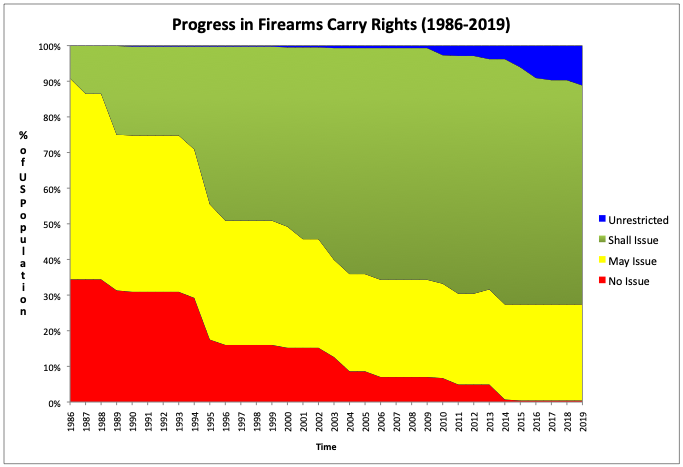
Every Picture Tells a Story has been an ongoing series on this blog since 2011. It graphically illustrates the growth in firearm carry rights over time. Going back to 1986, over 90% of Americans lived in states with either no carry permitted or may-issue carry permits. By contrast, approximately two-thirds of all Americans live in a state with either shall-issue permits or constitutional carry.

The area that has shown the most growth in terms of number of states is constitutional or permitless concealed carry. With the recent addition of South Dakota and Oklahoma, there are now 15 states that do not require you to have a permit to carry concealed. This equates to about 11% of the population of the United States.

As the creator of this graphic, Rob Vance, notes, “While the Supes are figuring out if the word “bear” in the 2nd Amendment actually means something – 15 states have already clarified that simple reading of the English word meaning ‘to carry.'”

This number would have jumped even more if the Republican leaders of the North Carolina Senate had not refused to bring up the bill allowing permitless carry in the state. The bill had passed the NC House but Senate Republican were afraid of losing their super-majority if they went on record voting for permitless carry. Ironically, they lost their super-majority anyway.

District Court Denies TRO In Bump Stock Cases

Judge Dabney Friedrich of the US District Court for the District of Columbia turned down a motion for a temporary restraining order to prevent the Trump Administration’s bump stock ban from going into effect. This ruling impacts a few of the bump stock ban challenges including Guedes, FPC v. Whitaker, and Codrea v. Barr.

In his ruling Judge Friedrich said that the BATFE was entitled to Chevron deference allowing it to redefine the actual meaning of words.

Most of the plaintiffs’ administrative law challenges are foreclosed by the Chevron doctrine, which permits an agency to reasonably define undefined statutory terms. See Chevron v. Nat. Res. Def. Council, 467 U.S. 837 (1984). Here, Congress defined “machinegun” in the NFA to include devices that permit a firearm to shoot “automatically more than one shot, without manual reloading, by a single function of the trigger,” 26 U.S.C. § 5845(b), but it did not further define the terms “single function of the trigger” or “automatically.” Because both terms are ambiguous, ATF was permitted to reasonably interpret them, and in light of their ordinary
meaning, it was reasonable for ATF to interpret “single function of the trigger” to mean “single pull of the trigger and analogous motions” and “automatically” to mean “as the result of a self- acting or self-regulating mechanism that allows the firing of multiple rounds through a single pull of the trigger.” ATF also reasonably applied these definitions when it concluded that bump stocks permit a shooter to discharge multiple rounds automatically with a single function of the trigger. That this decision marked a reversal of ATF’s previous interpretation is not a basis for invalidating the rule because ATF’s current interpretation is lawful and ATF adequately explained the change in interpretation.

The plaintiffs have already said that they plan to appeal this to the DC Court of Appeals.

You can read the reaction of the plaintiffs in this joint statement by the Firearms Policy Coalition and the Firearms Policy Foundation.

GRNC Alert – Federal Gun Control Vote This Week

Grass Roots North Carolina released an alert concerning votes on HR 8 and HR 1112 which may be coming this week. The first mandates universal background checks for all purchases and transfers while the second changes the procedure for a “hold” on NICS checks. Tom Gresham has written about this combination and the danger it poses. While a Democrat president might not use emergency powers to declare an emergency over “gun violence” (sic), it has been threatened by Speaker Nancy Pelosi. When you add the combination of these two bills to a declared emergency, you could have a perfect storm for the gun culture. That, of course, is the intent of all these type of bills – to make it so hard to purchase or own a firearm that most people will just give up.

FEDERAL GUN CONTROL
VOTING THIS
WEEK


As you know, Democrats
in Washington are pushing dangerous gun control bills, and it appears the US House will be voting on these measures this
week…

After assuming power in the US House,
the anti-gun party went right to work pushing heavy-duty gun control—two bills particularly. In brief, H.R. 8 (Bipartisan Background Checks Act of
2019
) makes private firearms transfers a crime, while H.R. 1112 (Enhanced Background Checks Act of
2019
) establishes a nationwide waiting period for gun purchases.

Although bills such as
these seem like “Democrat” bills that would never make it through the
Republican-held Senate, don’t be so sure. As it stands, these bills are
labeled “bi-partisan” because some less reliable Republican
lawmakers (read: RINOs), have co-sponsored them. This allows for the
following scenario:

  1. If these bills have bi-partisan support, they’ll likely pass the House
    easily, even
    if a few conservative Democrats vote against them. As it stands, no less
    than five Republicans have signed on to H.R. 8. So far, H.R. 1112 has
    only
    one Republican co-sponsor, but it can still be labeled bi-partisan, and
    is quite likely to pass the House. Other than the co-sponsors, it’s
    anyone’s guess how many other unreliable Republicans will vote for one
    or both of these bills.

  2. If there are Republicans in the House
    who sign on to these oppressive gun control laws, who’s to say that certain “moderate” Republicans in the
    Senate won’t do the same?
  3. While it’s true that we have a Republican
    executive, it’s also true that President Trump has dithered on questions of gun control. He has supported so-called “red flag” laws,
    which arbitrarily deny due process and strip citizens of their Second
    Amendment rights by bureaucratic whim. Also, by executive fiat the
    president
    recently banned bump stock devices.
    By these
    examples, you can see there is no guarantee that the president would
    veto a gun control bill, and there is even reason to believe that he
    would
    happily sign into law certain gun control measures.

In
the very possible scenario outlined above, one can see that there is real risk here, and
things could start sliding the wrong direction this
week
!
Clearly, it’s up to us, the people, to stop this.

It appears that the US House will

be voting on gun control measures this week
…

… so please, as soon as possible, contact your representative and demand that he or she continue to
recognize and vigorously defend guaranteed human rights
. Below, see how you can easily email and phone your Republican US House Representative and demand these very
things. 


Support “Rights Watch International”
AmazonSmile Learn more about Rights Watch
International


You shop. Amazon
Gives.
(What is Amazon Smile?)


IMMEDIATE ACTION REQUIRED!


  • PHONE AND EMAIL YOUR REPUBLICAN US HOUSE REPRESENTATIVE:
    If
    your House rep. is a Republican, inform him or her that you are well
    aware of the gun control bills being proposed in the US House (H.R. 8
    and H.R.
    1112). Insist that he or she oppose these bills, and by doing so,
    vigorously defend the Natural rights guaranteed by the Constitution. 
    Tell him
    or her that nothing short of unwavering resistance to these leftist gun
    control bills will be acceptable.

    Below is a phone number list and email form links for
    North Carolina Republicans in the US House. For the electronic message,
    use the
    copy/paste text provided under ‘Deliver This Message.’

    If you don’t know who your representative is, click here to find that information. (On the right,
    toward the top, provide your zip code and then click LOOK UP
    ).

  • PHONE MINORITY LEADER KEVIN McCARTHY
    if your representative is not a
    Republican, or if you live in the 3rd or 9th district (currently
    unfilled seats). Tell Rep. McCarthy that you expect Republican
    leadership to live up
    to the party platform, and push all Republicans to stand firm on the
    Second Amendment (vote ‘NO’ on H.R. 8 and H.R. 1112). Contact
    information for
    Rep. McCarthy is also below.

  • PLEASE CONTRIBUTE TO GRNC: Help us fight gun control while we
    promote Second Amendment principles. Please
    CLICK HERE to contribute. Also, bear in mind that GRNC is an all-volunteer organization,
    so you can be sure your donations are put to the best possible use. Any amount helps, and any amount is appreciated.

CONTACT INFO
Republican Rep. Name (District)

Phone Number Contact Form
Rep. George Holding
(2)   
(202) 225-3032 https://holding.house.gov/contact/
Rep. Virginia Foxx (5) (202) 225-2071 https://foxx.house.gov/connect/default.aspx
Rep. Mark Walker (6) (202) 225-3065 https://walker.house.gov/contact/email
Rep. David Rouzer (7) (202) 225-2731 https://rouzer.house.gov/contact/email
Rep. Richard Hudson (8) (202) 225-3715 https://hudson.house.gov/email-me/
Rep. Patrick McHenry (10) (202) 225-2576 https://mchenry.house.gov/contact/
Rep. Mark Meadows (11) (202) 225-6401 https://meadows.house.gov/contact/
Rep. Ted Budd (13) (202) 225-4531 https://budd.house.gov/contact/
House Minority Leader
Kevin McCarthy
(202) 225-4000 Call if your district’s seat is not held by a Republican or
is currently unfilled (3rd & 9th).

DELIVER THIS MESSAGE

Suggested Subject (where applicable): “Oppose Gun Control Bills H.R. 8 and H.R. 1112”  
Dear Representative:

I am
writing to express unequivocal opposition to the gun control bills
recently
introduced in the House of Representatives. In general, gun control is
an affront to a free people and a violation of the human rights
recognized and
protected by the Constitution. Bills recently introduced, H.R. 8 and
H.R. 1112, are no exception and are truly egregious examples.

It’s discouraging to see that both
bills carry bipartisan sponsorship, but I want to make it clear that I
expect you to stand for what is right, not what seems most expedient due
to the
perceived zeitgeist, nor out of a belief that there is virtue in all
compromise. While compromise has its place, there can be none when it
comes to
questions of Natural human rights, particularly Second Amendment rights.

Oppose H.R. 8 and H.R.
1112. Oppose them publicly and vigorously. This is the only proper and
acceptable path for a member of the Republican Party, a party that has
documented its broad support for the Second Amendment in its party
platform. As
my representative, I expect you to live up to this.

I will be monitoring your actions on this matter through alerts from Grass Roots North Carolina.

Respectfully, 

Shorty Shotgun Shells – Worth A Try?

I’m in the process of updating my old Mossberg 500 and “slicking” it up. That is, I’ve polished the bore, replaced the follower, and have removed the rust, crud, and dried up oil. I still plan to repaint the camo from a kinda woodland to a black and green tiger stripe. I may even put a red dot on it.

Originally, only Aguila had the short shotgun shells. They have been joined by Federal (see the video below) and the Canadian brand Challenger.

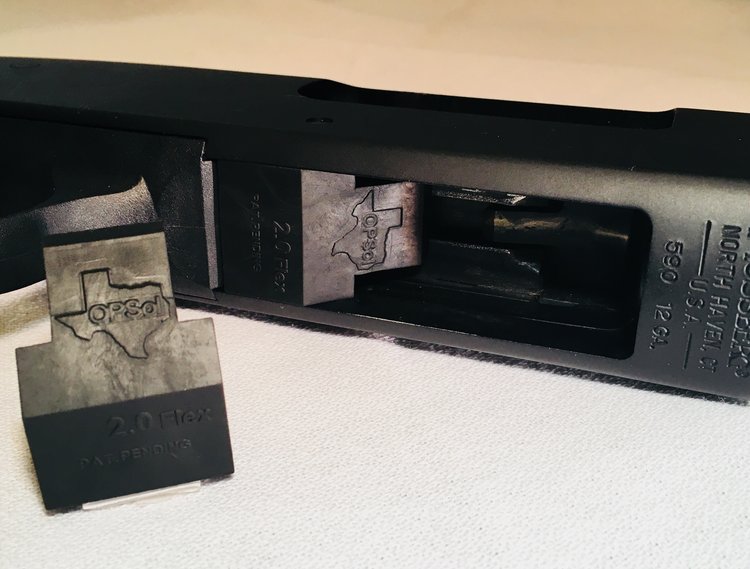
The problem from what I’ve deduced viewing many reviews of the shorty shells on YouTube is that they have feed problems even with modifications. The OPSol Mini-Clip for the Mossberg seems to have had the best success in fixing the problem. Even so, from what I’ve read even it is not a sure thing with a pump shotgun.

That said, for the price of the OPSol Mini-Clip ($17 ppd) and a few boxes of various shorty shells, it might be worth a try just to run my own tests. I know the supposed advantage of the shorty shell is that it gives you more rounds in a standard shotgun in a defensive situation. However, if it doesn’t function 100% every time then it becomes a liability. That said, it might work well enough for extended practice so that you don’t kill your shoulder whereupon you switch back to regular 2 3/4″ shells for actual defensive situations.

I did get to shoot the Mossberg Shockwave with the shorty shells at the SHOT Shell at the Crimson Trace booth. It worked well enough there so I don’t think I have much to lose by giving it a try.

A Sign Of Things To Come?

Rogers et al v. Gurbir Grewal et al is a case from New Jersey that is a challenge to the state’s may-issue concealed carry law. It is currently on appeal to the Supreme Court seeking a writ of certiorari after the Third Circuit said New Jersey’s law met intermediate scrutiny.

In late January, the attorneys for New Jersey filed a waiver saying they didn’t intended to file a response to the petition for a writ of certiorari by Thomas Rogers and the New Jersey Association of Rifle and Pistol Clubs. This could be taken as a sign that New Jersey fully expected the Supreme Court to summarily deny the petition for a writ of certiorari.

As Guns.com reported earlier today, the Supreme Court has now issued an order requiring New Jersey to file a response by March 21st.

The Association of New Jersey Rifle and Pistol Clubs issued a release yesterday that said, in part:

Today, the U.S. Supreme Court required the State of New Jersey to file a brief in response to ANJRPC’s petition asking the High Court to hear its challenge to NJ’s carry laws. Under the Supreme Court’s order, the State of New Jersey is required to file papers by March 21, arguing why the High Court should not agree to hear ANJRPC’s appeal. NJ had previously ignored the appeal.


While the move is not a guarantee that the Supreme Court will agree to hear the appeal, the fact that the court is requiring NJ to take a position on ANJRPC’s request is significant, and signals that the court is not willing to take any action without first hearing from both sides.

The case has attracted a number of amicus briefs on behalf of Rogers and ANJRPC. These include briefs from the National African American Gun Association,  a number of law enforcement groups and state gun associations, the Second Amendment Foundation, the National Rifle Association, and the American Civil Rights Union. There is also an amicus brief in support of Rogers from the attorney generals and governors of 24 states which was organized by Arizona Attorney General Mark Brnovich.

As the petition for the writ notes, Mr. Rogers met all the requirements for a carry permit from the state of New Jersey with the exception of showing a direct threat to his life. He has been robbed at gun point and manages an ATM service company which, by definition, involves large amounts of cash. Police in Wall Township, NJ agreed he met the training eligibility requirements but “he failed to show Justifiable Need.”

One can only hope that this move by the Supreme Court is a positive sign and that they will finally take up a carry case. This is especially true as there are diverging opinions between the circuits as well as a divergence in the proper level of scrutiny.

Dave Hardy’s Presentation At Second Amendment Symposium

Lincoln Memorial University’s Duncan School of Law held a Second Amendment Symposium on January 18th in Knoxville, Tennessee. I would have loved to attend this but I was leaving the next day for the SHOT Show. The symposium featured scholars who represented both the standard model and the collective rights model of the Second Amendment. Representing the standard  model were Clayton Cramer, Stephen Halbrook, David Kopel, and Dave Hardy. The representatives of the collective rights model were Carl Bogus and Robert Spitzer.

Dave Hardy’s presentation has been published to YouTube. While the audio isn’t the best, it is still worth listening to if you are interested in the history of the Second Amendment and what the Founding Fathers intended when they added it to the Bill of Rights.

Dave writes of his presentation:

The theme is that Second Amendment had two independent purposes; one does not control the other. The militia phrase is indeed militia-centric, and the right to arms clause is focused on an individual right. James Madison and the First Congress were trying to satisfy two different constituencies, one of which wanted to protect the militia, the other of which wanted to guarantee an individual right to arms. They chose to appeal to both. This means that the individual right guaranteed is not one only for militia use; they were two separate ideas, and one is not a restriction on the other, anymore than the First Amendment’s guarantee of a right to religious exercise means that its freedom of the press only protects books on theology.

 It will be interesting to read the papers that will come out of this symposium. I have an email in to the LMU Law Review asking when they will be published. I’ll update this when I get a response.