They Can’t Claim Ignorance Any More

The NRA Board of Directors has long relied upon the word of EVP Wayne LaPierre for virtually everything. If a disturbing matter was brought up to them, they, for the most part, would say something like, “Well, I talked to Wayne and he said blah, blah, blah.” They considered this as doing their duty of care as a Board member.

As I pointed out in my post on fiduciary duties, duty of care means to give “reasonable attention and care to providing oversight.” Under New York public charities law, that includes knowledge of the organization’s finances.

Over the last few days, I have listened intermittently to the hearings held on the NRA’s Chapter 11 bankruptcy. I have also read synopses of these hearings on other sites. Some of the things I heard had me shaking my head while shouting at the computer, “How could you not know?”

For example, Wayne LaPierre testified before the court that he had no knowledge of the consulting contract awarded to former CFO Woody Phillips and that he had only recently learned of it. The contract in question was for $30,000 monthly to run for four full years. The total value of the contract would then be worth $1,440,00. How can a CEO not know that his recently retired CFO just got a contract worth over $1.4 million?

The one thing I do believe that came out of Wayne’s rambling testimony is his acknowledgement that he didn’t inform the Board of his intention to seek bankruptcy before filing it. If he had, I believe more Board members would have reacted at the time like Judge Phil Journey saying “we didn’t authorize that.” Their ex post facto motion saying they authorized filing bankruptcy then and now is frankly nothing more than a cover garment.

On Friday I listened to live testimony from Wayne’s former BFF Tony Makris as well as AckMac CFO Bill Winkler. A deposition of former NRA CFO Woody Phillips was also read into the record with one NYAG attorney reading the questions and another reading Phillips’ response. The key thing that was continually pointed out by Makris and Winkler is that the vague invoices sent by AckMac were at the direct request of Wayne. This continued even after a new agreement was reached that stated the only deviations had to be in writing from Wayne as EVP. Wayne, of course, still continued with his way of not putting his wishes in writing. Greg Garman, one of the NRA’s attorney, pounded on AckMac’s Bill Winkler about ignoring the letter of the contract and going along with how things had been done in the past. I think this was a strategic mistake on his part as it opens the door to questioning similar vague invoices from Brewer, Attorneys and Counselors.

I should note here that Woody Phillips’ testimony primarily consisted of him saying, “I decline to answer based on the privilege accorded me by 5thamendment of the US Constitution.” The one thing I can say about that is that you can’t be accused of perjury if you always take the Fifth.

As I said in the headline, the NRA Board of Directors cannot claim ignorance any longer. The beauty of WebEx is that it does a good job of capturing who is participating or listening in to an event. In this case, I saw reporters such as Danny Hakim of the NY Times, Mark Maremont of the Wall Street Journal, and Stephen Gutowski of the Free Beacon. I also counted at least six Board members listening in. They included Carrie Lightfoot, Anthony Colandro, Joel Friedman, Linda Walker, Howard “Walt” Walters, and Judge Phil Journey (who I expected to listen in). There may have been more as there were people who logged on by phone and not by computer.

My point is that after multiple days of testimony and over 600 documents, pleadings, exhibits, motions, and replies, it is impossible for anyone on the Board to say they don’t know what is going on. If they do, then they need to resign.

NRA Bankruptcy Hearing

The US Bankruptcy Court for the Northern Texas District is holding a live hearing on the NRA’s bankruptcy petition today. You can watch it live using this link: https://us-courts.webex.com/webappng/sites/us-courts/dashboard/pmr/hale

I believe this is the third day of the hearing and the witness is NRA EVP Wayne LaPierre.

Wayne does not make a good witness. The judge has had to admonish him a dozen times or more to limit his answer to the question asked. His own attorney has instructed him to just answer “yes or no” when asked that kind of question. On virtually every other answer, the attorney asking him the question has to ask the judge to strike part or all of the answer as being non-responsive and Judge Hale is sustaining that objection.

I believe every NRA Board member needs to be watching Wayne’s testimony. There are a few that I’ve noticed listed in the WebEx as being online. Given what I’ve seen so far, board members need to be asking themselves this question: Is it or is it not time for Wayne to retire?

I know what my answer is.

New NRA Special Meeting Scheduled

A Special Meeting of the NRA Board of Directors has been scheduled for Dallas, TX for March 28th. As the Complementary Spouse pointed out to me, it is exactly 14 days after the previously scheduled meeting and is the length of time that the CDC formerly recommended for quarantine after COVID exposure. While I doubt that was the actual reason for the original cancellation, they are sticking with appearances.

March 18, 2021

                               OFFICIAL NOTICE: SPECIAL MEETING OF THE BOARD OF DIRECTORS

TO: Board of Directors and Executive Council

The NRA President has requested a special meeting of the Board of Directors to take place on Sunday, March 28, 2021, at 10:00 a.m. in Dallas, Texas. The  purpose of the meeting is to provide a legal briefing to the Board regarding the NRA’s plan of reorganization and other pending matters.

The NRA Board of Directors and Executive Council will meet at the Sheraton Dallas Hotel, 400 North Olive Street, Dallas, Texas 75201, (214) 922-8000. The date, time and location of all meetings are on the attached schedule of meetings and meals.

Please notice the change in wording from the first Special Meeting notice:

The sole purpose of the meeting is to provide a briefing to the Board regarding the NRA’s reorganization plan and the legal matters overseen by the Special Litigation Committee, and to take any necessary action directly related to those matters.

Any mention of the Special Litigation Committee is deleted. Moreover, it does not have a mention of “any necessary action.”

Speculation is that an 1129 Reorganization Plan will be presented to the Board. These reorganization plans be presented by the debtor (NRA), the unsecured creditors committee, or a trustee if one is appointed. However, the bankruptcy judge, as I understand it, cannot present a reorganization plan and must only rule on the merits of those presented.

By presenting an 1129 reorganization plan, it is speculated that Brewer, Attorneys and Counselors, will have their fingers all over it and will use it to keep themselves attached to the NRA like barnacles on a rock. A friend pointed out to me today that in the course of proceedings that the bankruptcy judge could not only disallow Brewer to serve as a special counsel but cut off all payments to him given his role in draining the NRA’s finances through legal billings. We can only hope!

NRA Special Meeting…Canceled

Stephen Gutowski of the Washington Free Beacon is reporting on Twitter that the NRA Special Board Meeting scheduled for Sunday has been canceled.

While airlines and hotels have been pretty fair about cancellations due to COVID, there are undoubtedly some board members who had already left for Texas and those expenses will need to be reimbursed.

It would be cynical to think the meeting cancellation had anything to do with the attempt by the NY Attorney General’s Office to depose Judge Phillip Journey. A hearing on that is set for Monday in US Bankruptcy Court. However, it will be by WebEx.

Fiduciary Duties And The NRA Board

The term “fiduciary” is bandied about without much explanation or definition. That said, it is a critically important to understand what it means when it comes to an organization.

Investopedia defines it this way:

fiduciary is a person or organization that acts on behalf of another person or persons, putting their clients’ interest ahead of their own, with a duty to preserve good faith and trust. Being a fiduciary thus requires being bound both legally and ethically to act in the other’s best interests.

While they are talking about a person who handles your finances, it is equally applicable to anyone who serves on the board of a non-profit like the National Rifle Association.

The website Charity Lawyer puts it this way when talking about the fiduciary responsibilities of a board member of a non-profit organization.

The board collectively, and directors/trustees individually, owe fiduciary duties to the nonprofit organization they serve. In essence, exercising fiduciary duties means that board members have a duty to act with care and in the best interest of the organization and remain loyal to its mission, as opposed to acting in their own interest or the interest of the CEO/Executive Director they supervise. (emphasis added)

So what are the fiduciary duties of a board member?

Under New York law a board member has three fiduciary duties: the duty of care, the duty of loyalty, and the duty of obedience. To assist new or potential nonprofit board members, the Charities Bureau publishes a booklet outlining what these mean. Using their words plus others let’s take them in order.

Duty of Care

The duty of care mean that board members should give give reasonable attention and care to providing organizational oversight. There is no precise definition of what is meant by reasonable but it should include, at the minimum, that members attend board meetings, they read the reports, and that they have knowledge of the organization’s finances. New York says that “directors must act in “good faith” using the “degree of diligence, care and skill” which prudent people would use in similar positions and under similar circumstances. (Remember the NRA still operates under NY law because the Board in 1992 ignored the warnings of Director and law professor Joe Olson.)

Among the item mentioned by the Charities Bureau on duty of care include a whistleblower policy, that the minutes reflect dissenting votes, that there is a clear process for major obligations, and that monthly financial reports are reviewed by board members.

I would say that Oliver North and Richard Childress were exercising the duty of care when they expressed concerns about the enormous legal billings from William Brewer III.

Duty of Loyalty

The duty of loyalty is owed to the organization meaning that directors are mandated to work in the interests of the organization and not their own self-interest. While the NRA does have a conflict of interest policy and disclosures are made, I have to wonder if it is anything more than lip service when someone like a Marion Hammer receives hundreds of thousands of dollars annually.

Charity Lawyer notes:

The fiduciary duty of loyalty of board members is the responsibility to act in the interests of the non-profit, those it serves, and those donating funds for operations, as opposed to their own self-interest…

It can also be said that board members have a duty not to act in the personal best interest of the non-profit CEO (lead staff member) where that interest conflicts with the nonprofit’s best interest. Hiring the CEO, setting the salary, and providing oversight and accountability of such CEO, is among the most important responsibilities of a non-profit board.

The duties of care and loyalty are the basics of all fiduciary responsibilities. The law recognizes what is called the “business judgment rule”. This protects board members if they exercise these two duties with diligence and prudence as courts have held.

I came across this from the major law firm IceMiller LLP with regard to the fiduciary duties when dealing with an insolvent or near insolvent corporation. While the NRA asserts it is far from insolvent, they are, however, in Chapter 11 bankruptcy proceedings.

Applying the business judgment rule, courts will ordinarily not scrutinize corporate decision-making if the decision was made through a valid exercise of the board’s business judgment. Essentially, corporate fiduciaries who act in good faith, make informed decisions, and do not personally benefit from their corporate actions can rest easier knowing their actions will not be scrutinized after-the-fact with the benefit of hindsight. The business judgment rule facilitates prudent risk-taking and forgives reasonable mistakes in judgment.

A recent interview that Michael Bane had with MidwayUSA’s Larry Potterfield brought something to mind. When Michael asked him about the NRA’s turmoil, Mr. Potterfield insisted that it was in fine shape and there wasn’t really any turmoil because that is what Wayne LaPierre assured him personally.

Think about that if you are a director and not merely a contributor like Mr. Potterfield. Would a court hold that the business judgment rule applied and that you fulfilled your fiduciary duties to make an informed decision if you merely relied on the assurances of Wayne LaPierre in the face of all the other contradictory information out there? I will get into more specifics in a moment.

Duty of Obedience

The duty of obedience means that the board has a fiduciary responsibility to ensure that the organization is abiding by its stated mission and is complying with all state and federal laws. New York goes further and includes abiding by its internal governance documents and policies. In this case, that would mean the NRA bylaws and its internal governance documents requiring board approval for major contracts such as that with Brewer, Attorneys and Counselors.

The NRA’s stated mission on its IRS Form 990 says:

Firearms safety, education, and training, and advocacy on behalf of safe and responsible gun owners.

You may remember that US District Court Judge William Campbell, Jr. allowed David Dell’Aquila’s class action lawsuit against the NRA over misuse of donor fund to continue. He did dismiss it against Wayne LaPierre and the NRA Foundation but found that the expenditures of the NRA for Wayne’s clothing and trips and Brewer’s legal fees may not have been in furtherance of the NRA’s mission. That suit is on administrative hold while the bankruptcy is still ongoing.

NRA Bankruptcy and Special Meeting

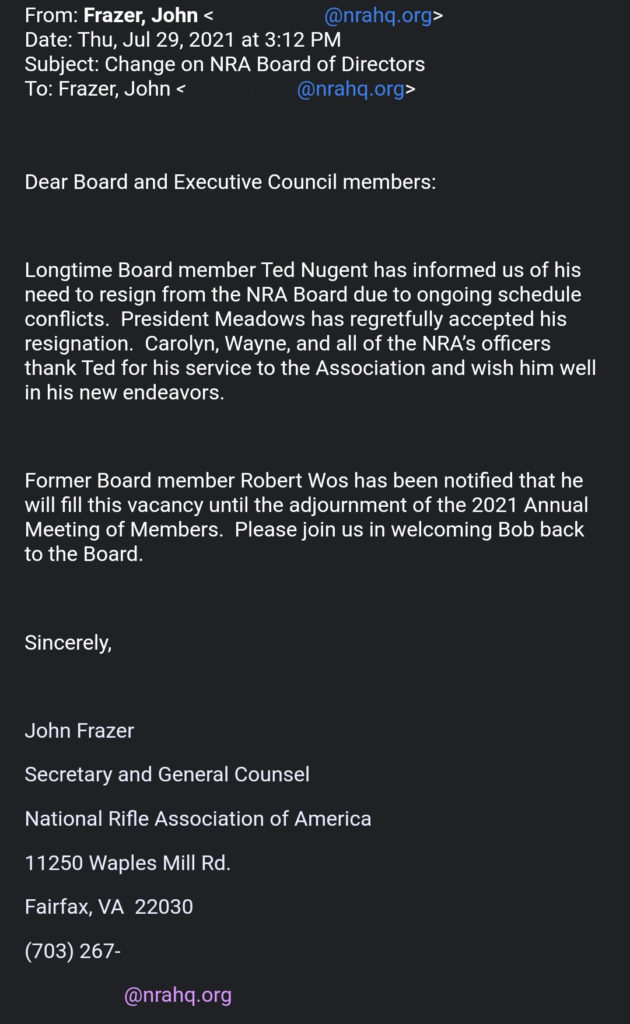
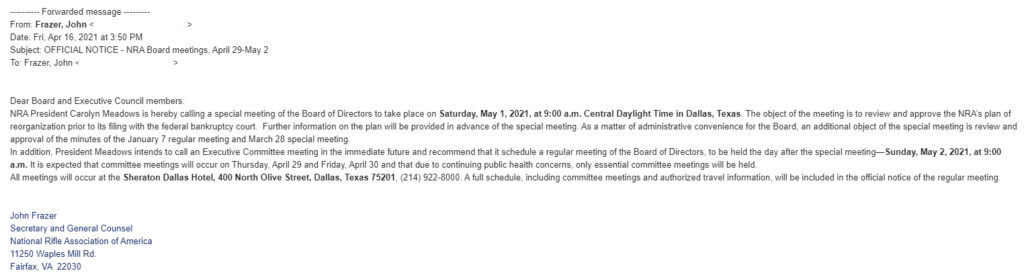
The Board of Directors is holding a called Special Meeting this coming Sunday, March 14th, in Dallas, Texas. It is widely assumed that one of the action items will be an explicit ex post facto approval of the bankruptcy filing.

The sole purpose of the meeting is to provide a briefing to the Board regarding the NRA’s reorganization plan and the legal matters overseen by the Special Litigation Committee, and to take any necessary action directly related to those matters.

Judge Phillip Journey, a Kansas state judge and NRA Director, has asserted, correctly in my opinion, that the Board was kept in the dark about the plan to declare bankruptcy. The formation of the Special Litigation Committee never mentioned a planned bankruptcy as he told Stephen Gutowski of the Free Beacon.

Journey said he had voted to support the committee, but had no idea the group’s leadership and legal advisers had planned to go into bankruptcy. He disputed NRA filings that claimed board members were properly informed. Those filings were signed by embattled executive vice president Wayne LaPierre, who was not present at the meeting when the committee was discussed, according to Journey. The Kansas jurist believes the law has been violated and he has a duty to report it to the court.

“It certainly was a fraud perpetrated on the court,” Journey said. “I told them all when I got on the board, ‘Look, I’m a judge. I’m a mandatory reporter. Whatever we do, we got to be on the up and up.'” 

I believe Judge Journey not only recognized his fiduciary duty of care but his duty as a officer of the court when he filed his Motion for an Examiner. He followed President Ronald Reagan’s dictum – “trust, but verify” – when it came to assurances from LaPierre and William Brewer. He looked at the New York Attorney General’s dissolution suit and recognized that there was too much there to just pass it off as a vendetta against the NRA.

The leads me to the the US Trustee’s filing in the bankruptcy case objecting to the appointment of William Brewer and his firm as “special counsel”. For those that don’t know, the US Trustee is an officer of the court whose primary rationale is to “promote the integrity and efficiency of the bankruptcy system for the benefit of all stakeholders–debtors, creditors, and the public.” In other words, their job is to protect the process so it isn’t abused.

The US Trustee strongly objected to the appointment of Brewer, Attorneys and Counselors, as a special counsel to the NRA in the Chapter 11 bankruptcy proceedings. They assert that the services provided by Brewer do not fall within the constraints of bankruptcy law and that it has “divided loyalties and conflicts of interest.”

They go on to add:

These disqualifying conflicts are compounded by BAC’s failure to disclose them in the Application and by BAC’s failure to disclose all of its pre-petition compensation

Among the things the US Trustee asserts that Brewer did not disclose were the family relationship between Brewer and the McQueens, the allegations against the firm’s billing in two cases in which he was counsel (NYAG and Oliver North), and failure to disclose that Brewer himself was precluded from participating in any of the AckMac cases by the US District Court for Northern District of Texas. The Trustee said it shouldn’t be their responsibility to “ferret out” complete disclosures. This failure to make disclosures were grounds enough to prevent Brewer and his firm from serving as special counsel.

They detail what they call “adverse interests” against the estate. In other words, work that Brewer is doing that is not in the interest of the creditors nor in the real interests of the NRA as an organization. This is really the meat of their objection:

These adverse interests include:
a. potential claims by the Debtors’ estates against BAC for fraudulent conveyance based on allegations of billing improprieties raised by a former NRA president, a First VP, four members of the NRA’s Board of Directors, and the NYAG Action;
b. conflicted loyalties BAC may have between its own interests and those of the NRA in the NYAG Action, as well as in an action the NRA brought against its former president, Oliver North, in which Mr. North alleges he suffered retaliation from the NRA leadership when he raised concerns over BAC’s legal fees (the “Oliver North Action”);
c. conflicted loyalties BAC may have in the NYAG Action and generally between the interests of the NRA and those of Mr. LaPierre, based on BAC’s prior representations of Mr. LaPierre, and the steps Mr. LaPierre is alleged to have taken to stonewall internal inquiries regarding BAC’s fees; and
d. conflicted loyalties BAC may have because Ackerman McQueen is adverse to the Debtors in at least three lawsuits for which BAC is sought to be retained to represent the Debtors, when BAC’s named partner is married to the sister of Ackerman McQueen’s CEO.

The Board of Directors need to bear in mind that the US Trustee, despite wild accusations by Brewer and others with sweetheart deals, is independent and does not have an axe to grind. The US Trustee is neither anti-NRA nor pro-NRA but rather is pro-process and keeping it equitable for all involved.

So when doing their fiduciary duties of care, loyalty, and obedience, the Board of Directors should be asking themselves these questions.

Have I done my duty of care if all I’ve done is accept the assertions of Wayne LaPierre, William Brewer, and the Special Litigation Committee?

Am I performing my duty of loyalty to the members, the donors, the Second Amendment, and to the core values of the NRA?

Have I as a board member really overseen the actions of the CEO in the name of the organization or did I just go along?

Did I confuse my duty of obedience to the NRA with obedience and loyalty to certain individuals?

Will I be protected by the “business judgment rule” if I merely accepted the word of LaPierre and Brewer without going any further?

Finally, am I liable for a breach of fiduciary duties and what happens if I am?
A Correction On NRA Bylaws

Sometime since 2019, the NRA bylaws as they relate to called Special Meetings was changed and the time for notice considerably shortened.

From Article IV, Sec. 3 (b):

Special Meetings. A special meeting of the Board of Directors may be held at any time on the call of The President, or by action of the Executive Committee, or upon demand in writing stating the object of the proposed meeting and signed by not less than a majority of the Board. Notice of the time, place and object of such special meetings shall be transmitted to each Director at least seven days before the date of holding such a meeting in person, or 72 hours before any special meeting held by means of a conference telephone or similar communications technology pursuant to subsection (f) of this section.

Thus, I stand corrected on my comments on the update to the post on NRA Special Meetings that referenced the former 30-day notice requirement. The Special Meeting being held on March 14th would be valid under the bylaws as amended. Lest you think I was informed of this by a “friend of Wayne”, it came from Rob Pincus who is not.

I do wonder when this bylaw was changed and why. I do know that it was not voted on at either of the last two Meeting of Members as I attended both of those from start to finish.

I still anticipate that the Board of Directors will be asked to approve the bankruptcy filing ex post facto as seems to be the norm when called out on something.

NRA Special Meeting (Update)

Rumors started on Sunday with a report by Dan Zimmerman of TTAG about Wayne LaPierre’s speech to CPAC. After saying that Wayne’s speech was old and stale, he concluded with this teaser, “The good news is, we happen to know that the NRA is actively seeking his replacement.”

Then yesterday, John Crump who writes for Ammoland.com had a tweet saying to “prepare for some big NRA news on or around March 14.”

The March 14th date was interesting because there was no hearing set on that date in either the NY Attorney General’s dissolution case nor in the NRA’s bankruptcy case.

It turns out that NRA President Carolyn Meadows has called for a special meeting of the Board of Directors to be held in Dallas on March 14th.

March 2, 2021

                                                                  OFFICIAL NOTICE

                                SPECIAL MEETING OF THE BOARD OF DIRECTORS

TO:      Board of Directors and Executive Council

            The NRA President has called for a special meeting of the Board of Directors to take place on Sunday, March 14, 2021, at 10:00 a.m. in Dallas, Texas.  The sole purpose of the meeting is to provide a briefing to the Board regarding the NRA’s reorganization plan and the legal matters overseen by the Special Litigation Committee, and to take any necessary action directly related to those matters.

   The NRA Board of Directors and Executive Council and will meet at the Omni Dallas Hotel, 555 South Lamar Street, Dallas, Texas 75202, (214) 744-6664.  The date, time and location of all meetings are on the attached schedule of meetings and meals.  [Special Note:  The special meeting of the Board of Directors will start at 10:00 a.m. Daylight Savings Time on Sunday, March 14. Daylight Savings Time begins at 2:00 a.m. on Sunday, March 14.  On Saturday night, remember to set your clocks forward one hour (i.e., losing one hour) to “spring ahead.”]

Members in attendance are authorized reimbursement for ordinary and necessary expenses actually incurred on the following basis:

If I had to speculate – and that is always a dangerous thing – I would say that it is a move to get the Board of Directors to explicitly approve the filing for bankruptcy. You may remember that Judge Phillip Journey made the point in his motion for a court-appointed examiner that the directors’ never voted to file bankruptcy. Further, bankruptcy law expert Prof. Adam Levitin wondered if the Board had shirked its fiduciary duties by not explicitly approving a bankruptcy filing.

As the after the fact approval of many expenditures by the Board’s Audit Committee makes clear, the NRA Board has a history of approving things after the fact that should have had explicit pre-approval. This could be one of those ex post facto approvals. I would be the most surprised person in the room if it was actually to announce a replacement to Wayne LaPierre. I just don’t see a Board packed with Wayne loyalists doing that.

UDPATE: A friend who knows the NRA bylaws far better than me just pointed out something about this special meeting. According to Article IV, Section 3 (b), while the President, the Executive Committee, or the majority of the Board can call a special meeting, it has a notification requirement.

From the NRA Bylaws:

Notice of the time, place, and object of such special meetings shall be mailed to each Director at least 30 days before the date of holding such meetings.

Now I know that the NRA Bylaws don’t mean much to Wayne and company but you would think that given both the dissolution lawsuit and the bankruptcy proceedings that dotting the I’s and crossing the T’s just might be the smart way to go. I don’t know if the Board is getting their advice from William Brewer III, NRA General Counsel John Frazer, or the Board’s attorney Wit Davis but whomever said it was OK to ignore the bylaws either doesn’t give a big rat’s ass or is an idiot.

Either way, anything voted on and decided in this Special Meeting of the Board could be challenged in court as being invalid due to violating the bylaws.

NRA Board Member Asks For Examiner

Attorneys for Phil Journey, a state judge in Kansas and a NRA Director, filed a motion in the NRA’s bankruptcy cased today. The motion asked the court to appoint an examiner (or independent investigator) to examine claims against the NRA made by the NY Attorney General Letitia James. These claims were made in the suit seeking the NRA’s dissolution.

Journey says he fully supports the NRA’s mission of protecting the Second Amendment through “education, training, and sport.” He then says:

Accordingly, Movant (Journey) seeks the appointment of an examiner to bring to light the veracity of the alleged fraud, dishonesty, incompetence, and gross mismanagement that has plagued the NRA’s reputation, caused significant alienation of the Association’s members and supporters, and hampered its ability to fulfill its core organizational purpose.

He then lays out the areas which he wants the examiner to investigate:

The best path to ensure that the NRA seizes upon the opportunity before it to recommit to its most historical ideals is to appoint an independent examiner to add transparency and confidence to the bankruptcy process. To that end, Movant requests the appointment of an examiner to examine and investigate: (i) the actions of Debtors’ pre- and post-petition management; (ii) the management practices being employed in the operation of the non-profit organization; (iii) the compensation of management; (iv) the benefits and perks being provided to the Debtors’ management team; and (v) the propriety of arrangements with certain vendors.

Journey goes on to accuse the NRA’s management of using Ackerman McQueen and other vendors as conduits to hide personal expenses and perks. He then says the Board has become a figurehead while “management” aka Wayne LaPierre actually steered the direction of the NRA.

He alleges the bylaws were violated by not having the Board of Directors to vote on the bankruptcy filing nor was the intent to seek Chapter 11 even disclosed to the Board. He goes on to note that the NRA’s management routinely ignored the bylaws, the laws of New York, and Robert’s Rules of Orders which led to Craig Spray resigning and the designated head of reorganization deciding not to take the job. Furthermore, the formation of Sea Girt LLC was not approved by the Board. Journey says information was withheld by management and the Board’s attorney which made it impossible for them to do their fiduciary duty.

The legal rationale along with case law is then presented in the argument as to why an examiner is needed.

I will be blunt. I always thought Phil Journey was a Wayne LaPierre loyalist which is why he got nominated and elected to the Board of Directors. This is either a measure of his disgust with Wayne, Brewer, and their cronies or the ultimate sleight of hand to divert attention elsewhere. Given what is in the motion, I’ll go with the former for now.

I fully expect Brewer and company fight tooth and nail against this. He did issue this statement to Bloomberg News on Journey’s motion.

The NRA disputed the claim that it didn’t follow its own rules when it filed bankruptcy. It didn’t directly address the question of whether an examiner should be appointed.

“This plan was undertaken in full compliance with NRA policy,” NRA lawyer William A. Brewer III said in an email to Bloomberg. “The plan has been widely endorsed by NRA board members, NRA members, elected officials, and other key stakeholders.”

I think this motion will get very serious consideration from Judge Harlin Hale for two reasons. First and foremost, Phil Journey is a sitting judge in a state court in Kansas. That alone elevates his concerns above that of a mere bystander. Second, he is now and has been in the past a director of the NRA. I think that would give him standing as he has a fiduciary duty.

For now, it will be very (very!) interesting to see what comes of this motion. I hope it succeeds and I hope the creditor’s committee is successful in getting a trustee appointed.

I have embedded the full brief below. Read it for yourself and tell me what you think.

Motion To Appoint Examiner In NRA Bankruptcy Filing by jpr9954 on Scribd

No NRA Petition Candidates For 2021

Unless there was someone besides Frank Tait seeking a nomination to run for the NRA Board of Directors by petition, there will be no petition candidates in the 2021 election. If you know of anyone else, please let me know in the comments.

Frank was notified yesterday that he fell short. He had submitted 725 signatures which was almost 32% greater than the required 551 valid signatures. However, he had 227 signatures disqualified for a variety of reasons. The greatest number of signatures disqualified was due to not being a member for five consecutive years.

Frank told me that he assumed that if someone went to the trouble to mail him a signed petition that the person was either a Life Member of some level or a five year member with voting privileges. He said his biggest mistake was not vetting those signatures which looked complete.

Given the restrictions on assembling in 2020 such as at gun shows, he really only had three months instead of the more normal five months to gather these signatures. I remember last year I gathered about a dozen or more valid signatures for Frank at the Grass Roots Policy Conference.

In 2017, there was a package of bylaw amendments that, among other things, raised the minimum number of signatures required from 250 to 0.5% of the number of valid votes in the preceding year. It was an all or nothing package. While some of the bylaw changes were mere housekeeping, others like changing the number of signatures required to be a petition candidate were not. Dave Hardy covered it well back then in his Of Arms and the Law blog.

I went back to read Dave’s post as well as the comments. I found the comments particularly relevant.

Ken914 wrote this, in part, on the bylaw changes:

If this is passed, the Board can assured the nominating committee, made up of Board members, will have complete control of who can run for the Board from now on. The limp-wristed celebrities, hangers-on, and 2A do-nothings that fill so so soooo many seats on the Board will be safe from the NRA membership attempting to replace them with new directors who will advocate for a full understanding of the RKBA.

Remember, this is the same BoD that defended Joaquin Jackson until his death. What could go wrong if we just let them become a closed club who hand-selects their own successors?

Jeff Knox, who urged a “no” vote on the bylaw changes wrote this:

Ken914 is spot-on in his assessment. This is an incumbent protection move, removing power from the members, and giving even more power to the Board.

David is correct that many of the changes are just housekeeping, and some of the other stuff could be justified, but this is an all-or-nothing proposal that would do serious harm.

The suggestion that Bloomberg is going to come in and take over the NRA – or stir up trouble by funding recall elections – is a straw man play. The formula they are suggesting would mean that only someone with Bloomberg’s money could possibly orchestrate a successful recall or bylaw petition.

I won’t go into the other changes wrought by the 2017 bylaw amendments. Suffice to say, it solidified power in the Board of Directors and has made another Cincinnati Revolt virtually impossible. Prior to these changes, Frank Tait would have been on the 2021 ballot.

I did vote NO on the bylaw amendments.

I am going to think long and hard before I support anyone that was nominated by the Nominations Committee for the 2021 Board election.