Supreme Court Opens October Term

The U.S. Supreme Court opened its October Term today. While it will have contentious cases dealing with ObamaCare, gay marriage, and Arizona’s immigration on the docket, only one – at best – Second Amendment case might be heard this year.

In their Orders released this morning, the Supreme Court denied certiorari for Williams v. Maryland. This was the case appealed from the Maryland Court of Appeals involving Charles Williams who had legally purchased a pistol in that state and who was arrested while transporting the pistol from his girlfriend’s home to his own. He was sentenced to a year in prison for unlawful transportation of a firearm without a permit.

The Maryland Court of Appeals opinion said, in essence, that there was no right to the Second Amendment outside the home. The decision included gems such as this:

it is clear that prohibition of firearms in the home was the gravamen of the certiorari questions in both Heller and McDonald and their answers. If the Supreme Court, in this dicta, meant its holding to extend beyond home possession, it will need to say so more plainly.

And this:

We shall hold that Section 4-203(a)(1)(i) of the Criminal Law Article, which prohibits wearing, carrying, or transporting a handgun, without a permit and outside of one’s home, is outside of the scope of the Second Amendment.

With Williams gone, this leave Masciandaro v. United States still open. It was docketed in June of this year on appeal from the 4th Circuit Court of Appeals. The Solicitor General’s Office was granted an extension of time to file a response to Sean Masciandaro’s petition until October 11th.

The Masciandaro case involves the arrest of Sean Masciandaro for possession of a firearm on National Park Service property. He had been driving home, felt himself falling asleep at the wheel, and pulled over to catch a little rest. Unfortunately, it was on Park Service property and he was arrested by U.S. Park Police after being informed of it by Mr. Masciandaro himself. Congressional action changed the law after his arrest but before his trial.

The Second Amendment Foundation has filed an amicus brief in this case authored by Alan Gura.

We will have to wait to see whether the Supreme Court grants certiorari in this case or not. In the meantime, the Wall Street Journal has a good video summation of what to expect in this term.

Is Charleston Looking To Chicago For Inspiration On Target Ranges?

Bob Chase owns a furniture store in Charleston, South Carolina which has a mostly vacant warehouse in a semi-industrial section of the city. According to the Charleston newspaper The Post and Courier, he’d like to convert this 6,000 square foot building into an indoor shooting range which seems a reasonable use in a city that has no indoor ranges. There are ranges in North Charleston and Summerville and outdoor ranges in the Francis Marion National Forest and Summerville.You can see the building in the picture below.

The problem for Mr. Chase is that he wants to open his range in a city headed by a member of Bloomberg’s Illegal Mayors. Mayor Joseph Riley has been mayor of Charleston for 36 years and a member of MAIG since 2009.

Mr. Chase had been meeting with city officials over his plans to open a range in the shadow of the on-ramp to the Ravenel Bridge which crosses the Cooper River. You can see this in the screen cap from Google Maps below which shows the street view as seen from the front of his warehouse.

On September 13th, the Charleston City Council passed the first reading of two ordinances that would regulate ranges and the discharge of firearms within the city. (More on this meeting a bit later.) Mr. Chase was given no indication from city officials over their plans to move these ordinances and feels somewhat blindsided by their actions.

Chase said he had been meeting with city officials to discuss the project but had no idea the ordinances were coming. “They really met with me just as a ruse,” he said. “I feel it’s disturbing the city would not follow the rules it has.”

Chase said he supports the mayor, but added, “I don’t have the authority of picking and choosing the laws I follow, so why should they?”

By moving as they did to start consideration of new ordinances, the Mayor and City Council  have foreclosed any grandfathering of Mr. Chase’s property and he will be subject to the new zoning ordinances if they are adopted. As the following from the Minutes of the September 13th meeting of City Council illustrate, their move on the ordinances was a rush job.

Councilmember White said, “I’m going to abstain from the vote and I just wanted to explain why. I don’t normally abstain, generally speaking, but I don’t have enough time to digest this and with all due respect. I recognize we sometimes have time constraints to deal with, but I’m just going to abstain without further information at this time.”

Mayor Riley said, “I can understand, I apologize for that. I was just nervous, that
if we didn’t have enough regulations in place, something might get through that we
would regret. So, it’s just to make sure we have that. “

The Mayor recognized Councilmember Hallman.”

Councilmember Hallman said, “Is there a pending permit for an indoor shooting range on Meeting Street that necessitates us voting on this tonight, versus deferring it and discussing it at the next meeting?”

Mr. Keane said, “We have the expectation that we could have one soon, so we
really prefer to get an ordinance. We can go through the ordinance if you’d like tonight, to explain it to you, if that would be helpful, if we can get first reading tonight, then we can continue to discuss it before it gets final reading. We’ll have public hearings and it will come back. But we’d like to have something pending in case we do get a permit. We could get one tomorrow.”

Mayor Riley said, “If there’s a pending zoning ordinance, and if someone were to
apply, while the ordinance is pending; if what they seek is not allowed in the ordinance, the pending ordinance would keep that from happening until the pending ordinance was disposed of. So, that was the thought.”

After the City Council had the first reading on two proposed ordinances, they were sent them to the Charleston Planning Commission for public hearings. The first ordinance would make indoor shooting ranges a permitted use but would require a conditional use permit if located within a light or heavy industrial zone. Moreover, it would impose additional conditions for indoor shooting ranges. While not mentioned in the proposed ordinance below, the article in the Post and Courier reports these conditions would be a location “at least 1,000 feet from the nearest church, city park or home.”

AN ORDINANCE TO AMEND CHAPTER 54 OF THE CODE OF THE CITY OF CHARLESTON (ZONING ORDINANCE) BY AMENDING THE TABLE OF PERMITTED USES IN ARTICLE 2 LAND USE REGULATIONS TO INCLUDE INDOOR SHOOTING RANGE AND OUTDOOR SHOOTING RANGE USES IN THE TABLE OF PERMITTED USES, TO MAKE INDOOR SHOOTING RANGE USES A CONDITIONAL USE WITHIN THE LIGHT INDUSTRIAL AND HEAVY INDUSTRIAL ZONE DISTRICTS, TO ADD CONDITIONS FOR INDOOR SHOOTING RANGE USES IN SECTION 54-207, AND TO CLARIFY THAT OUTDOOR SHOOTING RANGE USES ARE PROHIBITED WITHIN THE CITY OF CHARLESTON PURSUANT TO SECTION 5-213 OF THE CODE OF THE CITY OF CHARLESTON.

As can be seen in the zoning map below, this ordinance, if passed with the conditions mentioned, would preclude locating a range in Mr. Chase’s mostly vacant warehouse.

The second ordinance that passed it first reading amended the city code dealing with the discharge of firearms within the City of Charleston. It removed four current exceptions including one that allowed shooting galleries. I think it might be argued that a shooting range might qualify as a shooting gallery. It replaced these exceptions with an exception for indoor shooting ranges.

AN ORDINANCE TO AMEND SECTION 21-213 OF THE CODE OF THE CITY OF CHARLESTON TO DELETE SUBSECTIONS (1), (2), (3) AND (4) AS EXCEPTIONS TO SECTION 21-213 THAT GENERALLY PROVIDES THAT NO PERSON, EXCEPT IN CASES OF URGENT NECESSITY, SHALL DISCHARGE OR CAUSE TO BE DISCHARGED ANY FIREARM IN THE CITY, THEREBY ELIMINATING THE FOLLOWING EXCEPTIONS TO THE PROHIBITING OF THE DISCHARGING OF FIREARMS IN A SHOOTING GALLERY; (2) PURSUANT TO THE WRITTEN PERMISSION OF THE MAYOR OR PUBLIC SAFETY DIRECTOR; (3) TO THEATRICAL OR LIKE PERFORMANCES; AND (4) TO MILITARY OR SIMILAR DISPLAYS AND TO FURTHER AMEND SECTION 21-213 TO PROVIDE AN EXCEPTION FOR DISCHARGING FIREARMS IN AN INDOOR SHOOTING RANGE IN ACCORDANCE WITH LAW ON LANDS WITHIN THE CITY THAT ARE ZONED TO PERMIT SUCH USE.

In addition to Mayor Riley, opposition to the range comes from Councilman Robert Mitchell (District 4) and Councilman Jimmy Gallant III (District 5) who represent this area of Charleston. They were the ones who made the motion and second to approve the ordinances in question. Councilman Mitchell, in particular, is opposed to the proposed range. He made that quite clear according to the Minutes of the Council meeting.

Councilmember Mitchell said, “I heard about it and that’s part of the District that I and Councilman Gallant is representing, partially. I don’t think it needs to be in the Peninsula City of Charleston. I don’t believe something like that needs to be in the Peninsula City of Charleston. It’s an indoor firing range. But the problem I having it in that area with a lot of shootings, I don’t need something to be opening that up. I believe something like that can either be in the area, an industrial area like we did with the tattoo parlor, if you may. In an industrial area if you want to open something, they have one on Cross County Road, the same place I went to the shooting range, but it needs to be in an industrial area, but not in the Peninsula City. I don’t believe that.

The range that Mr. Mitchell refers to is ATP Gunshop and Range in Summerville which is located in another municipality. He was also quoted in the Post and Courier as saying another reason he opposes it is that there is “so much shooting anyway with individuals in the community.”

If one had access to a GIS system for Charleston, it would be quite interesting to see if any areas exist within the city that are not within 1,000 feet of a house, a church, or a city park. If this restriction amounts to a virtual ban on indoor ranges within Charleston, I think Mayor Riley and Charleston City Council would be on dubious legal ground. The City of Chicago found this out when their ban on target ranges was ruled void by the 7th Circuit in Ezell v. Chicago. In that decision, the court held that “the right to maintain proficiency in firearm use (is) an important corollary to the meaningful exercise of the core right to possess firearms for self‐defense.” While Ezell was decided in the 7th Circuit and Charleston is located within the 4th Circuit, judges look to other circuits for guidance. Mr. Chase had made it very clear that if he is precluded by the new zoning ordinances from opening his range, he will go to court. It could get expensive for the taxpayers of the City of Charleston.

David Thompson, NRA Attorney – “We Are Disappointed In This Ruling”

One of the attorneys for the NRA in Jennings v. BATFE, David Thompson, was interviewed by Ginny Simone of NRA News about the dismissal of the case. Mr. Thompson said that while they have the utmost respect for Judge Samuel Cummings, they are disappointed in his ruling.

Mr. Thompson said they plan to appeal the ruling next week to the 5th Circuit Court of Appeals. He said that he thought the judge erred in disaggregating the right of 18 to 20-year olds to possess a handgun from the right of those in this age group to purchase a handgun legally from a dealer. He also criticized the comparison of those in this age group to “infants”.

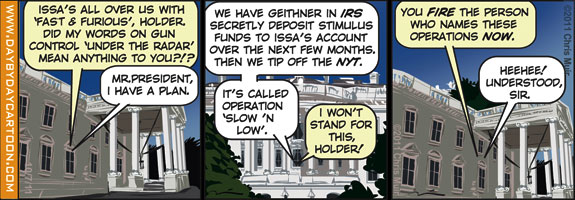
Iowahawk Satirizes Operation Fast And Furious

Iowahawk is one of the best satirists on the scene today. In a post he did today, he imagines a phone call between President Obama and a Mexican leader. The topic of Operation Fast and Furious comes up because the Mexican leader’s son was murdered by the drug cartels with a firearm provided by ATF. An excerpt is below but follow the link to read the whole thing.

Now, Juan, let’s not jump to conclusions here. We both know there are lots of machine gun murders in Mexico, and it doesn’t necessarily mean that they’re all…

Yes, Juan, I got your messages. As a matter of fact that’s why I’m calling this afternoon. I’ve had my people look into this thing and…

Mmhmm.

Mmmhmm.

Now… now Juan… let’s just calm down here a minute. Just, okay.. okay… let me please explain, okay? See, the funny thing is, it turns out, a couple years back there was, well, this stimulus program money, and then there were these brainstorming sessions, where, well, there were some ideas what to do with it. So, anyhoo, one of the ideas that happened was, ‘hey, what if there were, say, 2000 machine guns that got sent to Mexican drug lords?’ and so forth.

Well no, of course we couldn’t tell you. It would have ruined the surprise.

Well, okay, I guess the gato is out of the ol’ bag-o. You know that drug cartel war problem you’ve been having? So, well, the idea was, hey, wouldn’t it be great if somehow we could put a trace on the machine guns, and then, surprise! It’d be a like a whole pinata full of drug lord information.

Mmhm.

Why? Well see, if we traced all the machine guns we gave to your drug lords, then we could all learn how your drug lords get their machine guns.

New Videos From Crimson Trace

Iain Harrison from Crimson Trace sent out this release today.

(Wilsonville, OR) Crimson Trace today launched its new online video collection, featuring Media Relations Manager Iain Harrison. The video series addresses many of the frequently asked questions posed by CTC’s loyal customers and deals with installation, zeroing, care and maintenance, among other topics. “We had a lot of fun shooting these videos and believe our customers will find them very useful,” said Kent Thomas, Director of Marketing for Crimson Trace. “Each one gives an in-depth look at a specific topic that crops up regularly, which will give Lasergrip™ and Laserguard™ users another great source of information on Crimson Trace products.”

Crimson Trace’s Facebook friends were rewarded with a sneak preview of the videos last week and these have already proven to be immensely popular. The productions may be viewed either on the CTC website, or on their Youtube channel and the company expects to add new titles to the collection in order to keep up with both consumer demand and new product offerings.

Below is a video of Iain Harrison explaining parallax and the Crimson Trace Laser. Their YouTube channel is located here.

Jennings et al v. BATFE et al Loses In District Court

The NRA challenge to the ban on purchases of handguns from licensed dealers for those over 18 but under 21 was found in the favor of the defendants by U.S. District Court Judge Sam Cummings yesterday. The suit, Jennings et al v. BATFE et al (former D’Cruz v. BATFE), was brought in the U.S. District Court for the Northern District of Texas.

The NRA brought this suit approximately one year ago along with a companion suit against the State of Texas to allow the same age group concealed carry licenses. Texas currently only allows those who are serving or have served in the military to be able to obtain Texas concealed carry permits if they are under the age of 21. These are the suits in which the Brady Campaign took the low road and tried to villify James D’Cruz due to his Halloween costume.

The NRA brought both suits on Second Amendment and Equal Protection grounds.

The first thing Judge Cummings considered was whether the plaintiffs had standing to sue. The DOJ attorneys sought to have the case dismissed under Fed. R. Civ. P. 12(b)(1) saying that the court lacked subject matter jurisdiction over the complaint. Judge Cummings denied their Motion to Dismiss saying:

The ban prevents 18- to 20-year-olds from purchasing handguns and handgun ammunition from FFLs who would likely purchase these items were it legal to do so. The NRA presents evidence from its vendor members that they have lost profits from refusing to sell handguns to 18- to 20-year-olds and would sell handguns to law-abiding citizens in this age range if it were legal to do so. The fact that the ban restricts a would-be buyers’ market demonstrates a judicially cognizable injury directly affecting FFLs. See Craig, 429 U.S. at 194. As such, the NRA also has standing to bring this suit on behalf of its FFL members.

Judge Cummings then examined whether the ban on the sale of handguns by FFLs to the 18 to 20-years olds violated their rights under the Second Amendment. Noting along the way that nothing precluded them from purchasing handguns in private sales, he said that based upon the exceptions noted in Heller and on 5th Circuit precedent which made a distinction between possessing and the dealing of firearms, the rights of this age group were not violated under the Second Amendment. He then suggested that it was up to Congress to make the decision on this.

In essence, it is within the purview of Congress, not the courts, to weigh the relative policy considerations and to make decisions as to the age of the customer to whom those licensed by the federal government may sell handguns and handgun ammunition.

With that he granted the government’s Motion for Summary Judgment and denied the plaintiffs cross-motion for summary judgment as to the Second Amendment grounds. He also denied as moot the defendant’s motion to dismiss on Rule 12(b)(6) grounds (failure to state a complaint).

Finally, Judge Cummings examined whether this ban on the sale of handguns by FFLs to 18 to 20-years olds violated their rights under the Equal Protection Clause. While these rights apply expressly to the states, the Supreme Court has found that the Due Process Clause of the 14th Amendment encompasses the rights provided by the Equal Protection Clause.

Noting that the Supreme Court has held that age is not a suspect classification and that the defendants had presented evidence that Congress in passing the Gun Control Act of 1968 had made the considered decision that this age group was “emotionally immature, or thrill-bent juveniles and minors prone to criminal behavior”, he again found that the government was not violating the plaintiffs’ Equal Protection rights. He applied a Rational Basis scrutiny to this claim and said:

Congress identified a legitimate state interest—public safety—and passed legislation that is rationally related to addressing that issue—the ban; thus, it acted within its constitutional powers and in accordance with the Equal Protection Clause.

With that he granted the defendant’s Motion for Summary Judgment, denied that of the plaintiffs, and denied the defense motion to dismiss under Rule 12(b)(6) on their Equal Protection claim.

I would presume now that the NRA will appeal this case to the 5th Circuit as they needed a judgment at this level before they could move up the appellate chain. I know Alan Gura has said that in the cases he has brought for the Second Amendment Foundation that he has sought a quick decision, whether good or bad, so that the cases can then be brought to the relevant Circuit Court of Appeals.

Sebastian at Snowflakes in Hell is critical of Judge Cummings’ attempt to punt a decision on this back to Congress.

So Congress could say no one who has not yet attained the age of 90 is permitted to own a firearm, and that is completely within Congress’ purview? The Courts should have nothing to say about it? What other right do we treat that way?

It continues to amaze me how little regard lower courts have for Heller and McDonald. Maybe there’s sound legal reasoning involved here. I have not seen the opinion. But punting to Congress strikes me as awfully weak.

While I would agree with Sebastian, I do think Judge Cummings threw the NRA a bone when it said they and the plaintiffs had standing to sue. I don’t think it is reasonable to expect a District Court judge to go against precedent within his own circuit nor what other courts have said post-Heller on this sensitive issue. I think by saying they had standing and by closing this case out in just a little over a year, Judge Cummings may have done as much as he could do. This case was always going to be appealed regardless of how he ruled.

UPDATE: The NRA-ILA has announced plans to file a prompt appeal of Judge Cummings’ ruling in this case.

Yesterday, a federal judge in the Northern District of Texas ruled that the federal ban on dealer sales of handguns to adults from the ages of 18 to 20 does not violate the Second Amendment. The National Rifle Association plans to file a prompt appeal of the court’s ruling to the Fifth Circuit U.S. Court of Appeals.

“We strongly disagree with this ruling,” said Chris W. Cox, Executive Director of the NRA Institute for Legislative Action. “As we said when we filed this case, adults 18 and up have fought and died for American freedom throughout our country’s history. They are adults for virtually every legal purpose under federal and state law, and that should include the ability to buy handguns from licensed dealers to defend themselves, their homes and their families. Our fellow plaintiffs in this case are law-abiding and responsible young adults. We plan to defend their rights to the very end.”

The case is Jennings v. Bureau of Alcohol, Tobacco, Firearms and Explosives. A related case challenging Texas’ ban on issuance of concealed handgun licenses to adults in the same age group is still pending before the same court.

Canted Versus Non-Canted Holsters

Grant Cunningham is not only a talented revolversmith but a good firearms trainer as well. He has just published an interesting article on the differences between a straight or non-canted holster and a canted holster and which you should choose for your application.

In general, he finds that holsters that allow a straight up and down draw work well in competition events like IDPA but not so well when drawing from a defensive posture.

When I started my drawstroke from where I expected to be in an actual fight — from that threat reaction posture — my straight-drop holster felt as if it locked my gun into place. It was difficult to remove, and I found myself rising to a more upright position just to get the gun out of the holster. That sort of defeated the purpose of the realistic training!

When I realized this (and it took me about a year — I’m a stubborn learner), I changed to a forward-canted holster. That design was not suitable for competition but perfect for realistic defensive shooting practice because it conformed to what my body was most likely to do in a real life-or-death struggle.

The canted holster puts the exit path of the gun closer to the natural movement the hand is likely to make from an actual defensive posture. Put another way, the canted holster places the gun in the position the body is going to find itself in during a fight! It works better with the body’s natural reactions and trained responses than the straight-drop holster does. That makes it easier and more efficient to use under the circumstances in which I expect to defend myself.

This is an excellent article full of good illustrations. Grant’s parting advice is well worth taking to heart – “Pick your gear for the fight you’re likely to have, not the one you want to have.”