 by
by I don’t know if Johann Strauss would approve of this but I sure do!
H/T The Firearm Blog
I don’t know if Johann Strauss would approve of this but I sure do!
H/T The Firearm Blog
As reported in a release from the California Rifle and Pistol Association, three anti-gun bills in the California Assembly were voted down late last night. There was intense pressure on a few members to change their vote but they didn’t switch.
•AB 1810(Feuer) – Registration of Rifles and Shotguns
•AB 1934 (Saldana) – Handgun Open Carry Prohibition
•AB 2358 (De Leon) – Ammunition Registration
AB 1810 would have registered ALL rifles and shotguns in the same manner that handguns are currently registered in California.
AB 1934 would have prohibited the open carry of handguns whether loaded or unloaded. There is currently a growing movment among California gunowners to participate in unloaded open carry or UOC. The goal is to normalize perceptions of firearms and those who carry them.
AB 2358 would have “required that ammunition vendors transmit records of sale, information on the quantity and type of ammunition purchased, and the personal information of purchasers collected at the time of sale to local law enforcement if required by city or county ordinance.” The sponsor of this bill was the same Assemblyman who was the prime sponsor of AB 962 which requires face-to-face sales of handgun ammunition. The dangerous component of this bill is the last clause – if required by city or county ordinance. This would have allowed politicians in areas such as Oakland, LA, and San Francisco to make life even harder for lawful firearms owners.
Congratulations to our friends in California and to all who worked so hard to defeat these bills including CRPA and CalGuns.
UPDATE: Dirtcrashr at Anthroblogory has more including info on SB250 which mandated spay or neutering of (most) dogs.
Over the past few months I have had some interesting visitors to this blog. I have been honored to see the NRA checks it out from time to time. I have been intrigued to see multiple visitors from the Department of Justice ending up at the blog after doing a Google search on a potential Director of ATF. And today, I got this visitor from Washington, DC:
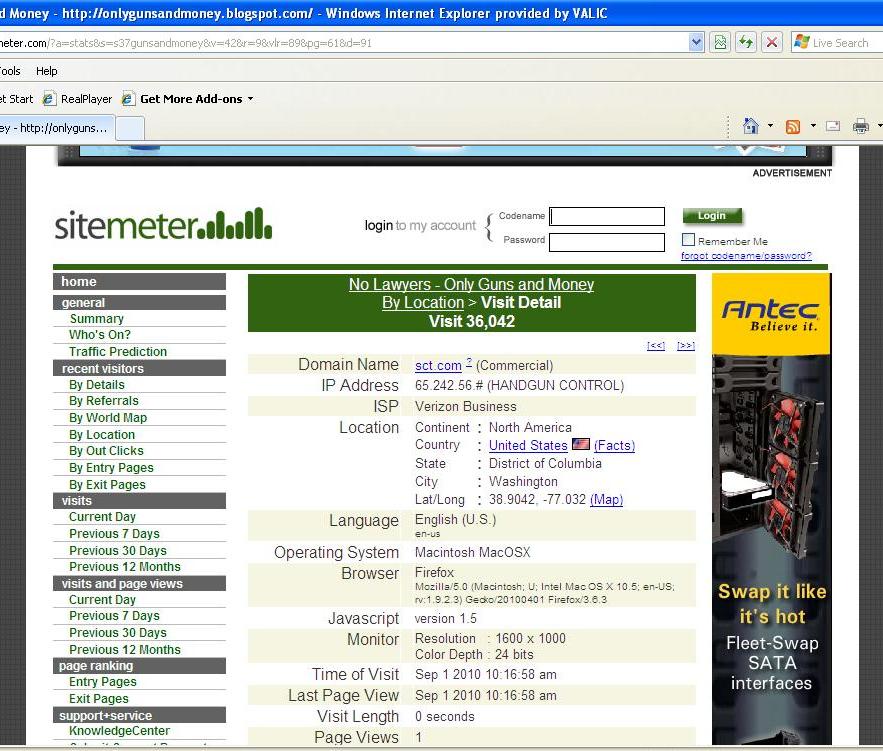
I don’t normally consider this blog as “not safe for work” but I guess it might be if you work for the Brady Campaign. Anyway, welcome visitor from the Brady Campaign. I hope you’ll come back again and maybe learn a thing or two about individual liberties and freedom which includes gun rights.
First off, I am a NRA Life Member. You will also find a recruiting button for the NRA on the sidebar of this blog. That said, for Chris Cox and the NRA to claim credit for the win in McDonald v. Chicago is just plain tacky. To not even mention the role of the Alan Gura and the Second Amendment Foundation just compounds it.
Tom Gresham hit on this in his GunTalk radio show on Sunday and he was right. It just doesn’t sit right. David Codrea has more in his National Gun Rights Examiner column from yesterday.
In terms of strategic Second Amendment litigation, Alan Gura is a master. He picks his plaintiffs with care and he crafts the case to have a narrow – but winnable – focus. One need only compare his follow-on Chicago case, Ezell v. Chicago, with that sponsored by the NRA, Benson v. Chicago. Ezell is focused solely on the gun range issue. Benson takes more of a scatter gun approach and has already been amended once.
In an ideal world, the NRA would focus on the legislative arena where they are really, really good and leave litigation to the Second Amendment Foundation and Alan Gura. The legislative arena calls for an organization that can be the 800-pound gorilla who must sometimes resort to steamroller tactics. Civil rights litigation requires a deft, strategic approach as the courts are not meant for steamroller tactics. With his wins in the Heller and McDonald cases, Alan Gura and – by extension – the Second Amendment Foundation have shown their great ability in Second Amendment litigation. The NRA is the heavy armored division to the SAF/Gura’s Special Forces A-Team. Both are needed to win the war but each should be employed where they will do the most good.
Buckeye Firearms Association, a grass-roots gun rights organization in Ohio, has come up with a gun quote collection. They are famous quotes from movies, celebrities, the Founding Fathers, Col. Jeff Cooper, and others.
Here are some samples:
“A fear of weapons is a sign of retarded sexual and emotional maturity.”
– Sigmund Freud“Among other evils which being unarmed brings you, it causes you to be despised.”
– Charlton Heston“An armed society is a polite society.”
– Robert Heinlein“You can say ‘stop’ or ‘alto’ or use any other word you think will work but I’ve found that a large bore muzzle pointed at someone’s head is pretty much the universal language.”
– Clint Smith“Remember the first rule of gunfighting … have a gun.”
-Col. Jeff Cooper“Among the many misdeeds of the British rule in India, history will look upon the act of depriving a whole nation of arms, as the blackest.”
– Mahatma Gandhi“The gun control extremist has at least two things in common with the Islamic extremist. He has a willingness to die for his fundamental beliefs. And he has the sanctimony to demand that others go with him.”
– Dr. Mike Adams
If you have a gun quote that is not listed in their collection, you can send it to them here.
Steve Gibson’s Righthaven LLC has added another newspaper chain to his list of clients according to a report in Wired. WEHCO Media, Inc. of Little Rock, Arkansas owns 15 daily newspapers, 13 weekly newspapers, and 13 cable companies. The majority of their holdings are in Arkansas.
It is not surprising that WEHCO has jumped on the Righthaven copyright troll litigation bandwagon. In November 2009, their subsidiary, the Arkansas Democrat-Gazette, Inc. formed an equal partnership with Stephens Media LLC and combined their operations in northwest Arkansas. The jointly owned company is called Northwest Arkansas Newspapers, LLC.
Knowing the relationship between WEHCO and Stephens Media now explains why they published a pro-Righthaven story in NWAOnline. I referred to the NWAOnline in the Stalinist term of “useful idiots”. Since I didn’t know of the relationship at the time, I am now changing my description of them to “fellow travelers”.
So who or what is WEHCO Media? WEHCO stands for Walter E. Hussman Company. Hussman was the son-in-law of Clyde Palmer who started what would become WEHCO in the early 1900s in Texarkana, AR when he bought the Texarkana Courier. Over the next few decades Palmer expanded his chain to include newspapers in Hot Springs, El Dorado, Camden, Magnolia, and Hope.
Hussman entered his father-in-law’s business a few year after marrying Betty Palmer. He succeeded Palmer as president of the newspaper chain in 1957 upon Palmer’s death. During the 1960s, he started to expand the company into the cable TV business which accounts for the 13 cable companies now owned by WEHCO. In 1973, Palmer Newspapers became WEHCO Media. The company is now run by Walter, Jr. who had managed the Arkansas Democrat of Little Rock which in time became the Arkansas Democrat-Gazette.
I think it can be safely said that between WEHCO Media and Stephens Media that they control the newspaper business in the state of Arkansas. The Arkansas Democrat-Gazette has the largest circulation of any paper in Arkansas and is the 43rd largest paper nationwide. So what newspapers and magazines does WEHCO own so that bloggers can avoid them just like we are avoiding the Stephens Media holdings. The following is a list by state:
Arkansas
Arkansas Democrat Gazette, Inc.
Banner-News Publishing Company
Benton County Daily Record *
Camden News
El Dorado News Times
Fayetteville Free Weekly*
Gentry Courier-Journal/Decatur Herald*
Gravette News Herald*
La Prensa Libre*
Northwest Arkansas Democrat Gazette *
Northwest Arkansas Times *
Rogers Morning News *
Sentinel Record
Smackover Journal
Springdale Morning News *
The Siloam Springs Herald Leader*
The Times of Northeast Benton County*
The Weekly Vista*
Washington County Enterprise-Leader*
White River Valley News*
Missouri
California Democrat
Fulton Sun
Jefferson City News Tribune
McDonald County Press *
The Lake Today
Tennessee
Chattanooga Times Free Press
Noticias Libres Sureste de Tennessee
Texas
* Part of “Northwest Arkansas Newspapers LLC”
UPDATE: The Atlantic named Walter Hussman, Jr. as one of their 27 “Brave Thinkers” because he began charging for online access to his newspapers back in 2002. I wonder if getting in bed with copyright trolls would also qualify as “brave thinking.”
In a surprisingly positive column in the San Francisco Chronicle, Phil Bronstein describes the fight that High Bridge Arms is having to endure in order to reopen their store. The store was closed temporarily and the North Bernal Alliance and three other neighborhood groups are fighting their reopening.
The neighborhood groups are asking the city authorities to deny the store the license it needs to operate. They say their members don’t want a gun store “near our homes and/or schools.” And, officially, they say they don’t object to people owning guns. However, as one member said:
They’d just “rather have something the neighborhood could enjoy – a laundry or wine and cheese shop.”
According to Yahoo Local, San Francisco has 131 specialty food stores and another 64 specializing in natural and organic foods. This is in addition to 675 grocery stores. Do they really need one more wine and cheese store?
High Bridge Arms has been in business for over 50 years and serves a good bit of the law enforcement community. The local police captain said they have never had any trouble due to the store. That said, he is getting 10-1 negative to positive e-mails about the store.
Fortunately, the local branch of the Pink Pistols is rooting for the store. Tom, the local chapter president said:
“California now has a law that you can’t receive ammunition through the mail. And many people in San Francisco don’t have cars.” Therefore, a city gun store is helpful and encourages the use of mass transit.
As Bronstein noted, Tom was trying to put a “green” spin on it. Tom did make the point that High Bridge is “a lawful business conducted in a lawful way for people who want to lawfully participate in the shooting sports.”
Bronstein concludes by urging everyone just to be a little sensible about it.
The article generated a lot of comments as one might expect. However, they weren’t as bad (for the most part) as one might expect. Here is a sample:
OMG… I’ve read a page or two of thoughts from the readers, I can’t believe these are chron readers? My second thought was, I didn’t know there was a gun store in SF.
This store, when it was open, always had the most insipid, tasteless posters in its windows advertising their brand name weapons for sale (Glock for example). The last one I noticed was an oversize glossy poster of a scantily clad blond white nurse in white pumps and white mini skirt being “saved” by white steroid junkies in kevlar from dark skinned perps. This owner may be mild mannered when the press calls but the fantasies he perpetuates with his adolescent window displays are everything but(t).
Guns are evil.
Are you kidding, a local “Gun Store” in San Francisco? We’ve even tried to close down a popular sandwich shop in the Castro simply because neighbors are complaining about the smell of bacon. “I love the smell of bacon in the morning… Smells like, Victory!” What next?
I am a happy card-carrying progressive on just about every issue out there. However, I am also a happy card-carrying member of the NRA. So, if these whiny Volvo-driving Montessori types think that guns are somehow “evil,” I’d like to remind them that so are criminals. Get out of 1968, kids. Our state needs a concealed carry law.
If the majority of comments are any indication, there may be hope for San Francisco after all.
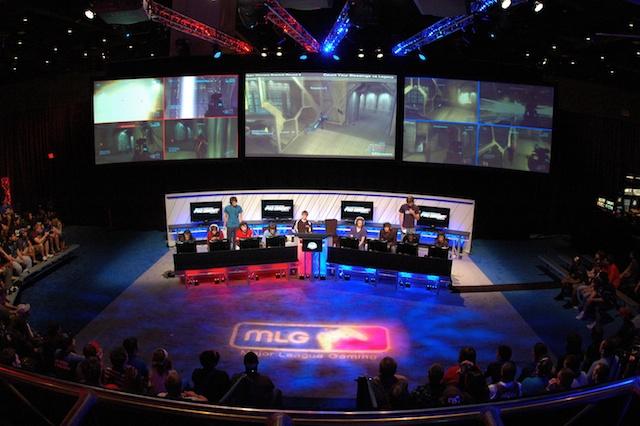
There will be light blogging this weekend as the Complementary Spouse and I will be traveling to Raleigh to see her nephews play in the MLGPro event.
They play Halo 3 in 4-man team competition. And they are pretty good. Kyle (ElamiteWarrior) is captain of Instinct, the number one ranked team, which is going for a three-peat as they have won the previous two events this year. Aaron (lx Ace xl) is on Status Quo which is seeded fifth. The winning team will split $20,000 in prize money.
 |
|
| Main Stage |
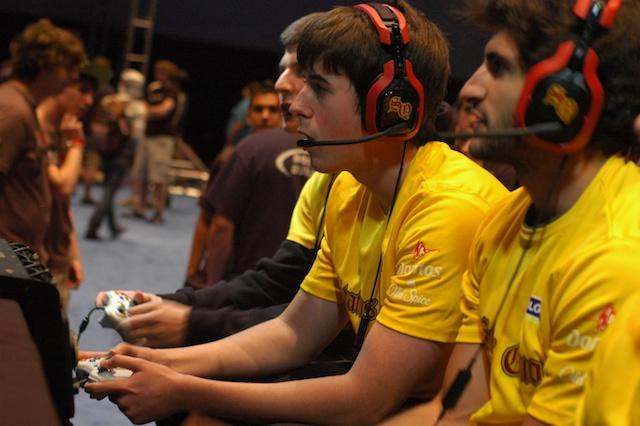 |
| Ace of Status Quo |
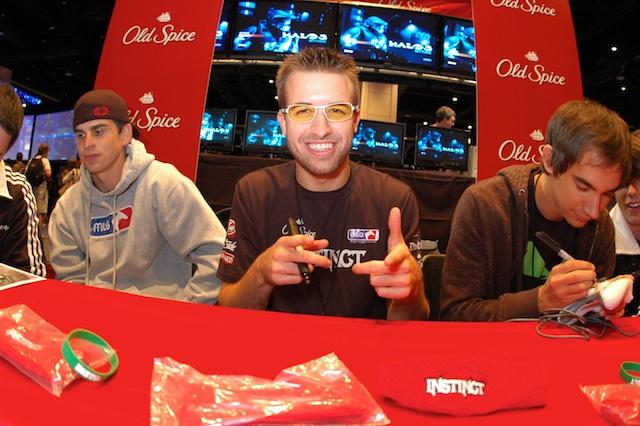 |
| ElamiteWarrior of Instinct at autograph session |
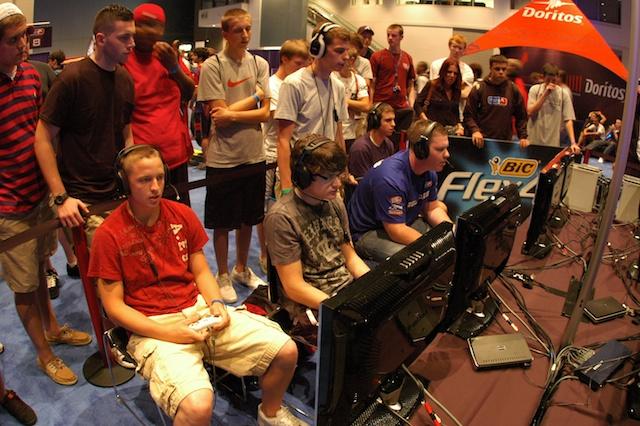 |
| Non-main stage competition at MLG Pro Raleigh |
MLG Pro provides live streaming video of the top games along with commentary. You can find it here.
MLG Pro seems to have adopted the NASCAR model of promoting their sponsors. You will see signs and ads everywhere for Dr. Pepper, Doritos, Old Spice, Bic, and Hot Pockets sandwiches. Gamers t-shirts are emblazoned with the logos of the sponsors. In the past sponsors have included Microsoft, the US Army, and Boost Mobile.
UPDATE: Sadly, Instinct finished in second place and did not get their three-peat. However, Aaron’s team, Status Quo, came in fourth which was higher than their seed. Had a great time catching up with family!
This statement was posted this afternoon on the NRA-Political Victory Fund site:
Statement From NRA-PVF Chairman Chris W. Cox On The 2010 Nevada U.S. Senate Race
Friday, August 27, 2010
In the coming days and weeks, the NRA Political Victory Fund (NRA-PVF) will be announcing endorsements and candidate ratings in hundreds of federal races, as well as thousands of state legislative races. Unless these announcements are required by the timing of primary or special elections, the NRA-PVF generally does not issue endorsements while important legislative business is pending. The NRA-PVF also operates under a long-standing policy that gives preference to incumbent candidates who have voted with the NRA on key issues, which is explained in more detail here.
The U.S. Senate recently considered a number of issues important to NRA members, including the confirmation of Elena Kagan to the Supreme Court. Out of respect for the confirmation process, the NRA did not announce its position on Ms. Kagan’s confirmation until the conclusion of her testimony before the Senate Judiciary committee. Her evasive testimony exacerbated grave concerns we had about her long-standing hostility towards the Second Amendment. As a result, the NRA strongly opposed her confirmation and made it clear at the time that we would be scoring this important vote.
The vote on Elena Kagan’s confirmation to the Court, along with the previous year’s confirmation vote on Sonia Sotomayor, are critical for the future of the Second Amendment. After careful consideration, the NRA-PVF announced today that it will not be endorsing Senate Majority Leader Harry Reid for re-election in the 2010 U.S. Senate race in Nevada.
NRA members and other interested parties are encouraged to visit www.NRAPVF.org for more information as Election Day draws near.
Given that the NRA’s Chris Cox and Wayne LaPierre are about as Washington Insider as it comes, the non-endorsement of Reid is recognition of two things. First, that the membership would rise up in protest if Harry Reid were endorsed. Second is the recognition that the tide against the status quo is so strong that most who get in its way will get wiped out. Just ask Republican incumbents like Robert Bennett, Bob Inglis of South Carolina, and quite probably, Lisa Murkowski.
Charlie Cook of the Cook Report is one of the best political handicappers in Washington. He has called this election a “wave election” akin to the 1994 Republican landslide. I think he is quite accurate in his description of it. When one looks at the number of political outsiders who have taken on the establishment and won by fighting a guerrilla war, it is astounding – and that is just in the primaries to date. The NRA is not an agile organization but it is smart enough to recognize reality when it is staring it in the face. Harry Reid is in trouble and they don’t want to go down with the ship.
As noted by Joe Huffman and SayUncle, the FBI and BATFE have been engaged in a turf war to see which agency would be the lead agency when it comes to investigating explosions. This has been going on for some years. As a result, every now and then the Justice Department leadership would issue a memo telling them to quit fighting. Of course, they never did.
Gary Grindler, Acting Deputy AG, issued a memo that was pretty much a smackdown to both agencies. In the future, the FBI will be the lead agency for both international and domestic terrorism related explosives cases. This was a slap to the ATF who thought they should have lead status on domestic terrorism.
Likewise, the ATF will be the lead agency in maintaining the explosives database called Bomb and Arson Tracking System (BATS). The Inspector General’s report found that the FBI had never reported any explosives incident data into the BATS database “even though it was previously designated as the single Department database for reporting and tracking explosives incidents.” Grindler order the FBI to immediately send all the info that they maintained to ATF for inclusion in the database. He noted that the Attorney General John Ashcroft had mandated all explosives data be stored in the single BATS database back in 2004.
The situation between the agencies had deteriorated to such a level that first responders didn’t know who was supposed to be in charge. TPMMuckraker reported that:
Inspector General Glenn Fine told Congress in February that agents would often race to the scene of an incident in the hopes of calling dibs on a case. Some agents acknowledged to Fine that they believed “possession is nine-tenths of the law.”
Some at ATF admitted that in the post-9/11 world their agency had “terrorism envy” and wanted to be a lead agency in the war against terror.
Now that this has been somewhat resolved for the time being, I wonder if the pressure to name a Director for ATF by the gun control groups will increase. With the leak of the name of the Chicago SAC Andrew Traver about a week and a half ago, one must wonder.
Originally posted on Aug 18.
UPDATE: The Washington Post has a story about these turf wars in today’s paper. I guess better late than never is their motto.